Sunday, January 13, 2013

Why Preach A Principle?

Jesus preached himself as the content of the gospel--a person, a presence. Why do Christians preach a system or an ethic or a principle? Why is it that we find the dynamic freedom of living that presence so abhorrent?

Maybe it is because the person isn't in your face anymore. Maybe it isn't abhorrence, more like simple common sense...dude isn't standing there. Maybe the real abhorrence comes from people telling you to "follow the phantom." What might be missing is the "system" that teaches one how to believe in a presence--a person who once drank wine with you but now only does it "in spirit."

On the contrary, we have no lack of capacity to believe in presences, the thing is we prefer to reify fictitious phantoms. We find it completely natural to believe that the little green pieces of paper we (may or may not) have in our pockets actually have real value (this, even in the face of inflation and threatened market collapse.) There is not now nor has there ever been anything underdeveloped in the human ability to believe in phantoms, whether it be creationism or evolutionism, causation or the demonic consciousness present in plumbing, the State or grandpa's ghost or progress. However, what I am talking about is an experiential power rather than a spiritualization of demands. I would go as far as to say that either the Holy Spirit is a real, effective power and presence in and through us or Christianity is false and moreover a waste of time and energy.

Why do we so deeply fear the uncertainty of living the presence of Jesus in the deep complexity of the world and instead cower in the false refuge of ethical principles and semi-baptized political or economic programs?


More importantly, how do we become accustomed to, I think that getting comfortable with is a ridiculous hope, living the dynamic freedom of the active embodiment of the presence of Jesus? It goes way beyond what is usually meant when we are urged to step outside our comfort zone. It is actively living without a roadmap, without a system to depend on to tell us what is the right thing to do or to use to judge others. It is living along a completely different tangent than the flow of the world.

Tuesday, January 8, 2013

Baptism Isn't Magic

The issue of baptism occasionally comes up in several different groups I associate with, from academic theological discussion groups to Christians who have no clue what baptism is about to non-Christians who have no clue what baptism is.

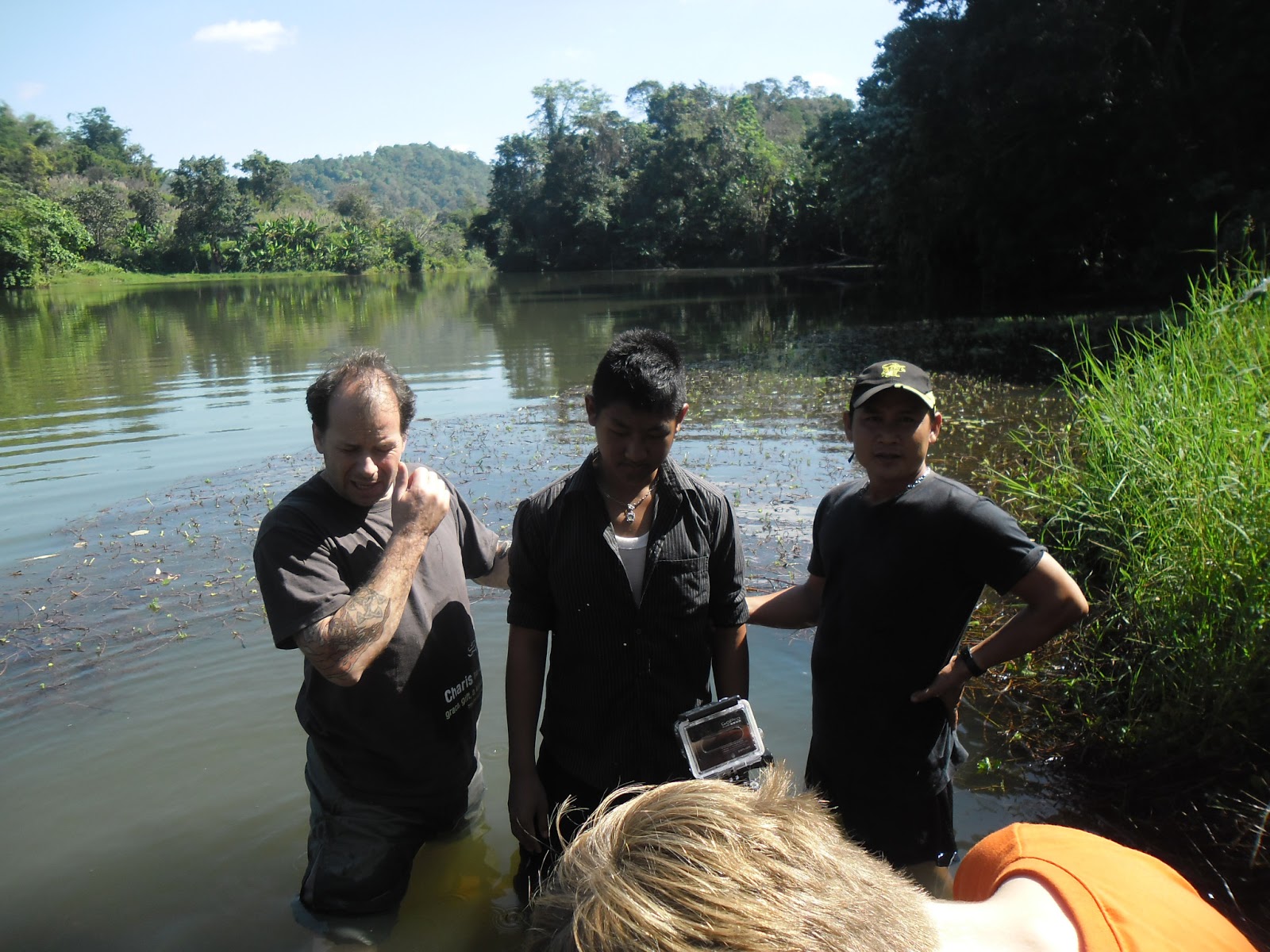
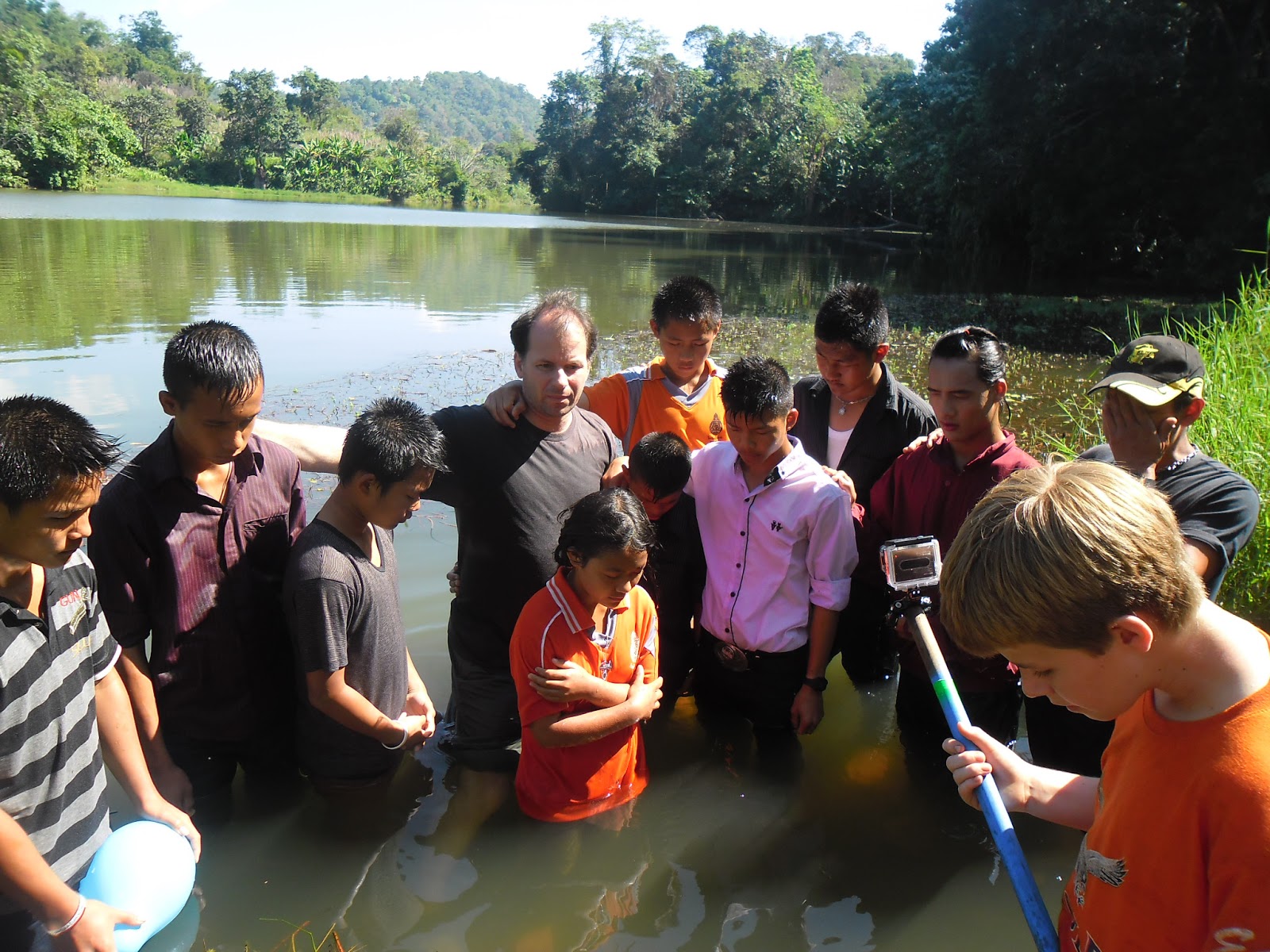
Well here is how I explained it and then did it on my recent visit to Ban Saeng Sawan with The Charis Project.

Now, I don't push baptism. If people ask I respond. I don't push it because I have not yet been in a position where that seemed the right thing to do. I may some time find myself in such a situation and will cross that bridge when I get to it. When I was with my friends up in the hills in Thailand, Judah, the lead guy at the children's home we manage, notified me that there were a number of the kids and one guy from the village who wanted to be baptized and that they wanted me to do it.

So we talked about it for a bit. I started off by saying that there are a lot of different understandings of what baptism is. Many Christians think many different things about it, but this is what I think.

Historically, Christian baptism comes from the Hebrew practice of baptism which was a mixture of ceremonial washing and a reenactment and recapitulation of Israel's passage through the Red Sea in the Exodus, the event in which Israel was transformed from the family of Abraham into the nation of the people of God. In Christian baptism a person is participating in the cleansing redemptive work of Jesus and is going through the "naturalization" process into citizenship in the "people of God." (I take this "people of God" to be a functional designation rather than a designation of status, that is, it is an entry into responsibility rather than into a position of special standing.)

I said that it is a public declaration of solidarity with all the others who have been baptized.

I also said that baptism is not magic. It is not the sort of thing that if you do it wrong, you mispronounce the incantation, you perform the act incorrectly (maybe the water is the wrong sort or or you did it at an age that someone thinks is wrong or whatever), or the wrong person does it, it will not work. It is the one baptism of Jesus that we participate in however we are able.

Then we went out to the lake.


When there, I said that baptism is a public declaration of a person's commitment to be a disciple of Jesus. I commented that different Christian traditions may have a process that leads up to baptism but I will just ask two questions and if you agree to them then I will go ahead and baptize you.


Then with each of the people I asked, "Do you choose today to be a disciple of Jesus for the rest of your life?" Then, "Do you commit to obey his commands and to work for the growth of his kingdom in this world from this day forward?" When they said "yes" to these questions I and Judah then dunked them in the water saying, "I baptize you in the name of the Father, in the name of the Son, and in the name of the Holy Spirit." When they came back up I hugged them and said, "Welcome to the community of disciples."


There has been much ink spilled and blood shed in this topic. I tend to take differences in how one does baptism to come down more to style than substance. As with marriage, it is what you do with it that imbues it with it's lasting meaning and significance.

What has been your experience of baptism?

Sunday, January 6, 2013

The Jungle House Of God


There is a picture I tell when I am speaking in the rural areas of Thailand, working with The Charis Project, that I have brought back to tell on the US side. I tell it to my children enough that they roll their eyes at me when I start to tell them again. But I will tell them again because I want the picture built deep into how they see the world, I want it to form part of the architecture that makes up the stories in which they live.

In the rural areas of Thailand, as in many areas of the world that are prone to heavy rainfall and possibly flooding, the people build their houses on poles set in the ground. They will lay out the shape of the house and dig holes and set hardwood poles in those holes and fill them back in. Then, at a  height off the ground that will keep the floor out of flooding water, they will attach some manner of timbers, maybe wood or maybe bamboo to those poles as the floor supports. Then, higher up at the top, they attach the timbers that make up the roof structure. On the roof structure goes leaves, or plastic, or metal, depending on how much money they have. And on the floor timbers goes the floor of woven bamboo or wood planks. The walls too, between the floor and roof will be made out of woven bamboo or wood planks.

Now, if you cut at one of the poles with a knife or axe or whatever it will become weaker, the cuts will give purchase for mold and termites and eventually the pole will fail. It will fall down and it will not be alone. That pole was holding up part of the house, part of the same house that the other poles are holding up. All of the poles are attached to each other by the house that they are each built together into. When one pole fails it pulls on all the others. If others have also been weakened then they could collapse as well. So cutting at one of the poles puts the whole house in danger.


On the other hand, if you build up that same pole, if your shore it and add strapping and bind additional poles to it it will become stronger. If you coat it with oil treatments rot and termites will not be able to get at it. That pole will become stronger and stronger. When that pole is strengthened it is more able support the weight of other poles if they get damaged and be more resilient to damage itself as well, also as that pole gets stronger it is able to hold more weight, it can hold up a larger structure so the house can be built larger.

building up the pillars
A family, or a community, or a church is like one of these houses. Each person is like one of the poles.

When we criticize or scold or judge one another or gossip or do any such things it is like taking a knife and cutting at one of the other poles holding the house up. The more we cut at the other person the weaker and more susceptible to further damage they become. When we do this we are actively contributing to the destruction of the house, the house that we are built into. Doing such things damages the other's ability to support us when we get damaged.

However, if we build up each of the people around us they get stronger. Encouragement, blessing, holding the sideways tongue and replacing it with speaking good words of truth and actions of support, these things strengthen and shore up and defend the other pillars. Such actions make the house all together stronger. When you get damaged the other pillars will be able to hold you up and they will be far more resistant to damage themselves.

Extend this out. As we all keep building up and strengthening all the other pillars the whole house gets stronger and can grow bigger and bigger until this house of God is big enough to shelter and protect the whole world.

One more thing, this is grace. Grace is not letting people slide, grace is building people up in the power of the redemption.

Now, how can I make a pillar stronger today?

Friday, January 4, 2013

This Is What A Lay Up For A Major Slam Dunk Looks Like

I recently returned from Thailand working with The Charis Project. This is a major highlight from that trip that I recently shared on the Charis Blog. It is so Important to me that I need to share it here as well.

On our Face Book page a short while ago I said that it looked as though we were on a layup for a slam-dunk. This is what I was talking about.

We have been working with a group of people in Mae Sot for about a year. We have been moving slowly and working at getting to know each other and to understand how, and if, our visions intersect and how, and if, we will be able to work well together.

That work is ready to take the next step.

On this last trip we spent an extended period of time discussing in-depth where to move forward and they were already on-board with where we see going.

The de facto leader of the group is named Philip. His father-in-law led in founding a college for hill-tribe peoples and Philip worked there as a teacher. In fact he was one of Judah and Saeng Chen's* teachers when they went there.

This group in Mae Sot is already working responsibly to build up, support, and empower children of the Burmese migrant and refugee community in the area. They have very little in terms of resources aside from the income they themselves earn as laborers and they do not ask for handouts. Instead they have been envisioning businesses that they could start to do a better job of supporting the work they are doing with the children.They are educated, they are motivated, they are hard-working, and they have already begun to innovate.

They do not want to live on donations because they see begging, even for a very good cause, as a weakness that they would very much like to avoid.

Philip and I excited about our vision for moving forward in Mae Sot

They are about the perfect partners for the Charis Project. They are thrilled with our vision for integrating entrepreneurism and the care for at-risk children. They see that what we envision pushes beyond what they thought possible and are excited to bring this all together. They and we are becoming us.

They brought to our discussions two or three business ideas that they had already been thinking about and over the course of our conversations we together came up with half-a-dozen more workable business concepts.

Now, the step we are working on next, is to model, assess, and select the best of these concepts to move forward on, to invest in, and to launch as the financial and entrepreneurial-education foundation of the empowering work with the children living out in the teak plantations and bamboo thickets.

A few of the kids and another of the team members at Mae Sot
Obviously we are very excited and are chomping at the bit to be on site to work directly with them as we launch this new Charis Community and take what we learn here to feed back into the Doi Muser home to build it up even further.


*Directors at the Doi Muser Home

Tuesday, December 18, 2012

Deep Value And Truth From An Odd Source


I have never posted a link to another article before. I am doing it now because this deserves it. I read this and think, with tears at the back of my eyes, "What have I actually accomplished?" Then I realize it's not too late.

We have a world to build, lets actually do it.

http://www.cracked.com/blog/6-harsh-truths-that-will-make-you-better-person/

Monday, December 10, 2012

Widows, Orphans, AND Aliens


My wife is writing a terrific series of Advent Meditations for Kids. This evening she read me the one she just put up on How To Treat The Poor. The readings from Exodus, Deuteronomy, and Leviticus reminded me of a thorn in my side. There are three classes of people consistently mentioned in conjunction as the lynchpins of God-like behavior: widows, orphans, and aliens. According to scripture how Israel treated these people determined whether the people of God were truly the people of God or not. Moreover, it is clear that God's blessing is contingent on how these classes of people are treated.

There is much talk in Christian circles as to how we in America are doing things that repudiate the blessing of God. I will not enumerate them as they are such hot button issues as will completely sidetrack what I am attempting to say. However, if we are truly serious and biblical about placing this nation in the blessing of God then these three classes should be foremost in our actions. We talk about caring for widows and orphans. Yet very few churches actively engage in substantive care for single mothers nor does hardly anyone adopt children from the foster care system. But further still, the aliens are consistently left out of the "widows and orphans" formula. The aliens include those guys down in the Home Depot parking lot, all those people who are here illegally and are the subject of great political dispute.

Biblically, the blessing of God hinges on how we treat the foreigners who have come here legally or otherwise and not on whether we are allowed to pray in schools or whether the Ten Commandments are written on some wall or even on whether gay people are allowed to get married.

Many will say, and have said to me, "I am ok with legal immigrants, but the illegals must go and should be excluded from society, etc." It comes down to legality. There are legal ways to enter this country. Anyone who doesn't come by these means is a pariah. Now, the same people make heroes of the kids who stand up and pray, illegally, in assembly, stating that they are obeying a higher law. Where is that higher law when it comes to the alien?

I tend to be a conservative and toward limiting the rights of citizens to citizens. However, God doesn't seem to care about what I think about this and hinges his blessing on how we treat the one who is not a citizen.

I am fully in favor of inviting the blessing of God. I wonder what he is in favor of?

Friday, November 30, 2012

Mystical Union And Sneezing: A Brief Hemenutic Of Mysticism

Recently on a discussion thread I am involved in someone wondered about the difference between mysticism and prophecy. I started to reply but that reply quickly got out of hand. What follows is characteristically dense. Each paragraph could relatively simply be expanded into a chapter with full citations and completely fleshed out reasoning; something I may do sometime if I have nothing better going on. I here speak more about mysticism than prophecy because that was more pertinent in the discussion this came out of and not because I think that prophecy is a settled matter. Rather, there is a huge amount of goofy thinking about prophecy as well but it is of a different sort.

I should note that I define mysticism as a separate entity to contemplation. Contemplation treats an object, text, or activity Iconically. To treat something Iconically (that is in the same manner as the Eastern Christian tradition treats Icons) is to take that thing as pointing to something beyond itself rather than as an object taken in itself and to pursue or contemplate the thing beyond. Great value as well as great foolishness can come from this approach to things. Simultaneously, the same value and foolishness is manifestly true of the non-Iconic treatment of the same things.

Mysticism pursues union, the sense of being fully taken up, a sense of direct connection.

My deep thinking on this began when I was living in India and Nepal. Naturally I was exposed directly to a wide variety of traditions and understandings of reality. Something that caught my attention was the striking similarity in the form of experience described my the mystical branches of the various religious traditions. Hindu, Buddhist, Muslim, Jewish, Christian, all these traditions have mystical branches. Each use language and images from their conceptual universe to describe their mystical experience. But, they all describe an experience that involves a loss of distinct selfness where the practitioner feels as though their existence ceases to be distinctly separate from anything else in space or time, they feel as though they absorb into the infinite. Muslims will use Muslim words to describe the experience. Christians will use Christian words. Hindus will use Hindu words. And so on. But, they are all describing exactly the same experience.

I then found that I was not the first to observe this. I discovered that there have been many voices within the mystical paths of the various religions that have observed this striking similarity of experience across traditions and took that to indicate that all paths lead to the same place. They take the common mystical experience as evidence of the truly unified ultimate foundation all the religious traditions.

I became more curious about what this experience is. I noted the strong similarities of practices among the different traditions. Looking past what the traditions said their techniques meant they all had the same form. All the traditions engage in some collection of repetitive action, extreme treatment of the body, practices of focus/centering/meditation. I started to get familiar with the neuroscience research on mystical experience. There is quite a bit. What it shows is that the similar practices lead to the same effects in the brain. In particular they affect the sections of the brain that produce our sense of self. Either by deprivation or over-stimulation those sections of the brain lose the ability to clearly define our selfness to our consciousness. This results in the sense of release and union with something beyond our self. Mystical union is a brain state. It is a physical response to the techniques used my those earnestly seeking that experience just like a sneeze is a physical response to irritation in the nasal passage.

Some have linked the beliefs of the "all paths" school I just mentioned to this neurological research to say that all religion is a response to this brain-state. I don't think that this is the case, and dealing with this is not my purpose here.

What I find interesting is the way in which the mystical experience takes on meaning. The experience takes on the meaning attributed to it by the person working to achieve it. When a Christian engages in the mystic disciplines they are seeking a union with Christ. When they achieve the brain-state they experience it as union with Christ. When a Zen Buddhist achieves the same state they experience satori as that is the meaning they brought to it with them.

Now, it would appear that the experience itself can better be understood as an Icon. This would place mysticism as a sub-set of contemplation where the thing in itself is the brain-state and what is important or truly meaningful is the thing beyond that it is taken to point to. The difficulty is that the thing in itself is an internal physical state rather than a painting on a board so it is far more difficult to make the separation between it and the thing it points to. This is why the meaning brought to the experience has historically been conflated with the experience itself.

This conflation has given rise to theological problems in Christian mysticsm. There is a consistently Gnostic flavor to it. Thinking about it has been directed toward escaping the mundane physicality of this world to experience a more purely spiritual reality. This has significant theological problems. Primarily, we were created as bodies with Spirit put into us to make us alive and not as spirits trapped in bodies thus it denies the absolute goodness of our bodyness. It is a force that relativizes our presence in this world that we were created to live in and bring to completion. It takes away from the true experience of union with Christ through participation in his redeeming work in the blood and dirt of this world.

However, I do not reject the disciplines that lead to the brain-state. If for no other reason than that they are demonstrably therapeutic, bringing a calmness of mind, having beneficial effects on blood pressure, as well as on several other body systems. Moreover, when taken Iconically the experience can function as a deep heuristic for internalizing the reality of the union already established in the incarnation and of the full loving adoption by our Heavenly Father.

The difference between prophecy and mysticism is pretty clear to me. Prophecy is the concrete calling of the people of God to God by God with specificity. Mysticism is founded on a particular feeling of spatiotemporally disconnected floatyness that is produced by a specifically identifiable neuro-chemical brain-state that is caused by particular intentional practices. Prophecy must in itself have positive truth content, and must be effectively specific even if it is not entirely lucid. Mysticism is, strictly speaking, neither true nor false but is meaning-absorbing while prophecy is meaning-excreting. Mysticism takes on whatever meaning or content is given to it while prophecy looks you in the face with it's own meaning. While prophecy, if it is true, is always valuable, the value of mysticism lies in what we bring to it.
Related Posts Plugin for WordPress, Blogger...