Showing posts with label Reality. Show all posts

Friday, January 4, 2013

This Is What A Lay Up For A Major Slam Dunk Looks Like

I recently returned from Thailand working with The Charis Project. This is a major highlight from that trip that I recently shared on the Charis Blog. It is so Important to me that I need to share it here as well.

On our Face Book page a short while ago I said that it looked as though we were on a layup for a slam-dunk. This is what I was talking about.

We have been working with a group of people in Mae Sot for about a year. We have been moving slowly and working at getting to know each other and to understand how, and if, our visions intersect and how, and if, we will be able to work well together.

That work is ready to take the next step.

On this last trip we spent an extended period of time discussing in-depth where to move forward and they were already on-board with where we see going.

The de facto leader of the group is named Philip. His father-in-law led in founding a college for hill-tribe peoples and Philip worked there as a teacher. In fact he was one of Judah and Saeng Chen's* teachers when they went there.

This group in Mae Sot is already working responsibly to build up, support, and empower children of the Burmese migrant and refugee community in the area. They have very little in terms of resources aside from the income they themselves earn as laborers and they do not ask for handouts. Instead they have been envisioning businesses that they could start to do a better job of supporting the work they are doing with the children.They are educated, they are motivated, they are hard-working, and they have already begun to innovate.

They do not want to live on donations because they see begging, even for a very good cause, as a weakness that they would very much like to avoid.

Philip and I excited about our vision for moving forward in Mae Sot

They are about the perfect partners for the Charis Project. They are thrilled with our vision for integrating entrepreneurism and the care for at-risk children. They see that what we envision pushes beyond what they thought possible and are excited to bring this all together. They and we are becoming us.

They brought to our discussions two or three business ideas that they had already been thinking about and over the course of our conversations we together came up with half-a-dozen more workable business concepts.

Now, the step we are working on next, is to model, assess, and select the best of these concepts to move forward on, to invest in, and to launch as the financial and entrepreneurial-education foundation of the empowering work with the children living out in the teak plantations and bamboo thickets.

A few of the kids and another of the team members at Mae Sot
Obviously we are very excited and are chomping at the bit to be on site to work directly with them as we launch this new Charis Community and take what we learn here to feed back into the Doi Muser home to build it up even further.


*Directors at the Doi Muser Home

Wednesday, June 13, 2012

Reality, Models, And The Legitimation Of Evil

Last day of finals tomorrow.

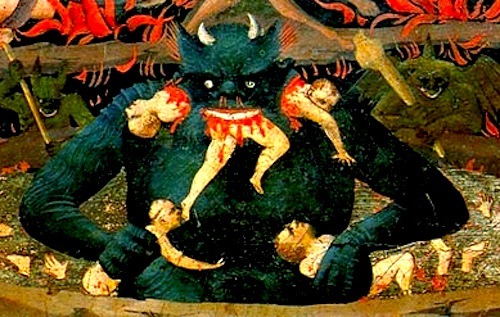
The Last Judgement, detail of satan devouring the damned in hell, by Fra Angelico c. 1431.


I apologize for the language below. This is an early attempt at getting this stuff out and this is more-or-less the sort of language I think in. This is what it looks like before I have become so comfortable with it that I am almost able to use words that make sense to actual humans.

There are three things that I want to draw out of that last post on 'The Problem Of Evil." Now, these three are not necessarily the most directly significant to that post however they are foundational to that which was directly important.

These three things are: the fundamental historicity of reality, the model building nature of theology, and the way the standard approaches to the problem of evil are actually functional justifications of evil.

I have been thinking about this notion of fundamental historicity for quite some time and am yet to develop language that accurately and adequately conveys what I am trying to get at. It would not surprise me if someone else has done this. But I haven't read what I am trying to get at. There is some of the Marxist influence of "real history" in the notion but without the Hegelian dialectic. I mean something beyond the statement that "history matters." Something more along the lines that concrete history is the fundamental stuff of reality. This is not the claim that we must study history to have a proper education but that the stuff that happens is the only stuff that really is. But neither is this a physical reductionism because I include in this anything that happens whether it is susceptible to a physical reductionist analysis or not. An upshot of this is the radical limitation of our capacity for knowledge of reality proportional to actual reality. Another upshot of this is that it is what actually happens in concrete history that really matters.

Yet a further upshot of this is that theology is less a systematizing of truth than a construction of models that attempt to simplify features of reality that we happen to have access to. It is just as much mental model construction as theoretical physics is. We build idea models that attempt to draw simple lines between the features of reality that we observe. Like constellations in the sky. I would hold that this is what the biblical authors were doing just as we do it today (and this is not, in my mind, a problem for the authority of scripture.) What this means is that theology is never in the fullest sense true. It can be more or less powerfully explanatory but it is always a simplification, an abstraction from reality. It will never be the case that a theology of salvation (soteriology) will be the same thing as whatever has been effected in history. The model and the concrete historical reality are completely different orders of being (while at the same time the model has actually entered into the reality of history, by nature of it's happening, but as an abstraction it is irrevocably other than and is unable to ever equal the reality it purports to explain.)

Now some will say, "well sure that is true and tritely so." To that I reply, "then act like you believe it." Theologians ought to take on the criticism that many attack scientists with. That is the holding to dogmatic buttresses rather than searching for counterfactuals. In other words, test the model. Try to break it rather than ignoring or dismissing features of reality that are problematic. This is how actual understanding of the reality that is really out there develops.

And third, the big fault of the traditional approaches to the problem of evil is that they assert that here is a legitimate place for evil in the structure of this world. With the aim of justifying God (or building a model in which God is no-longer legitimately culpable by our standards) in light of the undeniable presence of evil, the traditional approaches take evil as in-principle given and in so doing reflexively justify evil. If God is justified in "allowing" (or whatever term makes you happy) evil then evil itself is given a legitimate place in the model's understanding of reality. My shift from this in the previous post is to take evil as a historical reality within a progression of history rather than an in-principle reality within a steady-state logical model.

So there it is. A lump of ideas that mean quite a bit to me but I am not sure if they make any difference or are even comprehensible to any one else.

Any thoughts?
Related Posts Plugin for WordPress, Blogger...