Wednesday, November 5, 2014

Is That Biblical?

Photo Credit: this photo is from the cited article

First, read this:

http://www.missionfrontiers.org/issue/article/god-of-the-thai

I live in Thailand working with The Charis Project. So I am part of some of the missionary discussions around this article and the parallel discussions about different evangelism strategies. There has been some profound backlash in some circles. Accusations of syncretism, departure from Biblical truth, etc. Here is one comment:

Very disappointing read!!!! The author's mindset would be comparable to saying the reason all the Ninevites repented is because Jonah crafted his message to fit the culture of Ninevah. Come on, I am all for contextualization but let's think a little more Biblically and Theo-centric.

Now there are many problems with this comment but I am not about to address them here. I cite it here because it is demonstrative of a particular method of assessment that I disagree with.

From the discussions I have seen, I believe that the commenter is saying that the evangelism method that the author of the article is advocating is not Bible-centered because it is not centered on the Bible as the ultimate truth to which all other cultures are opposed and so Christianity must be preached using only explicitly Bible words and images and cultural practices. Moreover, it seems that he does this entirely neglecting that the Bible is a highly encultured collection of books and that it was not written in English or to English idiom and that he has already reenculturated it from it's original context into a Protestant and western reading.

It seems to me that the Bible gives precedent for exactly the sort of evangelism the article speaks of. This is what Paul did in Athens. The difference appears to be that where Paul’s attempt failed the same style of evangelism is succeeding in Thailand. Moreover I believe that evangelism is about growing the body of Christ rather than forming people after he image of Western Christendom.

To me, a far more important point is the way we assess the method of evangelism advocated by the author of the article.

I advocate giving a priority to a reading of scripture whereby we learn from the methodologies recorded as spirit led. This means that we would look to scripture to get a grip on how those who it records as being led by the Spirit went about coming to the conclusions they came to and then treat it as a training manual for us to learn the same methodologies.

With this in mind we should look at the first council of Jerusalem recorded in Acts as a case study. Here we have in scripture a record of Spirit led assessment of mission. The issue at hand was fundamental to the young Church’s doctrine of salvation: could Gentiles be included in Jesus’ reconstitution of Israel in himself as Gentiles or did they have to become Jews in order to be included? Remember, at this time there were no Christians. The followers of Jesus were a Jewish sect and to them the following of Jesus and his whole reconstitution of Israel project was strictly a Jewish happening. And then Peter goes and preaches to Cornelius’ household. And the Spirit comes. On Gentiles. While they were still Gentiles. This presented a problem since to them this Jesus thing was Jewish. Thus the council. So what did they do? They listened to the testimony of a credible witness about the event. From this they concluded that since the Spirit came on Gentiles the same as the Spirit came on Jews God didn’t seem to hold the same doctrine that they did. Because of this they shifted their doctrine and recognized that Gentiles could very well be members of Jesus as Gentiles. Now this is very important. In technical terms they let experiential pneumatology take precedence over soteriology. The observation of the outbreaking of the Kingdom of God trumped their doctrine of salvation.

This scriptural case study seems to me to directly bear on the testimony of the author of this article. To be in keeping with apostolic methodology we should look at the testimony and be ready to have our preconceived doctrines of how God is supposed to work trumped by the outbreaking of the Kingdom. And, we in fact find exactly this outbreaking in the Thai communities the author speaks of. Our Biblical response then is to recognize the effectiveness of the method of evangelism as taking ground against the futility and chaos of this world and to accept these Thai people following Jesus in their Thai way as our brothers and sisters in Jesus.

An admittedly not so charitable question that comes up in my mind is whether those who oppose the evangelism witnessed to in the article have a sufficient working knowledge of the Spirit of the living God to be able to recognize him when he shows up where they did not expect to see him?

As a post script, I wonder how this apostolic methodology would work in the debate over the place of LGBT folks in the Kingdom? But, I will leave that question to those of you for whom this is already an active discussion.

(Side point on the article: in discussion with some of my Thai pastor friends it appears that the historical background that the author cites as the basis of the difficulty really isn't an issue as even though they are highly educated they knew nothing about that religious/political conflict. From their perspective that historical background is a non-issue.)

Thursday, April 17, 2014

individualism, independence, differentiation, and community

(This post is a thumbnail sketch of something I have been working on for some time now. I am aware that the arguments are not fully worked out and that the language is complicated.)

In the western world we live in the least individualized most interdependent society that has existed in human history.

In more primitive societies there is a high degree of individual self sufficiency. Subsistence farming, hunting and gathering, etc. societies are made up of self sufficient individuals that gather together for the marginal benefits of larger group interaction. However the group is not essential to their survival and well-being. Each member of the community could leave the community and do just fine on their own compared to the quality of life within the society. Leaving the group entails no substantive change in the life of the individual.

In more modern societies this becomes reversed. The the individual becomes highly interrelated within the community such that these interrelations become the primary identity of the individual. For the individual to leave the community they need to undergo significant and substantive change. Their being and identity becomes inextricably subsistent to the community. The gains of participation in the community shift from being marginal to being essential to the existence of the individual.

I am now going to make a distinction in my language. I will distinguish between community and homotype. A community is a group made up of independent individuals while the members of an homotype have lost their independence and individuality.

I posit that we as humans hunger for community. I believe further that as our social independence decreases our psychological hunger for individuality increases. This is because we want that sort of self sufficient relatedness but it has been superseded by the inextricability of our social interconnections. 

We sense this as a void, as a lack, as a pulling hunger. Greed and selfishness is a pathological response to this condition. I am not saying that this condition creates greed or selfishness but that we fall to those vices out of a desire to set ourselves apart so that it becomes possible for us to engage in community rather than be enmeshed in an homotype. Greed and selfishness are not a desire to have more but to have more than. They are specifically vices of distinction.

In some Christian circles that observe modern western society there is a strong criticism of "individualism." Part of this criticism is valid in that it is actually talking about the pathology of greed and selfishness used to individuate. This should be made distinct in the language of the criticism for the sake of coherent communication.

There is another part of the criticism that is more problematic. This part comes out of the inherent conservatism of religion. It comes out of a primitive need for cohesion. In primitive societies the marginal benefits of community were augmented by ideological hegemony. The individuals of the group had no essential structural need to remain in the community but the marginal benefits that accrued to the community were diminished if an individual defected. Ideological hegemony could mediate against this defection to the marginal benefit of the whole. This cohesion effect is one of the major historical social benefits of religion. It is because of this history that religion hungers for this hegemony and out of this hunger comes the illegitimate modern criticism of individuality. Religion continues to work to hold together a society that is already too tightly packed for human comfort. The "individualism" criticism has conflated the pathologies of greed and selfishness with the now extinct danger of social defection.

It is telling that the criticism of individualism is in the name of preserving community. A community that the forces of society have rendered non-existent by eroding the very independent freedom that individualism is the attempt to regain.  And that the criticism is of the most thoroughly interdependent society ever to exist in human history.

Though I believe that this drive for ideological hegemony is foundational to religion, however socially helpful it has historically been, I do not believe that it is at all essential to the actual movement of God in the world.


Tuesday, April 8, 2014

What Are We Going To Do Tonight, Brain?

In 1999 I met Jeff Hammond. My brother, Emmet, and I had traveled to Indonesia to “research ministry opportunities and help out however we could.” Some friends in Australia had introduced us to Jeff and encouraged us to connect when we got to Jakarta. So, some flights and busses and taxis and emails and phone calls later we sat in a restaurant in a “suburb” of Jakarta with Jeff and his wife Annette. After a few pleasantries “the question” came up as it always does when expats and missionaries and such meet overseas.

“So, Jeff, what are you up to?”

“Taking over the world.”

No hyperbole, no humor, no arrogance, just completely serious. On the day-to-day Jeff was working throughout Indonesia building unity among the different denominations at the local level with a concentration on grace, prayer, and signs and wonders. But this was a stepping-stone toward the real goal of “taking over the world.”

Hearing this man say this set me free. Anything less than total global domination became too small of a strategic goal. This attitude integrated nicely with my developing kingdom theology and open, progressive, quasi-universalist eschatology along with my burgeoning rejection of the neo-platonic underpinnings of some of dominant Christianity’s beloved doctrines.


Let me tell you a story.

At the beginning God brought this world into being. He did this because he thought it would be worth doing. He formed and sculpted the world doing, by his standards, a good job of it all along the process. Till at one point he said, “Yah, that’s pretty good I reckon. I am about done with working on it from the outside. I will now get in there and finish the work.” So God made humans to be his own idol of himself, to be his very presence in the world and put his life and power into them so that he could finish what he started through them. To have them go out and subdue the earth, to finish forming the formless and filling the void.

A significant problem developed when the humans set up an abstract system of rules about fairness over against mere direct obedience to God. They obeyed the rules as if the rules were God. So, to protect the as yet unfinished world from accelerated damage, God removed his life and power from them and the “complete the world” project went on hold. The whole earth has been groaning for that life and power to return so that it could finally be completed and actually get started with its real story.

For thousands of years God worked to disabuse the humans of their infatuation with law and judgment and to retune them to grace and obedience. Finally he put his own image back in the world again to decisively and concretely enact his own obedience and grace in the history of the world. The result being that the presence and power came again into those humans who accepted that grace and obedience and finally the stalled completion of the world got back on track.

We now work in grace and obedience for the fullness of creation. Not bound by law and judgment but filled with the life and power of God to complete what God has begun.

Now, a consistent problem with all theology is that it is problematic. Every way of telling has it’s problem verses. What I like about this story is that it provides a robust explanatory matrix that significantly shifts perspective on a number of historically intractable problems ranging from the problem of evil to foundations for evangelism given the universal grace of God to the paradox of continuity/discontinuity in the movement from “Old” to “New” covenants. But what really gets me about this story is that it is truly and deeply beautiful. The other thing is that it provides an organic impetus (nearly as a categorical imperative) for “mission.” We all know that mission is important but we seem to be at pains to say why in a way that doesn’t continue to feel like it is tacked on rather than absolutely fundamental to our very existence. In this story salvation and mission and calling and existence are absolutely inextricable. We as humans exist to be the very presence of God in the world to complete the creation that is still “under construction” and in Jesus we have been reinstated as that presence to fulfill that calling and re-empowered to live the mission to all the world.

In this telling, evangelism and discipleship cannot separate. Rather, our fundamental human purpose dictates that all our life, including our human interactions drive toward the completion of creation. When It comes to other humans we work to empower more competent world builders. From this perspective evangelism and discipleship are exactly the same thing. So we go out and preach the gospel in all things because that is what Jesus commanded us to do and also because the gospel is the power of God, living and active, the salvation and freedom and empowerment to competently and consciously participate as wholly engaged and alive humans, integrated images of God, ushering in the New Heavens and New Earth, the completion of this world.

We have been given the honor and the responsibility of materially participating in and contributing to the completion of creation. I want to see what happens when the creation is complete and the real story gets rolling. I look forward to the resurrection so that I can get in on that story. I work now to invite and equip as many as I possibly can as well as I possibly can to be world creators, like our Father, together with me. I work now to hone my skill as a craftsman in the likeness of Jesus working by obedience and grace and cunning strategies as one called to participate in completing this world.

I work with a development organization. We work at the intersection of care for at-risk children and community development. We are not street corner witnessers, however we do not hide the one who we serve. We are working through trial and error and (hopefully) the inspiration of the Spirit to develop structures of human interaction that are self reinforcing and that produce ever increasing positive externalities. We are working on food security because there are no hungry people in the Kingdom of God. We are working on solving problems of abuse because there is no abuse and are no victims in the Kingdom of God. We are working primarily with children because it is more effective to shift a social structure by shifting those who are coming into it than to attempt to shift those who have a vested interest in the status quo, this is not a “burden” or “calling,” it is goal-oriented pragmatism.

Now, 15 years after I met Jeff, I am working with an organization whose marketing talks about “sustainability through entrepreneurism,” “deinstitutionalization of orphan care,” and “deployable models of effective development.” Bullshit NGO/UN terms that I hate but that are helpful to both indicate and obfuscate that what we are really about is executing a legit plan to achieve total global domination. Like Jeff, we are not kidding. Like Jeff, we are not overstating our goals. Like Jeff, we are not boasting. This is a weight and a responsibility that is only achievable at the intersection of the full grace of God and the intense and sustained effort of people. Our true success is measured by our participation in manifesting the fullness of the Kingdom of God, by how well we participate in God’s work to complete the creation.


You can do much worse with your life than to try to tell a beautiful story.

Sunday, January 13, 2013

Why Preach A Principle?

Jesus preached himself as the content of the gospel--a person, a presence. Why do Christians preach a system or an ethic or a principle? Why is it that we find the dynamic freedom of living that presence so abhorrent?

Maybe it is because the person isn't in your face anymore. Maybe it isn't abhorrence, more like simple common sense...dude isn't standing there. Maybe the real abhorrence comes from people telling you to "follow the phantom." What might be missing is the "system" that teaches one how to believe in a presence--a person who once drank wine with you but now only does it "in spirit."

On the contrary, we have no lack of capacity to believe in presences, the thing is we prefer to reify fictitious phantoms. We find it completely natural to believe that the little green pieces of paper we (may or may not) have in our pockets actually have real value (this, even in the face of inflation and threatened market collapse.) There is not now nor has there ever been anything underdeveloped in the human ability to believe in phantoms, whether it be creationism or evolutionism, causation or the demonic consciousness present in plumbing, the State or grandpa's ghost or progress. However, what I am talking about is an experiential power rather than a spiritualization of demands. I would go as far as to say that either the Holy Spirit is a real, effective power and presence in and through us or Christianity is false and moreover a waste of time and energy.

Why do we so deeply fear the uncertainty of living the presence of Jesus in the deep complexity of the world and instead cower in the false refuge of ethical principles and semi-baptized political or economic programs?


More importantly, how do we become accustomed to, I think that getting comfortable with is a ridiculous hope, living the dynamic freedom of the active embodiment of the presence of Jesus? It goes way beyond what is usually meant when we are urged to step outside our comfort zone. It is actively living without a roadmap, without a system to depend on to tell us what is the right thing to do or to use to judge others. It is living along a completely different tangent than the flow of the world.

Tuesday, January 8, 2013

Baptism Isn't Magic

The issue of baptism occasionally comes up in several different groups I associate with, from academic theological discussion groups to Christians who have no clue what baptism is about to non-Christians who have no clue what baptism is.

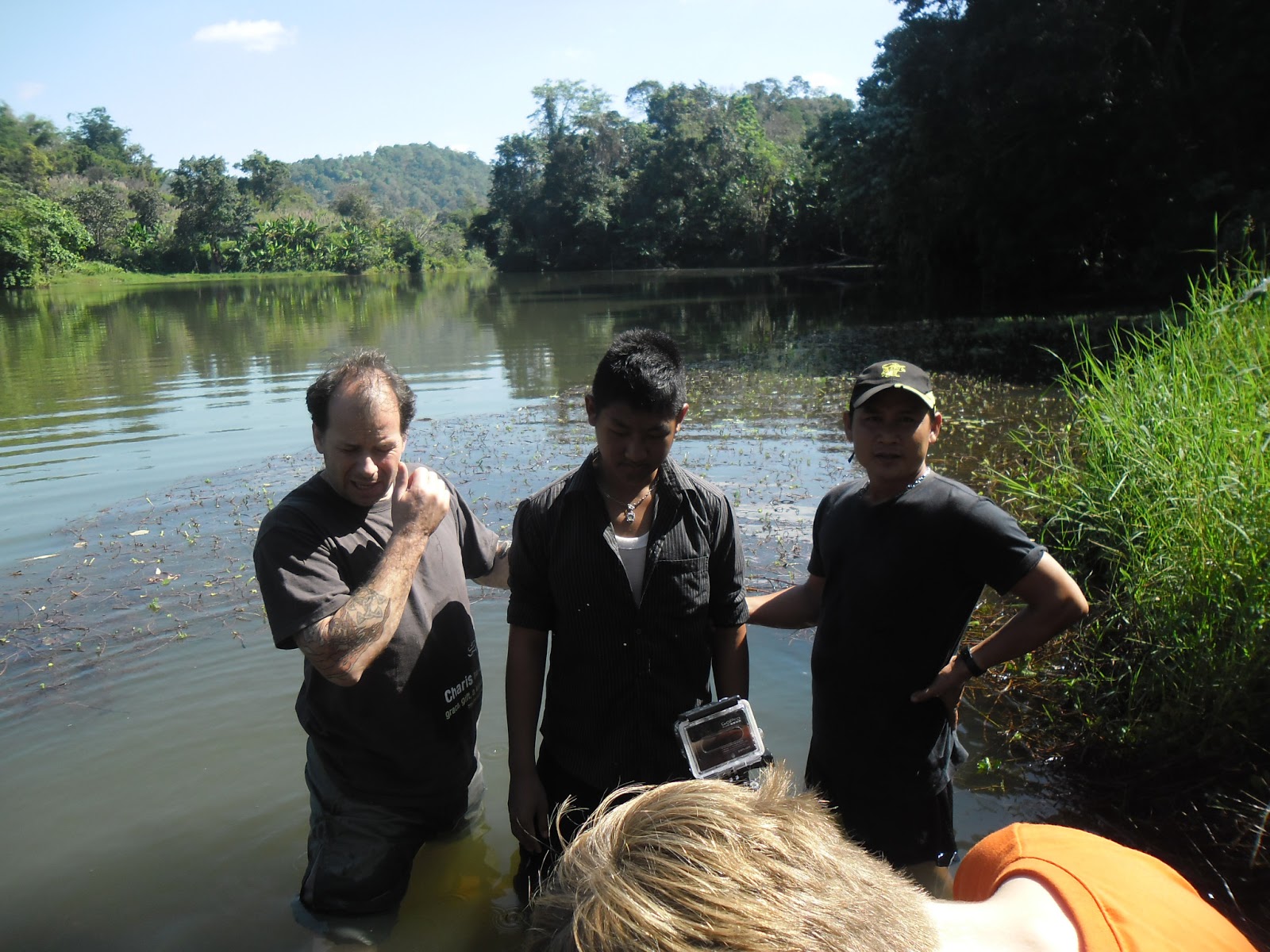
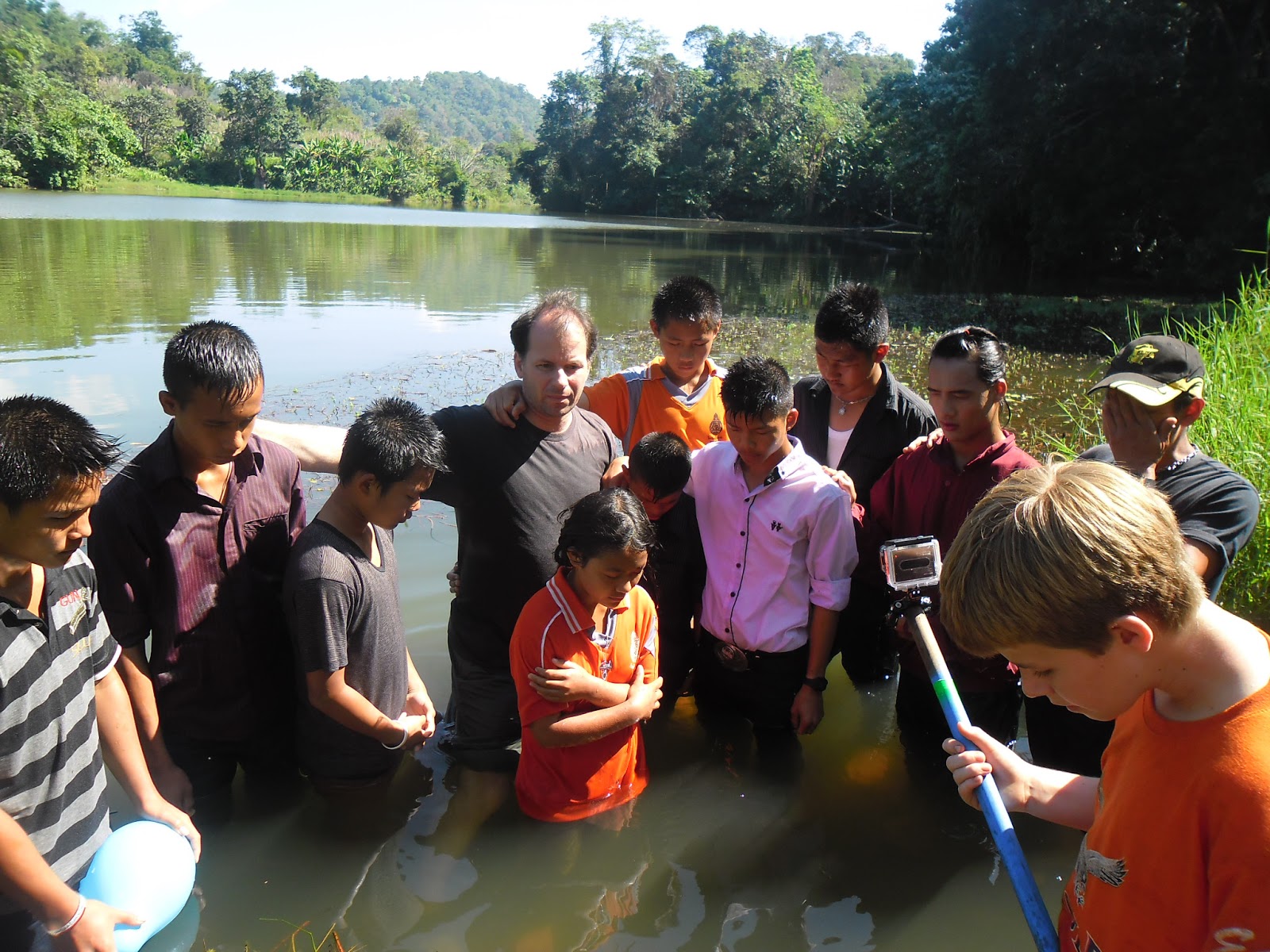
Well here is how I explained it and then did it on my recent visit to Ban Saeng Sawan with The Charis Project.

Now, I don't push baptism. If people ask I respond. I don't push it because I have not yet been in a position where that seemed the right thing to do. I may some time find myself in such a situation and will cross that bridge when I get to it. When I was with my friends up in the hills in Thailand, Judah, the lead guy at the children's home we manage, notified me that there were a number of the kids and one guy from the village who wanted to be baptized and that they wanted me to do it.

So we talked about it for a bit. I started off by saying that there are a lot of different understandings of what baptism is. Many Christians think many different things about it, but this is what I think.

Historically, Christian baptism comes from the Hebrew practice of baptism which was a mixture of ceremonial washing and a reenactment and recapitulation of Israel's passage through the Red Sea in the Exodus, the event in which Israel was transformed from the family of Abraham into the nation of the people of God. In Christian baptism a person is participating in the cleansing redemptive work of Jesus and is going through the "naturalization" process into citizenship in the "people of God." (I take this "people of God" to be a functional designation rather than a designation of status, that is, it is an entry into responsibility rather than into a position of special standing.)

I said that it is a public declaration of solidarity with all the others who have been baptized.

I also said that baptism is not magic. It is not the sort of thing that if you do it wrong, you mispronounce the incantation, you perform the act incorrectly (maybe the water is the wrong sort or or you did it at an age that someone thinks is wrong or whatever), or the wrong person does it, it will not work. It is the one baptism of Jesus that we participate in however we are able.

Then we went out to the lake.


When there, I said that baptism is a public declaration of a person's commitment to be a disciple of Jesus. I commented that different Christian traditions may have a process that leads up to baptism but I will just ask two questions and if you agree to them then I will go ahead and baptize you.


Then with each of the people I asked, "Do you choose today to be a disciple of Jesus for the rest of your life?" Then, "Do you commit to obey his commands and to work for the growth of his kingdom in this world from this day forward?" When they said "yes" to these questions I and Judah then dunked them in the water saying, "I baptize you in the name of the Father, in the name of the Son, and in the name of the Holy Spirit." When they came back up I hugged them and said, "Welcome to the community of disciples."


There has been much ink spilled and blood shed in this topic. I tend to take differences in how one does baptism to come down more to style than substance. As with marriage, it is what you do with it that imbues it with it's lasting meaning and significance.

What has been your experience of baptism?

Sunday, January 6, 2013

The Jungle House Of God


There is a picture I tell when I am speaking in the rural areas of Thailand, working with The Charis Project, that I have brought back to tell on the US side. I tell it to my children enough that they roll their eyes at me when I start to tell them again. But I will tell them again because I want the picture built deep into how they see the world, I want it to form part of the architecture that makes up the stories in which they live.

In the rural areas of Thailand, as in many areas of the world that are prone to heavy rainfall and possibly flooding, the people build their houses on poles set in the ground. They will lay out the shape of the house and dig holes and set hardwood poles in those holes and fill them back in. Then, at a  height off the ground that will keep the floor out of flooding water, they will attach some manner of timbers, maybe wood or maybe bamboo to those poles as the floor supports. Then, higher up at the top, they attach the timbers that make up the roof structure. On the roof structure goes leaves, or plastic, or metal, depending on how much money they have. And on the floor timbers goes the floor of woven bamboo or wood planks. The walls too, between the floor and roof will be made out of woven bamboo or wood planks.

Now, if you cut at one of the poles with a knife or axe or whatever it will become weaker, the cuts will give purchase for mold and termites and eventually the pole will fail. It will fall down and it will not be alone. That pole was holding up part of the house, part of the same house that the other poles are holding up. All of the poles are attached to each other by the house that they are each built together into. When one pole fails it pulls on all the others. If others have also been weakened then they could collapse as well. So cutting at one of the poles puts the whole house in danger.


On the other hand, if you build up that same pole, if your shore it and add strapping and bind additional poles to it it will become stronger. If you coat it with oil treatments rot and termites will not be able to get at it. That pole will become stronger and stronger. When that pole is strengthened it is more able support the weight of other poles if they get damaged and be more resilient to damage itself as well, also as that pole gets stronger it is able to hold more weight, it can hold up a larger structure so the house can be built larger.

building up the pillars
A family, or a community, or a church is like one of these houses. Each person is like one of the poles.

When we criticize or scold or judge one another or gossip or do any such things it is like taking a knife and cutting at one of the other poles holding the house up. The more we cut at the other person the weaker and more susceptible to further damage they become. When we do this we are actively contributing to the destruction of the house, the house that we are built into. Doing such things damages the other's ability to support us when we get damaged.

However, if we build up each of the people around us they get stronger. Encouragement, blessing, holding the sideways tongue and replacing it with speaking good words of truth and actions of support, these things strengthen and shore up and defend the other pillars. Such actions make the house all together stronger. When you get damaged the other pillars will be able to hold you up and they will be far more resistant to damage themselves.

Extend this out. As we all keep building up and strengthening all the other pillars the whole house gets stronger and can grow bigger and bigger until this house of God is big enough to shelter and protect the whole world.

One more thing, this is grace. Grace is not letting people slide, grace is building people up in the power of the redemption.

Now, how can I make a pillar stronger today?

Friday, January 4, 2013

This Is What A Lay Up For A Major Slam Dunk Looks Like

I recently returned from Thailand working with The Charis Project. This is a major highlight from that trip that I recently shared on the Charis Blog. It is so Important to me that I need to share it here as well.

On our Face Book page a short while ago I said that it looked as though we were on a layup for a slam-dunk. This is what I was talking about.

We have been working with a group of people in Mae Sot for about a year. We have been moving slowly and working at getting to know each other and to understand how, and if, our visions intersect and how, and if, we will be able to work well together.

That work is ready to take the next step.

On this last trip we spent an extended period of time discussing in-depth where to move forward and they were already on-board with where we see going.

The de facto leader of the group is named Philip. His father-in-law led in founding a college for hill-tribe peoples and Philip worked there as a teacher. In fact he was one of Judah and Saeng Chen's* teachers when they went there.

This group in Mae Sot is already working responsibly to build up, support, and empower children of the Burmese migrant and refugee community in the area. They have very little in terms of resources aside from the income they themselves earn as laborers and they do not ask for handouts. Instead they have been envisioning businesses that they could start to do a better job of supporting the work they are doing with the children.They are educated, they are motivated, they are hard-working, and they have already begun to innovate.

They do not want to live on donations because they see begging, even for a very good cause, as a weakness that they would very much like to avoid.

Philip and I excited about our vision for moving forward in Mae Sot

They are about the perfect partners for the Charis Project. They are thrilled with our vision for integrating entrepreneurism and the care for at-risk children. They see that what we envision pushes beyond what they thought possible and are excited to bring this all together. They and we are becoming us.

They brought to our discussions two or three business ideas that they had already been thinking about and over the course of our conversations we together came up with half-a-dozen more workable business concepts.

Now, the step we are working on next, is to model, assess, and select the best of these concepts to move forward on, to invest in, and to launch as the financial and entrepreneurial-education foundation of the empowering work with the children living out in the teak plantations and bamboo thickets.

A few of the kids and another of the team members at Mae Sot
Obviously we are very excited and are chomping at the bit to be on site to work directly with them as we launch this new Charis Community and take what we learn here to feed back into the Doi Muser home to build it up even further.


*Directors at the Doi Muser Home

Tuesday, December 18, 2012

Deep Value And Truth From An Odd Source


I have never posted a link to another article before. I am doing it now because this deserves it. I read this and think, with tears at the back of my eyes, "What have I actually accomplished?" Then I realize it's not too late.

We have a world to build, lets actually do it.

http://www.cracked.com/blog/6-harsh-truths-that-will-make-you-better-person/

Monday, December 10, 2012

Widows, Orphans, AND Aliens


My wife is writing a terrific series of Advent Meditations for Kids. This evening she read me the one she just put up on How To Treat The Poor. The readings from Exodus, Deuteronomy, and Leviticus reminded me of a thorn in my side. There are three classes of people consistently mentioned in conjunction as the lynchpins of God-like behavior: widows, orphans, and aliens. According to scripture how Israel treated these people determined whether the people of God were truly the people of God or not. Moreover, it is clear that God's blessing is contingent on how these classes of people are treated.

There is much talk in Christian circles as to how we in America are doing things that repudiate the blessing of God. I will not enumerate them as they are such hot button issues as will completely sidetrack what I am attempting to say. However, if we are truly serious and biblical about placing this nation in the blessing of God then these three classes should be foremost in our actions. We talk about caring for widows and orphans. Yet very few churches actively engage in substantive care for single mothers nor does hardly anyone adopt children from the foster care system. But further still, the aliens are consistently left out of the "widows and orphans" formula. The aliens include those guys down in the Home Depot parking lot, all those people who are here illegally and are the subject of great political dispute.

Biblically, the blessing of God hinges on how we treat the foreigners who have come here legally or otherwise and not on whether we are allowed to pray in schools or whether the Ten Commandments are written on some wall or even on whether gay people are allowed to get married.

Many will say, and have said to me, "I am ok with legal immigrants, but the illegals must go and should be excluded from society, etc." It comes down to legality. There are legal ways to enter this country. Anyone who doesn't come by these means is a pariah. Now, the same people make heroes of the kids who stand up and pray, illegally, in assembly, stating that they are obeying a higher law. Where is that higher law when it comes to the alien?

I tend to be a conservative and toward limiting the rights of citizens to citizens. However, God doesn't seem to care about what I think about this and hinges his blessing on how we treat the one who is not a citizen.

I am fully in favor of inviting the blessing of God. I wonder what he is in favor of?

Friday, November 30, 2012

Mystical Union And Sneezing: A Brief Hermenutic Of Mysticism

Recently on a discussion thread I am involved in someone wondered about the difference between mysticism and prophecy. I started to reply but that reply quickly got out of hand. What follows is characteristically dense. Each paragraph could relatively simply be expanded into a chapter with full citations and completely fleshed out reasoning; something I may do sometime if I have nothing better going on. I here speak more about mysticism than prophecy because that was more pertinent in the discussion this came out of and not because I think that prophecy is a settled matter. Rather, there is a huge amount of goofy thinking about prophecy as well but it is of a different sort.

I should note that I define mysticism as a separate entity to contemplation. Contemplation treats an object, text, or activity Iconically. To treat something Iconically (that is in the same manner as the Eastern Christian tradition treats Icons) is to take that thing as pointing to something beyond itself rather than as an object taken in itself and to pursue or contemplate the thing beyond. Great value as well as great foolishness can come from this approach to things. Simultaneously, the same value and foolishness is manifestly true of the non-Iconic treatment of the same things.

Mysticism pursues union, the sense of being fully taken up, a sense of direct connection.

My deep thinking on this began when I was living in India and Nepal. Naturally I was exposed directly to a wide variety of traditions and understandings of reality. Something that caught my attention was the striking similarity in the form of experience described my the mystical branches of the various religious traditions. Hindu, Buddhist, Muslim, Jewish, Christian, all these traditions have mystical branches. Each use language and images from their conceptual universe to describe their mystical experience. But, they all describe an experience that involves a loss of distinct selfness where the practitioner feels as though their existence ceases to be distinctly separate from anything else in space or time, they feel as though they absorb into the infinite. Muslims will use Muslim words to describe the experience. Christians will use Christian words. Hindus will use Hindu words. And so on. But, they are all describing exactly the same experience.

I then found that I was not the first to observe this. I discovered that there have been many voices within the mystical paths of the various religions that have observed this striking similarity of experience across traditions and took that to indicate that all paths lead to the same place. They take the common mystical experience as evidence of the truly unified ultimate foundation all the religious traditions.

I became more curious about what this experience is. I noted the strong similarities of practices among the different traditions. Looking past what the traditions said their techniques meant they all had the same form. All the traditions engage in some collection of repetitive action, extreme treatment of the body, practices of focus/centering/meditation. I started to get familiar with the neuroscience research on mystical experience. There is quite a bit. What it shows is that the similar practices lead to the same effects in the brain. In particular they affect the sections of the brain that produce our sense of self. Either by deprivation or over-stimulation those sections of the brain lose the ability to clearly define our selfness to our consciousness. This results in the sense of release and union with something beyond our self. Mystical union is a brain state. It is a physical response to the techniques used my those earnestly seeking that experience just like a sneeze is a physical response to irritation in the nasal passage.

Some have linked the beliefs of the "all paths" school I just mentioned to this neurological research to say that all religion is a response to this brain-state. I don't think that this is the case, and dealing with this is not my purpose here.

What I find interesting is the way in which the mystical experience takes on meaning. The experience takes on the meaning attributed to it by the person working to achieve it. When a Christian engages in the mystic disciplines they are seeking a union with Christ. When they achieve the brain-state they experience it as union with Christ. When a Zen Buddhist achieves the same state they experience satori as that is the meaning they brought to it with them.

Now, it would appear that the experience itself can better be understood as an Icon. This would place mysticism as a sub-set of contemplation where the thing in itself is the brain-state and what is important or truly meaningful is the thing beyond that it is taken to point to. The difficulty is that the thing in itself is an internal physical state rather than a painting on a board so it is far more difficult to make the separation between it and the thing it points to. This is why the meaning brought to the experience has historically been conflated with the experience itself.

This conflation has given rise to theological problems in Christian mysticsm. There is a consistently Gnostic flavor to it. Thinking about it has been directed toward escaping the mundane physicality of this world to experience a more purely spiritual reality. This has significant theological problems. Primarily, we were created as bodies with Spirit put into us to make us alive and not as spirits trapped in bodies thus it denies the absolute goodness of our bodyness. It is a force that relativizes our presence in this world that we were created to live in and bring to completion. It takes away from the true experience of union with Christ through participation in his redeeming work in the blood and dirt of this world.

However, I do not reject the disciplines that lead to the brain-state. If for no other reason than that they are demonstrably therapeutic, bringing a calmness of mind, having beneficial effects on blood pressure, as well as on several other body systems. Moreover, when taken Iconically the experience can function as a deep heuristic for internalizing the reality of the union already established in the incarnation and of the full loving adoption by our Heavenly Father.

The difference between prophecy and mysticism is pretty clear to me. Prophecy is the concrete calling of the people of God to God by God with specificity. Mysticism is founded on a particular feeling of spatiotemporally disconnected floatyness that is produced by a specifically identifiable neuro-chemical brain-state that is caused by particular intentional practices. Prophecy must in itself have positive truth content, and must be effectively specific even if it is not entirely lucid. Mysticism is, strictly speaking, neither true nor false but is meaning-absorbing while prophecy is meaning-excreting. Mysticism takes on whatever meaning or content is given to it while prophecy looks you in the face with it's own meaning. While prophecy, if it is true, is always valuable, the value of mysticism lies in what we bring to it.

Monday, November 26, 2012

Start Of An Incarnational Theology Of Worship Based In The Imago Dei

Worship, whatever else it is, is proclaiming the glory of God. It is telling the truth of the greatness of the creator.

My understanding of what the image of God is is somewhat different from a more dominant understanding. The more dominant understanding that I grew up with and most are likely familiar with takes image language to refer to something like the reflection in a mirror as if we are a sort of reflection of God. This in turn is understood in terms of  human attributes that match divine attributes: creativity, rationality, freedom, etc. Though I believe there is some merit to this it misses the main thrust. The image language in genesis has more to do with idols than reflections. This becomes clear when we read about God’s making of man in genesis against its contemporary cultural background. In that cultural context we need to remember that idols are not inherently evil rather they were understood as the very presence of the god they represent. That is what it is to be the image of God. It is to be the very presence of God in this world. The indwelling of the breath of God whereby the man became a living being produces this existence as presence.

In the fall we died. We lost that which made us living beings. We lost the spirit of the living creator that made us his presence in the world.

To be what we were created to be is the foundation of worship. As the actual presence of God in the world we inherently manifest God. We proclaim the creator. It is to naturally participate in God’s own self-proclamation through us. Our true being is to effectively demonstrate the greatness of God in the world.

This is only possible if we are the living beings we were created to be. Thanks be to God that he has redeemed us from death and sent his Spirit again to again create us as his presence in the world.
This is the foundation of all worship. Truly, we are to live lives of worship. We, being filled with the breath of God, live as his presence in this world. We proclaim the glory of God by walking by the spirit that makes us his presence. God’s own glory shines as he is present in the world through us who are living beings by the quickening of his breath. Our entire life is worship.

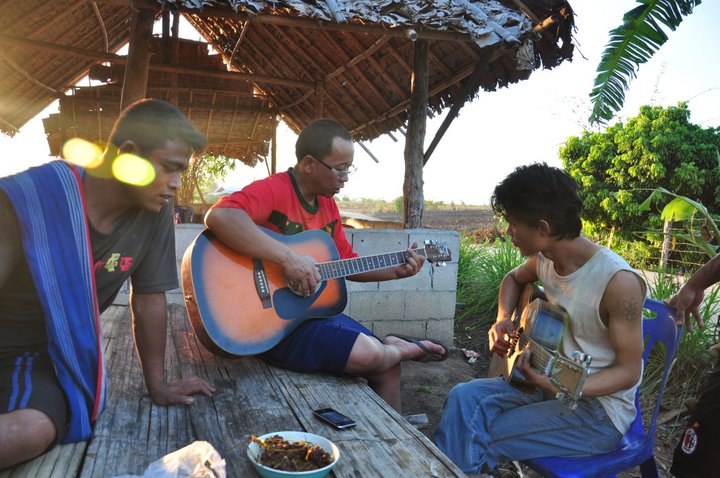
Nepali, Lahu/Shan, Burmese, working the tunes
The specific case of music is special. God created us as humans. With the indwelling of the Spirit we are living beings, truly human in the original sense. All that he created us to be is good and proper. It is absolutely not the case that the physical and that which essentially comes from it are inferior to the spiritual. God created us physical and said it was good. Who are we to disagree? This is important to recognize in all of life but it is particularly important in understanding worship in terms of music. We are complex beings with a huge range of capacities, physical, mental, etc. Music, more than anything else we do, has the capacity to engage and activate the full spectrum of those capacities. Good music engages more of these capacities more effectively and more integratively than bad music. Now it should be noted that I am making a quality distinction and not a moral distinction. You can have morally acceptable music that is crap. You can also have morally damaging music that is powerful and well done. The quality of music is a function of its ability to integrate and activate the full spectrum of human capacities.

So music as worship has the potential to activate and integrate the fullness of the human presence of God, more so than any other activity. Intellect, skill, emotions, aesthetics, physicality, the better the music the more fully the fullness is expressed. That is to say that the quality of music as worship is judged by the degree to which it activates and integrates the fullness of this truly human expression of the glory of God.

Friday, November 23, 2012

The Difficult Power Of Love

Here is a special treat. A guest post by my brother Wayland. He is a co-founder of The Charis Project, an officer in the United States Marine Corps, and one of the more spiritually aware people I know. A heads up: he prefers to work in shocking and uncomfortable imagery.

I spend a lot of time working through the choices thrust upon me be the sex and violence of day to day existence. Things like, what do I do now that I know the reason I don't see my students anymore is because they got sold to people who gang raped them? How do I keep the other kids I try to protect from having the same thing happen to them? Or, and this is much more banal, how do I keep the people I'm in charge of from doing something really stupid like marrying the stripper they met this weekend? Or how do I deal with my friend having killed himself after coming back from war? Or how come after doing everything I possibly can for this girl, in the most uncreepy, honest, and open way I could, it still seems like I have to use an ice pick to chisel my way through bitch mountain to get through to her?

We all face hardship and suffering, and for those of you who wish to change the world, you know who you are, the biggest sources of suffering come from the dissonance between the way things should be, which is obviously not the way things are, and the way things actually are. (Just admit it. Sh..y.) Now just try and follow the same path of self sacrifice and selfless giving up of yourself to change this and see how long it takes to, either end up drinking every night and generally feeling depressed, or, and I would argue that in this economy with gas prices the way they are this is the worse choice, becoming super conservative religious and trying to shut out all that pain with yet more small groups, even more volunteering and yet ever more advice from spiritual teachers. Not that there is anything wrong with any of this IN IT'S PROPER CONTEXT. That goes for the drinking every night also by the way. But the reason I, we, engage in these types of self destructive behavior is because we have taken our sacrifice and the love behind it and bent it out of it's proper context. Actually we have taken ourselves out of the proper context because we have fallen into the all too easy and most banally evil path of defining ourselves in opposition to what we oppose and in so doing become less than what we are.

When you really care about something, it gets really easy to define yourself in terms of opposing what is bad for it.

On a scale of twisted to perfect, that leaves us twisted, just like everything else that's wrong, including Lucifer, but I'll get to that at a later and undisclosed point. And don't think for a minute I'm about to say something about just embracing universal love and there is good in all. Find out about the girls you spent your time and effort looking after getting gang raped and see how long it takes for you to come up with new and exciting ways to dismember someone unto death and be absolutely right to feel that way.

I'm actually going to take this in a whole other direction. I'm really more interested in penetrating to the guts of the problem, and splitting it wide open to the point that it turns inside out and becomes something new. In doing so, I had to go looking for inspiration. I still find it strange that such would come from my work, which is really a lot more boring than people give it credit for. There is this concept we have called maneuver warfare, by which we seek not to kill off the enemy, but to destroy the enemy's system in key ways that cause him to collapse with as little real destruction as possible. It turns out God does the same thing.

Which means I'm about to go off in yet another direction. Those of you who know or, better yet, are mothers know what real selfless sacrifice actually is. Consider that God describes himself as a mother. He also calls himself love. Now, that word has been corrupted in the modern context to mean something more along the lines of, I love you, but…

I love you but you need to be more open.
I love you but you need to not not push me away.
I love you, but change or I can't do this anymore.

WEAK.

Or, "I care about poverty/love poor people, but we will always have the poor." Read: "I can't deal with this right now".

(What does that even mean? )

In other words the modern context of love has become hugely self centered and ends up leading us into defining ourselves and what we care about in opposition to what we don't like. Mothers, or at least good ones, know better. I'm not, nor will ever be one, but I am aware enough to see that waking up at all hours of the night to let a screaming, completely self centered little mammal literally suck nutrients out of you demands something else to be going on. Something very unselfish and rather embracing of the way things actually are and addressing them as they are, i.e. a screaming little mammal that needs to be fed.

Now, tying this back to maneuver warfare, I'm going to have to make an all too tantalizing jump into the mystical world of ideas. Ideas like, love is actually more than an emotion (it is that too, and that's totally fine) it's a choice you make. In fact it's one of those choices you make when confronted with the sex and violence of everyday existence.

This means I'm going to have to get to the point, which is that there is nothing wrong with pouring yourself out in self sacrifice for what, and who, you care about. And to make sure you don't end up being selfish about it you destroy the system that leads to that outcome. I have found the fastest way to totally overcome it all is to decide to be a slut about it. Love everything. The brokeness, the twistedness, the retrograde behavior. Try turning it on yourself if you want to get real kinky. Forgive and love everything about yourself. I know this feels strange at first, but we have to learn to take care of ourselves, you know. This works because love isn't a two way exchange between something or someone you are trying to get something from. It is a one way transformative (read redemptive) force that changes the twisted, broken things to what they, we, were meant to be. Destroy the system by embracing it and thus causing it to adapt to you, to the light that lives in you.

What better way to damage an agenda of damage than by applying a transformative and redemptive force to it. Instead of pushing away that which we are revolted by, and thus bringing it's existence into more clear relief, why don't we get right up next to it, assume that everything we hear about us being bigger, better, and more powerful is true and thus compel the that which is weaker to adapt to that which is stronger. It's a law of biology that the larger organism absorbs the smaller. It seems to work in all of life as well.

This makes dealing with your former students, if you can ever find them again, a lot easier because you can love their brokenness, and thus have any hope of changing it. You can love your friend who killed himself and leave it at that. You can love the people you are in charge of, and for that matter who are in charge of you, do your job and leave it at that. And you can love the passivity and sadness of the girl making you use an ice pick to chisel you way closer to her, which has a dramatic effect on determining how committed you are and how much you really care and actually produces positive changes. At least that is how it all works for me.

As for Lucifer? God loves him.......                                               

Monday, November 19, 2012

On My Father's Shoulders

I grew up saturated in the belief that the ultimate source of the universe is actively loving and that our highest notions of love reflect that ultimate source*. That is to say that God really loves us perfectly and his love is recognizable to us through our experience of it's reflection. Even more simply: God loves us completely in a way that makes sense to us.

My father did not grow up in this. Rather, he has had to fight for it. This fight has been most clear in his longstanding and often controversial teaching on the grace of God, speaking in defense of it for thousands of hours, all his writings, outworkings of defending the grace of God. The grace of God needs defending because it is and has been for much of history under attack.

To be more accurate, the grace of God does not need defense. It is quite secure in itself. Rather people are in need of being released from bondage to false notions of God that see him as vindictive, judgmental, irritable, distant, etc.


My father has worked at this for most of his life, pulling and pulling  because he needed the truth he knew to train his own heart. He has needed release from the same bondage he fought for for others. This understanding of God is something he has defended. This understanding of God is where I start. I grew up in this environment, starting with a radical notion of the grace of God, early saturation deeply setting the way I think and feel about the world and my life and my place in both. This deeply rooted understanding that reality has such a bright truth at its core grounds freedom and joy at the foundation of my life and work, but at the same time, not having to work for it, impedes my ability to articulate that very grace to people who do not yet truly know it.

The grace of God is not an "issue" for me. That God really loves us and this world he has created is where I start. The difficulty that arises from this is if other people do not start from the this same place, especially on such a fundamentally vital point, what I say can be very horribly misunderstood. Especially since I talk a lot about our responsibilities and the work we have to do in the world. One could very easily think that I am teaching that we in some way earn, by these works, our position with God. Nothing could be further from the truth.

Nothing I say has anything to do with securing a better position with God. Everything I say is predicated on the foundation that we are all already completely secure in the love and acceptance of God.

We are all fully loved and accepted by God, right now exactly as we are. That is bombproof. That is true whether we feel like it or not. That is just as true for the person across the street and across the ocean as it is for you and me. Jesus has already taken up all of humanity into the embrace of the Trinity. The Spirit is always already present in every place and person, ready to be honored and embraced. The Father has, from the very beginning, chosen each and all of us to be adopted as his true children.

That is my foundation. There is nothing I need to do to "get right with God." There are no hoops I need to jump through, no manual I need to read, no cross I need to nail myself to. All is grace. It is by  the grace of God that I do right and by the grace of God that I sin. My very existence is a gift. I have nothing and yet by the adoption of the Most High everything is mine.

Given the radical depth and power of the grace of God and his complete acceptance of us all the only thing that is left to us is to get down to work. There is nothing for us to earn so we might as well work at life and that more fully. That is where I go. Given the total love and acceptance of our Father lets get to work. We have been given a creation to complete.

I also talk about my father here.

*For a good primer on what I grew up with see: The Gospel Uncensored

Friday, November 16, 2012

Only You Can Renounce Your Right to Do Good

 
You can tell you’ve hit some sort of nerve when a post gets responses ranging from, “Now this looks more like what one would expect of someone who claims to love God and imitate Jesus” to, “Woe to them who call evil good and good evil." You can imagine the spectrum in between. There have been so many conversations, in so many places.

We have been accused of taking our theology too seriously because we have asserted that for Christians, politics is simply one small aspect of how we fight for justice and good and to bring the kingdom of God, and that there are other more powerfully fundamental means of transformation at our disposal. This leaves us wondering if some of the people who take politics so desperately seriously, some of the people who believe it a sin to disentangle their political involvement from their faith long enough to ask if the way they are going about their politics is harming or helping the goals of their faith, don’t take their theology seriously enough. Or maybe they just have a screwy theology that they take too seriously.

Imagine for a moment if we all actually believed that the gospel was the power of God. You know, unto salvation, the salvation of lives and communities from broken futility at their deepest roots. What if we actually believed that we are the fully adopted heirs of the Most High God, that our action in this world actually is in the power of our Father and is taking possession of our rightful inheritance. We are not on enemy territory, there is no enemy territory, we are in our own backyard. The life of faith, service to others, love for our neighbor, compassion and mercy, etc. is participating in the complete redemption and completion of creation. If we all believed that, what would we do?

Would we elevate our political ideology above the real human beings around us? Which is more valuable, our doctrines or the people we assault with them?

Would we pay lip service to the power of prayer and the testimony of our lives and then spend money and energy grasping at manufactured power in a man made arena? Look at where you put your money and time to see what you in fact love.

Would we spend more time fighting for laws in order to punish behavior or would we fight to do something directly helpful and loving that will change people?

Would we claw at our friends and family on facebook when we disagree with their political positions?

Would we yell at people we don’t know on their blogs because we disagree with their political positions. (We’re not talking about discussion or expressing an opinion in a respectful and well thought out manner. We’re talking about that other thing I know you all have seen people doing.) What is more important, to win the argument, or to transform the person?

Would we make dire predictions about the coming apocalypse and God’s judgement on a sinful nation, or would we get on our knees and pray to be shown what we can do to heal the brokenness all around us? Is it better to yell and scream about some coming judgement or is it better to repent and work to bring wholeness to broken people in order to avert the judgement?

It isn't people we are really opposing anyway. Our fight is against the evil and destructive chaos that tears at the heart, chaos that deforms and stunts human life and community, destroying our capacity to thrive. Unable to remedy this chaos, external legislation lays a blanket of judgement over a festering infection, pushing it out of sight so it can kill us in the shadows. This truth shapes how we raise our kids now. “How much pain must that person be in to act like that. I wonder if he has anyone who really loves him at home. Let’s pray for him that he will know Jesus love. Let’s be as kind as we can to him when possible. Don’t let him be mean to you, but don’t be mean back. Choose to be kind.” Not, “They are bad and need to be punished for that. Their mom and dad are stupid failures of parents. They need to be cut from assistance so that they get their act together.” The actual ways that we are given to fight evil are so much more effective at healing the infection than the ways we fight with each other, in the name of fighting evil.

It is life changing to listen to someone, to see them clearly, and to honor their humanity. For both of you.

No matter who is president, we are never powerless.

No matter what happens, only you can renounce your right to do good.

If you want to do something to prevent abortion, do something to prevent abortion. Listen to a teenager. Care about them. Talk to the girls about their value as women. Talk to the guys about their value as men, as someone who cares enough about them to listen and invest time in them. Try and figure out how you can do this in the communities where the demographics show the incidences of unwanted pregnancies are especially high. These are easy to find because they are usually the poorer neighborhoods. Take care of a mother who wasn’t planning on being pregnant. Give her somewhere to stay if she needs it. I have friends who did exactly that with a little suite on their house. Do something to help your local economy. Start a business that creates jobs. Offer to help pay for health insurance for an impoverished mother. Go through the process to adopt a child. And don’t be picky about the race. Or something else. How could you make a difference in the situation of an actual woman who might be considering abortion? Start there.

If you don’t like the way Planned Parenthood does it’s sex education, do something better. Make a video, or 10. Talk to the kids you know, starting with your own. And make sure your talk isn’t, sex is bad, and kissing on the mouth causes babies. Because that’s not educating. (Though it’s very cute when my 5 year old thinks it. “That’s what you and daddy do and now you have babies!”)

Organize your city to care for aids patients in Lesotho. Live your family life such that it is a beacon of hope to many who are hungry and lonely.


This is the last post we intend to write on the subject of Christianity and politics, and least, for now. It’s time for us to get back to the real work now of actually working to bring justice and mercy, rather than just talking about it.

I believe that we can make a difference, and that there is nothing stopping us from doing so.

What is in front of you to do?

It doesn't have to be big. Mother Theresa said if you want world peace, go home and learn to love your family.

Your home, your life, your family, your conduct is a witness. Start today by doing your best with what you already have to do, and loving well the people you are already given to love, and leave your heart prayerfully wide open to accept more people into it. You have no idea where that might take you


Carrien and Aaron (Look, we write stuff together too!)

************
You might find this post written today by Aaron's brother interesting as well. It comes at this topic from yet another perspective.  

The Immorality of Mass Charity  "We have the same opportunity we have always had. Will we love God and our neighbors, thereby making government irrelevant, or will we find peace in statements of "should" and the justification of intent? Will we be known by the way we love, or by our ideology? Neither is wrong, but one is useless without the other."

Tuesday, November 13, 2012

Another Position To Consider

Normally on this blog I spend my words thinking about how amazing God is and how wonderful our place in this world is, about the hard work of bringing redemption to this broken world in the blood, sweat, and tears of living a fully Christlike life among the people we interact with and the decisions we make, about the responsibility each of us has to obey the commands of the Spirit of the Living God.

Recently my wife and I have made the proposition that politics is not the primary venue for the advancement of the Kingdom of God (here, here, here, and here). But rather that Christians ought to guide their political actions by the ultimate goal of the redemption of each person. That is, aim for redemption rather than winning the argument.

Though neither I nor my wife has ever claimed to speak for God, rather we muse and explore what deeply following God means, both of us would hate to lead people astray.

A gentleman named Geoff recently proposed that we might be mistaken. I have posted below his unedited comment.

I put it to you to discern by the direction of the Spirit. The responsibility lies now with you the reader. You must make your own decision before God. If the proposition Carrien and I have made is false and misleading, I pray God will save you from our folly.

It should be noted that abortion is not what our comments have been about, though we have used the issue as an example. Though this alternative view is important, you should bear in mind that we have been discussing a Christian approach to political discourse and action and not abortion as a topic in particular.

(As the text is unedited, please read "Carrien and Aaron" where he says "Carrien" as he posted this comment to both of our blog postings.)
-----------------------

Carrien,

My wife is a big fan of your blog. She was so outraged by this she asked me to read this. I'm not one to comment on blogs, but I feel you have strayed so far from God's word I had to speak up. Up until now, we've loved most of what you've written, but I'm really disappointed because the Bible says, 'Woe to them who call evil good and good evil'. I feel your logic is going down that path. Even the tone in your post betrays you- as Brenda and others have pointed out.

As one who sets yourself up to promulgate truth from God's word, you are unaware/misinformed of what God has already told us in the Bible about the role of government. Secondly, I feel you are ignorant of history, and at a time like this, no one can afford to be ignorant of history for it repeats itself.

Here's an excerpt from a blog I wrote, "Who would Jesus vote for?" I think that is the only way to look at this issue from God's vantage point.

If He were here, who’d he vote for? I mean really can we know? We have seen so much corruption in politics that we might conclude that Jesus would give up on the whole process. I know that it is so tough to think through all the issues, we have the economy, poverty, and on and on it goes. Who is really telling the truth? Can we even know with a biased media what is best for the country? Is there any definitive way to see through all this mess? I think so. As a matter of fact, I think there is one issue that cuts through all the fog, and I can say with authority represents what Jesus would most care about most, and therefore who He would vote for.

First of all, the economy wouldn’t be a driving force of whom he would vote for. Jesus had a lot to say about money, and if He were here today, He would instruct us on seeking first the kingdom, not on what is better for the American economy.

I don’t think war would be a driving force either. Jesus
wasn’t a pacifist, when he spoke with the Roman soldiers He didn’t tell them to quit the army; He told them to be good soldiers. God has been behind wars throughout the Bible, so there is such a thing as a just war, its just hard to figure out what that is.

Maybe its poverty? Jesus had a lot to say about helping the poor. But upon a careful study of the scripture He wouldn’t ask the government to take care of the poor. They can’t for the simple fact that the government can’t solve the problem of poverty. The government is missing something crucial: accountability. Just handing people money does not help them it cripples them. Jesus
would tell us that we are our brother's keeper and every Christian should be involved in helping the poor. (Sadly, the church dropped the ball on this and the government has tried to become the savior of the people). Christians this is our doing!!!

According to the Bible, God has given the government the role of carrying out justice and protecting the weak and defenseless. Genesis 9 spells it out. First, the setting; the wickedness of man was so great that God had to destroy the entire human race except for one. That’s why the flood came. Man demonstrated that he could not govern himself. So God appointed human government, because He realized the propensity of man is to exploit the weak and defenseless. This world is tilted toward the rich and the powerful. So, God said that human life was to be
guarded at all costs, especially those who can't defend themselves. By doing this He demonstrated that life has inestimable worth. Every human life reflects part of who God is. Everyone matters to God, no matter what society says.
Genesis 9:1-6“And I will require the blood of anyone who takes another person’s life. If a wild animal kills a person, it must die. And anyone who murders a fellow human must die. 6 If anyone takes a human life, that person’s life will also be taken by 
human hands. For God made human beings in his own image.”

Government’s sole role is to protect and value human life, if they didn’t everything would slip into anarchy because the strong would kill off the weak. By valuing human life as its first priority, government carries out its God-given role, and people are able to live in relative prosperity.
This is because when a society values defenseless life above everything else (money, convenience, status, expediency, etc.) they are following God's value system, which is for people to prosper and enjoy freedom. People prosper in a just society where the stronger are not able to tread on the weaker just because they can.

In Moses' day Molech was a popular god. If parents were 'down on their luck' or hit by difficult financial circumstances they would offer one of their children to this god in hopes that their luck would change and this offering would get them out of their bad situation. Through appeasement this god (through baby sacrifice and sexually immoral rituals) would deliver one from bad 
circumstances.
The statue of Molech was a furnace. It was heated to the point where the outstretched arms glowed red-hot. Then the baby was thrown onto the arms where it was burned alive. Listen to 
how seriously God says to deal with those who worship the god of sex and ease.

Levitcus 20:2b-5 “If any of them offer their children as a sacrifice to Molech, they must be put to death. The people of the community must stone them to death. 3 I myself will turn against them and cut them off from the community, because they have defiled my sanctuary and brought shame on my holy name
by offering their children to Molech. 4 And if the people of the community ignore those who offer their children to Molech and refuse to execute them, 5 I myself will turn against them and their families and will cut them off from the community. This will happen to all who commit spiritual prostitution by worshiping Molech.”

Even though we are not under the Mosiac law, recognize two things: 1) God takes killing of babies very seriously. 2)Those who 
witness this and do nothing, God is going to come after them!
For this election, abortion is Jesus’ biggest concern. Please don't obfuscate the issue with lesser things. Anyone who votes for someone who does not protect the unborn child is sharing in their guilt. America has executed over 55 million of her children. Who is going to give an account for that? Not just the mother or the father, not just the Supreme Court justices, and not just the presidents who appointed them, but also those people who elected the presidents who appointed the justices.

We are our brothers’ keeper! I think Jesus would say that anyone who has such little regard for human life is incapable to lead a nation toward peace and prosperity. Someone who believes it is the mother’s right to kill her child, demonstrates that above all he does not value life, but will make decisions governed 
by selfishness and expediency, not what matters most to God; human life. I believe we have a modern day god of sex and convenience; no longer is his name Molech but “Pro Choice [1]”.

[1] The Bible states life begins at conception. It also makes clear that “the life is in the blood.” God considers an unborn baby fully human. (A baby has rudimentary blood vessels by the 2nd to 3rd week).

So to claim that neither president is going to do anything about abortion is missing the point entirely. Proverbs makes is clear that "godliness exalts a nation and sin is a reproach to any people."
What this means is that if leaders of a country have God's values, they will bring prosperity; if they don't, the country will deteriorate. Why, one simple fact, God has wired the universe in such a way that if we honor him, and his laws of the universe, justice, prosperity and good fortune will generally follow. America is a great case for this, the most blessed nation in the history of the world. Why? Because this government was set upon the Judea-Christian value system. Obviously it wasn't perfect, as no government will be perfect until Jesus rules.

A leader who defends the defenseless demonstrates that He has God's value system. His judgments will be based on this value system, not on what is expedient or because he will get kick-backs. To care for little people who can't return the favor demonstrates godliness. He will treat all fairly. He will truly be a knight in shining armor for the people.

He will uphold God's laws of cause and effect. You have sex before marriage, you'll likely be a mom/or dad-and dads you can't dodge responsibility, you must father that child-not leave your girlfriend holding the bag (essentially that is what abortion does-it is sexist and destroys women). You don't work, you don't eat. You work hard you are rewarded. He will recognize that as a government official his role is to carry out justice (God's value system). He will recognize the church and respect it, not try to replace it. He will know that government's role is limited and won't overstep his bounds, but allow the church to flourish and encourage them to take care of the poor, and teach them a work ethic, etc. With lower taxes the Christians can more easily help the poor. 
When we vote for a president who supports partial birth abortion and has voted 3 times for infanticide, this is means that we as a nation have left God's value system of defending the weak and defenseless. It means that we now have a leader who will not do the right thing, but do whatever is expedient, so long as he can get away with it. What it means is that his value system will from the top down will lead this country to a place where 'everyone does what is right in their own eyes" if they can get away from it. It means that lies and deception will be the rule of the day. Citizens will no longer govern themselves, but will do whatever if they can get away with. Not to mention, Obama will probably appoint at least four supreme court justices. What value system will he use when he picks them? That is why this matters!!!

Secondly, history repeats itself.

You mention, "How about we step back and stop playing the game, and do the real work of the kingdom instead?" Carien, you commit a logical fallacy here. You cannot separate life that easily. That may work for you in a nice cozy lifestyle here in America, but that is not real life. Travel a bit, go around the world to countries where government is rife with corruption. That argument only works for Americans. Tell that to the Jews in the Holocaust. I would urge you and others on this site to watch the Netflix documentary on Bonhoeffer.

Here was a man who began his life as a pacifist, he was all about advancing the kingdom of God and didn't want to get involved with politics. But he soon realized that was an ignorant position, he very wisely realized that evil triumphs when good men do nothing. He could not sit by (however, the majority of Christians in Germany did) and watch the defenseless be executed.

As one of his few compatriots said, "First they came for the socialists, and I didn't speak out because I wasn't a socialist.
Then they came for the trade unionists, and I didn't speak out because I wasn't a trade unionist. Then they came for the Jews,
and I didn't speak out because I wasn't a Jew. Then they came for me, and there was no one left to speak for me."

God expects us to be salt and light in this dark world. He expects us to stick our neck out there and speak up and stand against evil. He also expects us to take care of the widows and orphans. Please study history and you will see how dictators rose to power because good men did nothing. History repeats itself.

Carien, with all due respect, what makes this really difficult is that I'm not really into blog reading and comments, but I had to speak up because your ignorance of God's word in this issue is really leading people astray. Jesus' harshest words were reserved for us religious leaders who led people astray. You have set yourself up as espousing God's vantage point. At at a time like this you need to be very sure you are speaking accurately on behalf of God.

In sum, God warns us that they day will be coming when the prophets call good evil and evil good. The only way you will not fall into that trap is know God's word. If you are going to espouse your political views, please make a distinction between your opinion and what God says. In all sincerity, if you are going to speak on behalf of him, make sure you know what He has already told you in his word.

-----------------------------

What say you?
Related Posts Plugin for WordPress, Blogger...