Showing posts with label Body Of Christ. Show all posts

Tuesday, January 8, 2013

Baptism Isn't Magic

The issue of baptism occasionally comes up in several different groups I associate with, from academic theological discussion groups to Christians who have no clue what baptism is about to non-Christians who have no clue what baptism is.

Well here is how I explained it and then did it on my recent visit to Ban Saeng Sawan with The Charis Project.

Now, I don't push baptism. If people ask I respond. I don't push it because I have not yet been in a position where that seemed the right thing to do. I may some time find myself in such a situation and will cross that bridge when I get to it. When I was with my friends up in the hills in Thailand, Judah, the lead guy at the children's home we manage, notified me that there were a number of the kids and one guy from the village who wanted to be baptized and that they wanted me to do it.

So we talked about it for a bit. I started off by saying that there are a lot of different understandings of what baptism is. Many Christians think many different things about it, but this is what I think.

Historically, Christian baptism comes from the Hebrew practice of baptism which was a mixture of ceremonial washing and a reenactment and recapitulation of Israel's passage through the Red Sea in the Exodus, the event in which Israel was transformed from the family of Abraham into the nation of the people of God. In Christian baptism a person is participating in the cleansing redemptive work of Jesus and is going through the "naturalization" process into citizenship in the "people of God." (I take this "people of God" to be a functional designation rather than a designation of status, that is, it is an entry into responsibility rather than into a position of special standing.)

I said that it is a public declaration of solidarity with all the others who have been baptized.

I also said that baptism is not magic. It is not the sort of thing that if you do it wrong, you mispronounce the incantation, you perform the act incorrectly (maybe the water is the wrong sort or or you did it at an age that someone thinks is wrong or whatever), or the wrong person does it, it will not work. It is the one baptism of Jesus that we participate in however we are able.

Then we went out to the lake.
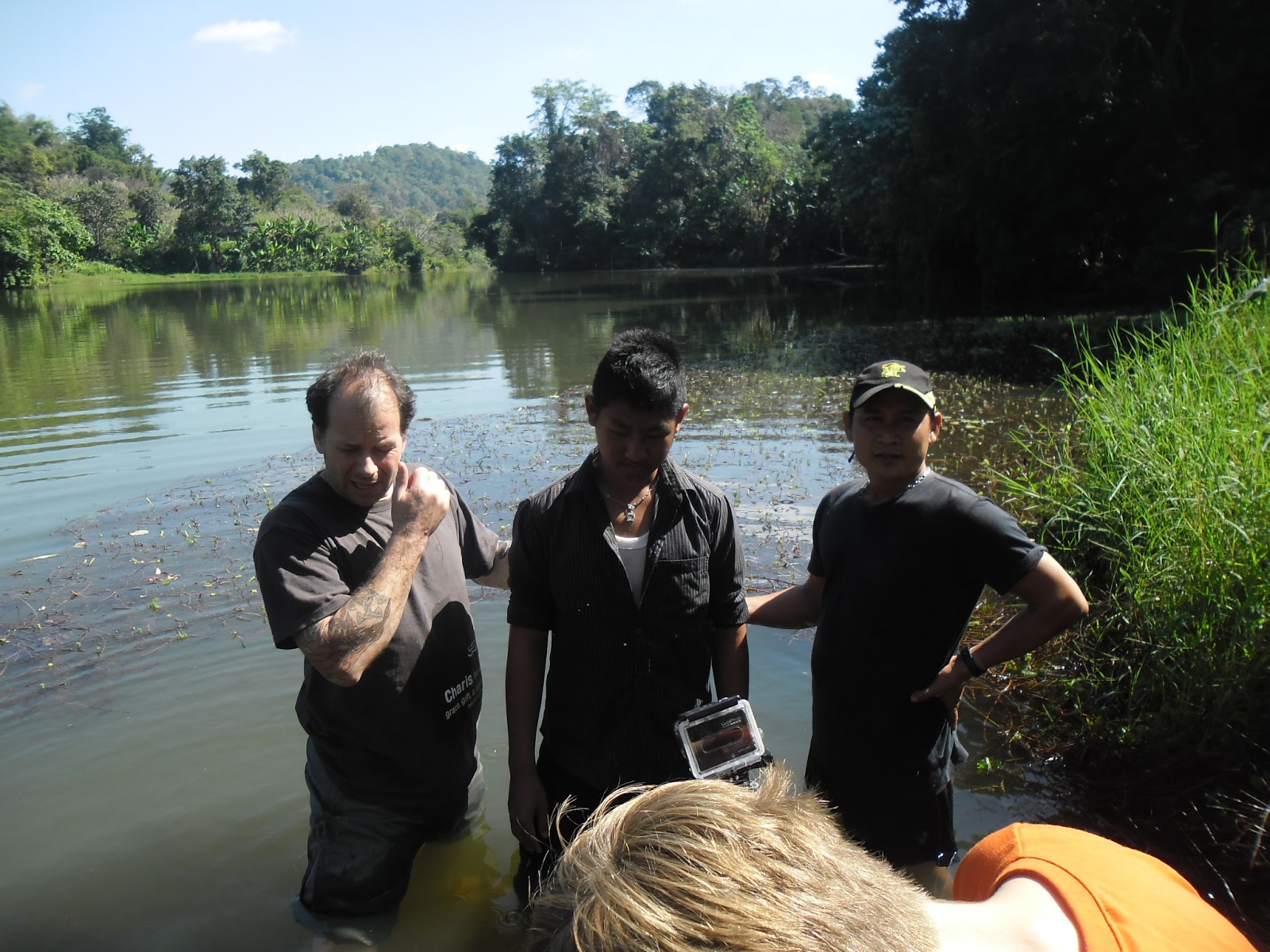


When there, I said that baptism is a public declaration of a person's commitment to be a disciple of Jesus. I commented that different Christian traditions may have a process that leads up to baptism but I will just ask two questions and if you agree to them then I will go ahead and baptize you.


Then with each of the people I asked, "Do you choose today to be a disciple of Jesus for the rest of your life?" Then, "Do you commit to obey his commands and to work for the growth of his kingdom in this world from this day forward?" When they said "yes" to these questions I and Judah then dunked them in the water saying, "I baptize you in the name of the Father, in the name of the Son, and in the name of the Holy Spirit." When they came back up I hugged them and said, "Welcome to the community of disciples."


There has been much ink spilled and blood shed in this topic. I tend to take differences in how one does baptism to come down more to style than substance. As with marriage, it is what you do with it that imbues it with it's lasting meaning and significance.
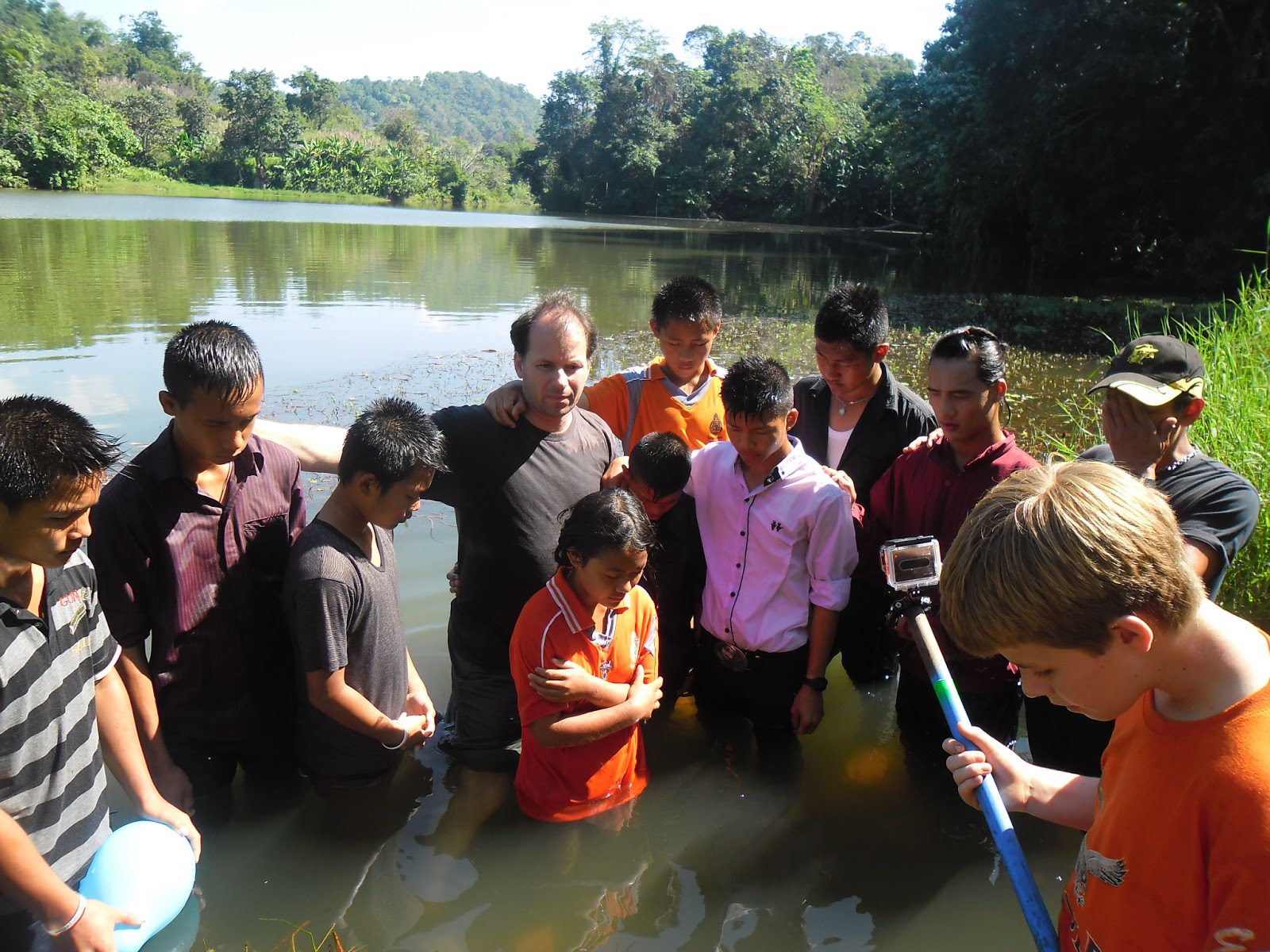
What has been your experience of baptism?

Sunday, January 6, 2013

The Jungle House Of God


There is a picture I tell when I am speaking in the rural areas of Thailand, working with The Charis Project, that I have brought back to tell on the US side. I tell it to my children enough that they roll their eyes at me when I start to tell them again. But I will tell them again because I want the picture built deep into how they see the world, I want it to form part of the architecture that makes up the stories in which they live.

In the rural areas of Thailand, as in many areas of the world that are prone to heavy rainfall and possibly flooding, the people build their houses on poles set in the ground. They will lay out the shape of the house and dig holes and set hardwood poles in those holes and fill them back in. Then, at a  height off the ground that will keep the floor out of flooding water, they will attach some manner of timbers, maybe wood or maybe bamboo to those poles as the floor supports. Then, higher up at the top, they attach the timbers that make up the roof structure. On the roof structure goes leaves, or plastic, or metal, depending on how much money they have. And on the floor timbers goes the floor of woven bamboo or wood planks. The walls too, between the floor and roof will be made out of woven bamboo or wood planks.

Now, if you cut at one of the poles with a knife or axe or whatever it will become weaker, the cuts will give purchase for mold and termites and eventually the pole will fail. It will fall down and it will not be alone. That pole was holding up part of the house, part of the same house that the other poles are holding up. All of the poles are attached to each other by the house that they are each built together into. When one pole fails it pulls on all the others. If others have also been weakened then they could collapse as well. So cutting at one of the poles puts the whole house in danger.


On the other hand, if you build up that same pole, if your shore it and add strapping and bind additional poles to it it will become stronger. If you coat it with oil treatments rot and termites will not be able to get at it. That pole will become stronger and stronger. When that pole is strengthened it is more able support the weight of other poles if they get damaged and be more resilient to damage itself as well, also as that pole gets stronger it is able to hold more weight, it can hold up a larger structure so the house can be built larger.

building up the pillars
A family, or a community, or a church is like one of these houses. Each person is like one of the poles.

When we criticize or scold or judge one another or gossip or do any such things it is like taking a knife and cutting at one of the other poles holding the house up. The more we cut at the other person the weaker and more susceptible to further damage they become. When we do this we are actively contributing to the destruction of the house, the house that we are built into. Doing such things damages the other's ability to support us when we get damaged.

However, if we build up each of the people around us they get stronger. Encouragement, blessing, holding the sideways tongue and replacing it with speaking good words of truth and actions of support, these things strengthen and shore up and defend the other pillars. Such actions make the house all together stronger. When you get damaged the other pillars will be able to hold you up and they will be far more resistant to damage themselves.

Extend this out. As we all keep building up and strengthening all the other pillars the whole house gets stronger and can grow bigger and bigger until this house of God is big enough to shelter and protect the whole world.

One more thing, this is grace. Grace is not letting people slide, grace is building people up in the power of the redemption.

Now, how can I make a pillar stronger today?

Monday, November 5, 2012

This Boss Idea Is Kind Of A Load Of Crap

This post follows on two previous musings on gender, one more on the ladies the other more on the dudes. Here I get more onto my deeper views on the discussion and kind of what underlies my approach in the other two posts.

In Christian circles there are two main camps in the understanding of gender relations.

Complementarian: equal but different
Egalitarian: equal but equal

COMP holds that men and women are equal in human value but that men are the ones who are designed and suited to be the boss. EG holds that women are suited to be the boss just as much as men. With both positions "boss" means the person who gets to tell the other people what to do.

Both positions assume a hierarchical power structure: someone needs to be the boss of someone.

A COMP defense of a hierarchical power structure is just as problematic as an EG addendum to a hierarchical power structure and the problem does not lie in the COMP or EG position. Rather the problem lies in the accepted hierarchical power structure.

What is the problem with hierarchy? On the plus side, it is an effective system for accomplishing our goals. How could we run businesses or churches without a well specified chain of command? How could we get people to give money and time and energy to our goals unless there was someone in charge telling them to do it?

Another benefit of hierarchy is for the people who are not at the top. It enables well structured organizations where each person knows their place and can relatively easily know what they are supposed to do: it allows an efficient way to cover your own ass. Without a well structured hierarchy people would have to take full responsibility for themselves rather that do what they are told.

The major problem with hierarchy is that it has nothing to do with the Kingdom of God.

When I was at seminary I attended a theological conference in which one of the presenters defended hierarchical structures based on analogy with the Trinity: the Father is the boss and the Son and Spirit do what the Father says, therefore there is a distinct chain of command within the godhead. Your humble servant then asked an impertinent question, "If we are going to establish a hierarchy within the Trinity would it not have to be flowing in a different direction? Jesus clearly teaches that the greatest is the servant. Therefore, the Spirit would be the greatest since he serves the Son and the Father and Jesus would be the #2 because he serves the Father. So by Jesus teaching, if the Trinity is a hierarchy then the Father is the least of the three." That presenter did a good job of quickly changing the subject and returning to the floor for another question. (Incidentally, other presenters came up to me afterward to shake my hand and thank me for the question.)
Byzantine mosaic of Christ washing the disciples' feet at the Monreale Cathedral. Public Domain.
Essentially, if we are to defend hierarchy from the trinity then we need to destroy the unity of the trinity and claim that the analogy comes before the ethics proclaimed by the Son (in obedience to the Father.) Moreover that those proclaimed ethics do not have their origin from within God and so are inconsistent with the ethical commands to imitate God. To my mind it makes much more sense to lose a defense of hierarchy.

The consistent teaching of Jesus links authority and greatness to service. And it runs in the direction of service yields the other two rather than the other two imply service. By this model the one in charge is the one who serves most and best rather than the one who gives the orders.

But hey, that is the way that the world works, there are bosses, someone needs to tell the other people what to do.

Well…….

First, is that supposed to be a defense of the system? If our systems are inconsistent with the Kingdom of God, what does that say about the system? Moreover, what does that say about our relationship to that system? Should our response be to capitulate or to transform? Even implicit acceptance of a problematic system ratifies that system. At the very least our responsibility is to be entirely clear that the system is inconsistent with the Kingdom. ENTIRELY CLEAR.

Second, that may be the way the world works. You may even find yourself in a "boss" position within a hierarchical system. It is now your responsibility to earn that position by truly serving, at least to the level that would make that position legitimate. That is, it is upon you to serve those that the system has placed under you. It is your responsibility to place them above you by your service to them.

Third, if the Church needs the hierarchy to get the people to do what needs to be done to maintain the Church then what does that say about the Church? Does the Church so constituted deserve to be called the Body of Christ?

So, ought we to debate whether women should be allowed to be "bosses"? Or could our time be better spent devising and implementing strategies of redemption that change the structure?

Monday, April 2, 2012

Going Hammer-Time On That Last Post

One of my friends requested that I rewrite "Theology Is A Deliverance Ministry" twice so that he can be sure of what I am saying. He is a lit professor so I will obey. I will rewrite in different formats and possibly even genres if only to work my skills.


In this first rewrite I will break it down:

God did not complete the creation.
The creation is yet to a significant degree subject to chaos and futility (formless and void).
God intends that creation be completed.
God created humans to complete the creation.
God truly loves the humans.
God put his life into humans so that they would be able to complete the creation.
Humans disobeyed God.
God forgives the humans for their disobedience.
The humans' disobedience broke them from the life of God.
 Without this life the humans are unable to complete the creation.

God intends that creation be completed.
The world exists as concrete time and space.
The forgiveness of God must come concretely into time and space to take effect in this world.
Jesus is the concrete expression of God's forgiveness in time and space.
As God takes on humanity in Jesus humanity is taken into God.
In the life, death, resurrection, and ascension of Jesus God effects his forgiveness on humanity.
The proof of this forgiveness is the return of the life of God into the humans.
Redemption is the action of this forgiveness taking full root in humanity.
Though the forgiveness has been made concrete the redemption is yet to be fulfilled in space and time.

Humans are complex entities.
The overtaking of this complexity by redemption involves the totality of this complexity.
As the redemption overtakes us we progressively become more aware and active in our participation in the reason for which we were created.
Our thoughts and beliefs are part of this complexity.
When our thoughts and beliefs are inconsistent with reality they require energy to maintain.
The greater our thoughts and beliefs diverge from reality the more energy they take to maintain.
Theology and evangelism are means by which our thoughts and beliefs come more into line with reality.
Theology and evangelism deliver us from ideas and beliefs that take up energy to maintain.
As these tools of redemption have their effect our energies are released to be focused on the completion of creation once again in obedience to God by the life of God in us.

We proclaim the good news because Jesus tells us to proclaim the good news.
We proclaim the good news because doing so moves redemption forward in the concrete time and space of this world.
We proclaim the good news so that the whole of humanity that has been taken up into God by the incarnation may become fully self aware as the body of Christ.
We proclaim the good news because the workers are few and the harvest is great, as great as the whole of creation.

Stop, hammer-time.

Sunday, April 1, 2012

Theology Is A Deliverance Ministry

Being Christian does not get you into heaven. That is not the point of Christianity. At least it wasn't until Christianity lost it's way and needed a punishment/reward system to compensate for it's waning focus on the centrality of Jesus' work of effecting the forgiveness of God in the concrete history of the world that reinstated humanity as the very presence of God by the indwelling of the Spirit of God and the participating instruments of God's plan to bring the creation to completion (see here) (also, the length of this sentence is a tribute to my partial German heritage).

The work of Jesus is universal in scope for all things are in him.

Yet this complete salvation is incomplete. This universality of salvation is in principle. Just as the forgiveness of God has been an in principle reality from the first instance of disobedience. Though God's forgiveness has always been there it still needed to have its concrete establishment in the actual history of the world for it to take effect in the world. In the same way, the universality of this forgiveness and redemption must work out into the actual dirt and blood of history. Though in the incarnation all of humanity has been drawn into the life, death, resurrection, and ascension of Jesus and been opened to the life of the Spirit this reality has yet to actually overcome the futility and chaos that pervade the concrete reality of history.

This points to the purpose of theology and evangelism.

Evangelism is the wider end of theology. Where theology deals with the fine grains, evangelism interacts on the level of large chunks but they are on the same continuum. They are both addressing the actual structure of reality.

If redemption is universal then why theologize or evangelize? If what we think and believe has nothing to do with our ultimate destiny then why concern ourselves with it? If "God Gets Everyone" then what is the point of working hard?

First, because Jesus tells us to proclaim the good news.

Second, because our ultimate destiny was never the issue. The issue has always been the fulfillment of creation, so the objection is really baseless in that it assumes a falsity.

Third, we proclaim the Gospel, we work hard to accurately grasp reality because our purpose is active participation in this plan of God for creation.

If our beliefs are inconsistent or are at odds with reality then we suffer cognitive dissonance. We must exert a tremendous amount of creative mental energy to hold together ideas and beliefs that do not fit.

Now, imagine how much God given creative energy would be freed up if we were delivered from false ideas. Energy that could then be directed toward our actual purpose in this world: our active participation in bringing the universal redemption enacted in principle in Jesus into the concrete blood and dirt of history.

Theology is a deliverance ministry. It releases the the children of God from the demonically onerous futility of screwy ideas.

Evangelism is the process by which the universal body of Christ becomes self-aware.

Wednesday, March 21, 2012

On Being the Body

This is a guest post from my brother Wayland. This is the same Wayland from the "On A Mission From God" post. I like his theology the most when he is ranting. I have posted this here with minor edits and his implicit permission.

You are a functioning member of the Body of Christ by wanting to be a member and acting on it. Thoughts without action are a disease and faith without works is dead. 

This has nothing to do with being saved, or not being saved. No one has enough faith to be saved because no one can do anything to be saved. I would submit that it is pointless to try and quantify such a thing. To admit anything into the discussion along the lines of something we should do to be saved is to lose sight of grace.

What I am talking about is the process of actually being the Body, which, unlike salvation, requires something on our part. Specifically, up to and including sacrificing everything to accomplish the work set before us, just like Jesus sacrificed everything to save the world. This is all to say that, in my view, salvation and being the Body are two different things.

Jesus descended into death to atone for the sins of the world, which to my understanding means everyone.

Being the Body on the other hand seems to include a lot more than salvation, especially when you consider that there is no suffering and no death and no poverty and no corruption and no prostitution and no exploitation and no murder and no war and no homeless people and no drug addiction and no financial collapse and no global heroin trade and no HIV and no manic depression and no religious violence and no orphans and no child soldiers, etc, etc, etc, in the Kingdom of Heaven. Now when we take into account that, as the Body, we are the representation of the Kingdom of Heaven, it follows that there is a lot of work to be done.

Thinking about these things and not doing anything about them is a disease. Having faith that they will change and not actually working to change them is dead.

If you have faith the size of a grain of sand, you can move mountains. Again though, I say that faith is not something that should be quantified. I would actually liken it to salvation. Something you step into. You know what is right and what the leading of the Spirit is and....... you act on it. This is what I mean by faith. This is what the Body does. This is what being a member of it constitutes.
Related Posts Plugin for WordPress, Blogger...