Showing posts with label Discipleship. Show all posts

Wednesday, November 5, 2014

Is That Biblical?

Photo Credit: this photo is from the cited article

First, read this:

http://www.missionfrontiers.org/issue/article/god-of-the-thai

I live in Thailand working with The Charis Project. So I am part of some of the missionary discussions around this article and the parallel discussions about different evangelism strategies. There has been some profound backlash in some circles. Accusations of syncretism, departure from Biblical truth, etc. Here is one comment:

Very disappointing read!!!! The author's mindset would be comparable to saying the reason all the Ninevites repented is because Jonah crafted his message to fit the culture of Ninevah. Come on, I am all for contextualization but let's think a little more Biblically and Theo-centric.

Now there are many problems with this comment but I am not about to address them here. I cite it here because it is demonstrative of a particular method of assessment that I disagree with.

From the discussions I have seen, I believe that the commenter is saying that the evangelism method that the author of the article is advocating is not Bible-centered because it is not centered on the Bible as the ultimate truth to which all other cultures are opposed and so Christianity must be preached using only explicitly Bible words and images and cultural practices. Moreover, it seems that he does this entirely neglecting that the Bible is a highly encultured collection of books and that it was not written in English or to English idiom and that he has already reenculturated it from it's original context into a Protestant and western reading.

It seems to me that the Bible gives precedent for exactly the sort of evangelism the article speaks of. This is what Paul did in Athens. The difference appears to be that where Paul’s attempt failed the same style of evangelism is succeeding in Thailand. Moreover I believe that evangelism is about growing the body of Christ rather than forming people after he image of Western Christendom.

To me, a far more important point is the way we assess the method of evangelism advocated by the author of the article.

I advocate giving a priority to a reading of scripture whereby we learn from the methodologies recorded as spirit led. This means that we would look to scripture to get a grip on how those who it records as being led by the Spirit went about coming to the conclusions they came to and then treat it as a training manual for us to learn the same methodologies.

With this in mind we should look at the first council of Jerusalem recorded in Acts as a case study. Here we have in scripture a record of Spirit led assessment of mission. The issue at hand was fundamental to the young Church’s doctrine of salvation: could Gentiles be included in Jesus’ reconstitution of Israel in himself as Gentiles or did they have to become Jews in order to be included? Remember, at this time there were no Christians. The followers of Jesus were a Jewish sect and to them the following of Jesus and his whole reconstitution of Israel project was strictly a Jewish happening. And then Peter goes and preaches to Cornelius’ household. And the Spirit comes. On Gentiles. While they were still Gentiles. This presented a problem since to them this Jesus thing was Jewish. Thus the council. So what did they do? They listened to the testimony of a credible witness about the event. From this they concluded that since the Spirit came on Gentiles the same as the Spirit came on Jews God didn’t seem to hold the same doctrine that they did. Because of this they shifted their doctrine and recognized that Gentiles could very well be members of Jesus as Gentiles. Now this is very important. In technical terms they let experiential pneumatology take precedence over soteriology. The observation of the outbreaking of the Kingdom of God trumped their doctrine of salvation.

This scriptural case study seems to me to directly bear on the testimony of the author of this article. To be in keeping with apostolic methodology we should look at the testimony and be ready to have our preconceived doctrines of how God is supposed to work trumped by the outbreaking of the Kingdom. And, we in fact find exactly this outbreaking in the Thai communities the author speaks of. Our Biblical response then is to recognize the effectiveness of the method of evangelism as taking ground against the futility and chaos of this world and to accept these Thai people following Jesus in their Thai way as our brothers and sisters in Jesus.

An admittedly not so charitable question that comes up in my mind is whether those who oppose the evangelism witnessed to in the article have a sufficient working knowledge of the Spirit of the living God to be able to recognize him when he shows up where they did not expect to see him?

As a post script, I wonder how this apostolic methodology would work in the debate over the place of LGBT folks in the Kingdom? But, I will leave that question to those of you for whom this is already an active discussion.

(Side point on the article: in discussion with some of my Thai pastor friends it appears that the historical background that the author cites as the basis of the difficulty really isn't an issue as even though they are highly educated they knew nothing about that religious/political conflict. From their perspective that historical background is a non-issue.)

Tuesday, April 8, 2014

What Are We Going To Do Tonight, Brain?

In 1999 I met Jeff Hammond. My brother, Emmet, and I had traveled to Indonesia to “research ministry opportunities and help out however we could.” Some friends in Australia had introduced us to Jeff and encouraged us to connect when we got to Jakarta. So, some flights and busses and taxis and emails and phone calls later we sat in a restaurant in a “suburb” of Jakarta with Jeff and his wife Annette. After a few pleasantries “the question” came up as it always does when expats and missionaries and such meet overseas.

“So, Jeff, what are you up to?”

“Taking over the world.”

No hyperbole, no humor, no arrogance, just completely serious. On the day-to-day Jeff was working throughout Indonesia building unity among the different denominations at the local level with a concentration on grace, prayer, and signs and wonders. But this was a stepping-stone toward the real goal of “taking over the world.”

Hearing this man say this set me free. Anything less than total global domination became too small of a strategic goal. This attitude integrated nicely with my developing kingdom theology and open, progressive, quasi-universalist eschatology along with my burgeoning rejection of the neo-platonic underpinnings of some of dominant Christianity’s beloved doctrines.


Let me tell you a story.

At the beginning God brought this world into being. He did this because he thought it would be worth doing. He formed and sculpted the world doing, by his standards, a good job of it all along the process. Till at one point he said, “Yah, that’s pretty good I reckon. I am about done with working on it from the outside. I will now get in there and finish the work.” So God made humans to be his own idol of himself, to be his very presence in the world and put his life and power into them so that he could finish what he started through them. To have them go out and subdue the earth, to finish forming the formless and filling the void.

A significant problem developed when the humans set up an abstract system of rules about fairness over against mere direct obedience to God. They obeyed the rules as if the rules were God. So, to protect the as yet unfinished world from accelerated damage, God removed his life and power from them and the “complete the world” project went on hold. The whole earth has been groaning for that life and power to return so that it could finally be completed and actually get started with its real story.

For thousands of years God worked to disabuse the humans of their infatuation with law and judgment and to retune them to grace and obedience. Finally he put his own image back in the world again to decisively and concretely enact his own obedience and grace in the history of the world. The result being that the presence and power came again into those humans who accepted that grace and obedience and finally the stalled completion of the world got back on track.

We now work in grace and obedience for the fullness of creation. Not bound by law and judgment but filled with the life and power of God to complete what God has begun.

Now, a consistent problem with all theology is that it is problematic. Every way of telling has it’s problem verses. What I like about this story is that it provides a robust explanatory matrix that significantly shifts perspective on a number of historically intractable problems ranging from the problem of evil to foundations for evangelism given the universal grace of God to the paradox of continuity/discontinuity in the movement from “Old” to “New” covenants. But what really gets me about this story is that it is truly and deeply beautiful. The other thing is that it provides an organic impetus (nearly as a categorical imperative) for “mission.” We all know that mission is important but we seem to be at pains to say why in a way that doesn’t continue to feel like it is tacked on rather than absolutely fundamental to our very existence. In this story salvation and mission and calling and existence are absolutely inextricable. We as humans exist to be the very presence of God in the world to complete the creation that is still “under construction” and in Jesus we have been reinstated as that presence to fulfill that calling and re-empowered to live the mission to all the world.

In this telling, evangelism and discipleship cannot separate. Rather, our fundamental human purpose dictates that all our life, including our human interactions drive toward the completion of creation. When It comes to other humans we work to empower more competent world builders. From this perspective evangelism and discipleship are exactly the same thing. So we go out and preach the gospel in all things because that is what Jesus commanded us to do and also because the gospel is the power of God, living and active, the salvation and freedom and empowerment to competently and consciously participate as wholly engaged and alive humans, integrated images of God, ushering in the New Heavens and New Earth, the completion of this world.

We have been given the honor and the responsibility of materially participating in and contributing to the completion of creation. I want to see what happens when the creation is complete and the real story gets rolling. I look forward to the resurrection so that I can get in on that story. I work now to invite and equip as many as I possibly can as well as I possibly can to be world creators, like our Father, together with me. I work now to hone my skill as a craftsman in the likeness of Jesus working by obedience and grace and cunning strategies as one called to participate in completing this world.

I work with a development organization. We work at the intersection of care for at-risk children and community development. We are not street corner witnessers, however we do not hide the one who we serve. We are working through trial and error and (hopefully) the inspiration of the Spirit to develop structures of human interaction that are self reinforcing and that produce ever increasing positive externalities. We are working on food security because there are no hungry people in the Kingdom of God. We are working on solving problems of abuse because there is no abuse and are no victims in the Kingdom of God. We are working primarily with children because it is more effective to shift a social structure by shifting those who are coming into it than to attempt to shift those who have a vested interest in the status quo, this is not a “burden” or “calling,” it is goal-oriented pragmatism.

Now, 15 years after I met Jeff, I am working with an organization whose marketing talks about “sustainability through entrepreneurism,” “deinstitutionalization of orphan care,” and “deployable models of effective development.” Bullshit NGO/UN terms that I hate but that are helpful to both indicate and obfuscate that what we are really about is executing a legit plan to achieve total global domination. Like Jeff, we are not kidding. Like Jeff, we are not overstating our goals. Like Jeff, we are not boasting. This is a weight and a responsibility that is only achievable at the intersection of the full grace of God and the intense and sustained effort of people. Our true success is measured by our participation in manifesting the fullness of the Kingdom of God, by how well we participate in God’s work to complete the creation.


You can do much worse with your life than to try to tell a beautiful story.

Sunday, January 13, 2013

Why Preach A Principle?

Jesus preached himself as the content of the gospel--a person, a presence. Why do Christians preach a system or an ethic or a principle? Why is it that we find the dynamic freedom of living that presence so abhorrent?

Maybe it is because the person isn't in your face anymore. Maybe it isn't abhorrence, more like simple common sense...dude isn't standing there. Maybe the real abhorrence comes from people telling you to "follow the phantom." What might be missing is the "system" that teaches one how to believe in a presence--a person who once drank wine with you but now only does it "in spirit."

On the contrary, we have no lack of capacity to believe in presences, the thing is we prefer to reify fictitious phantoms. We find it completely natural to believe that the little green pieces of paper we (may or may not) have in our pockets actually have real value (this, even in the face of inflation and threatened market collapse.) There is not now nor has there ever been anything underdeveloped in the human ability to believe in phantoms, whether it be creationism or evolutionism, causation or the demonic consciousness present in plumbing, the State or grandpa's ghost or progress. However, what I am talking about is an experiential power rather than a spiritualization of demands. I would go as far as to say that either the Holy Spirit is a real, effective power and presence in and through us or Christianity is false and moreover a waste of time and energy.

Why do we so deeply fear the uncertainty of living the presence of Jesus in the deep complexity of the world and instead cower in the false refuge of ethical principles and semi-baptized political or economic programs?


More importantly, how do we become accustomed to, I think that getting comfortable with is a ridiculous hope, living the dynamic freedom of the active embodiment of the presence of Jesus? It goes way beyond what is usually meant when we are urged to step outside our comfort zone. It is actively living without a roadmap, without a system to depend on to tell us what is the right thing to do or to use to judge others. It is living along a completely different tangent than the flow of the world.

Tuesday, January 8, 2013

Baptism Isn't Magic

The issue of baptism occasionally comes up in several different groups I associate with, from academic theological discussion groups to Christians who have no clue what baptism is about to non-Christians who have no clue what baptism is.

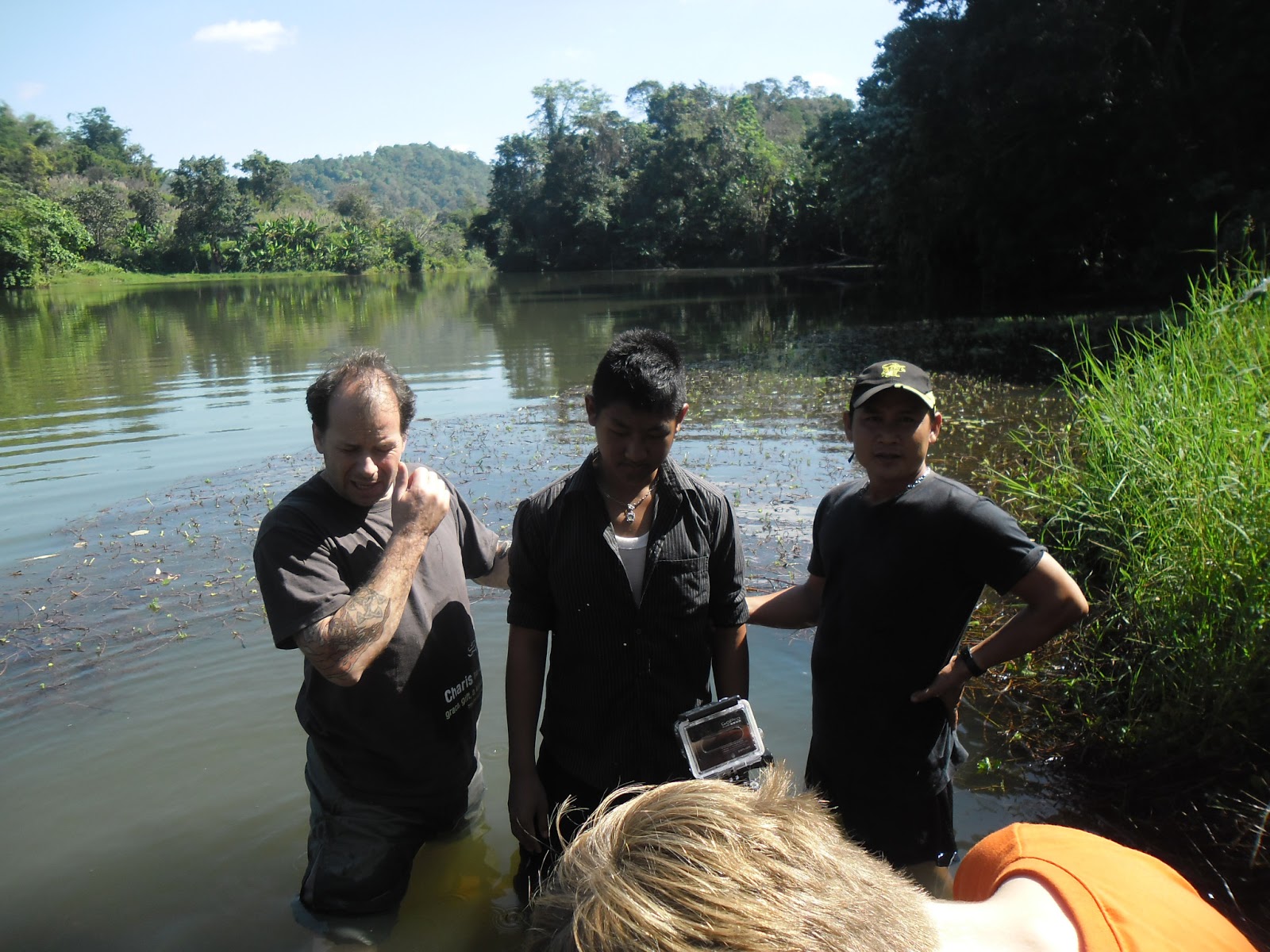
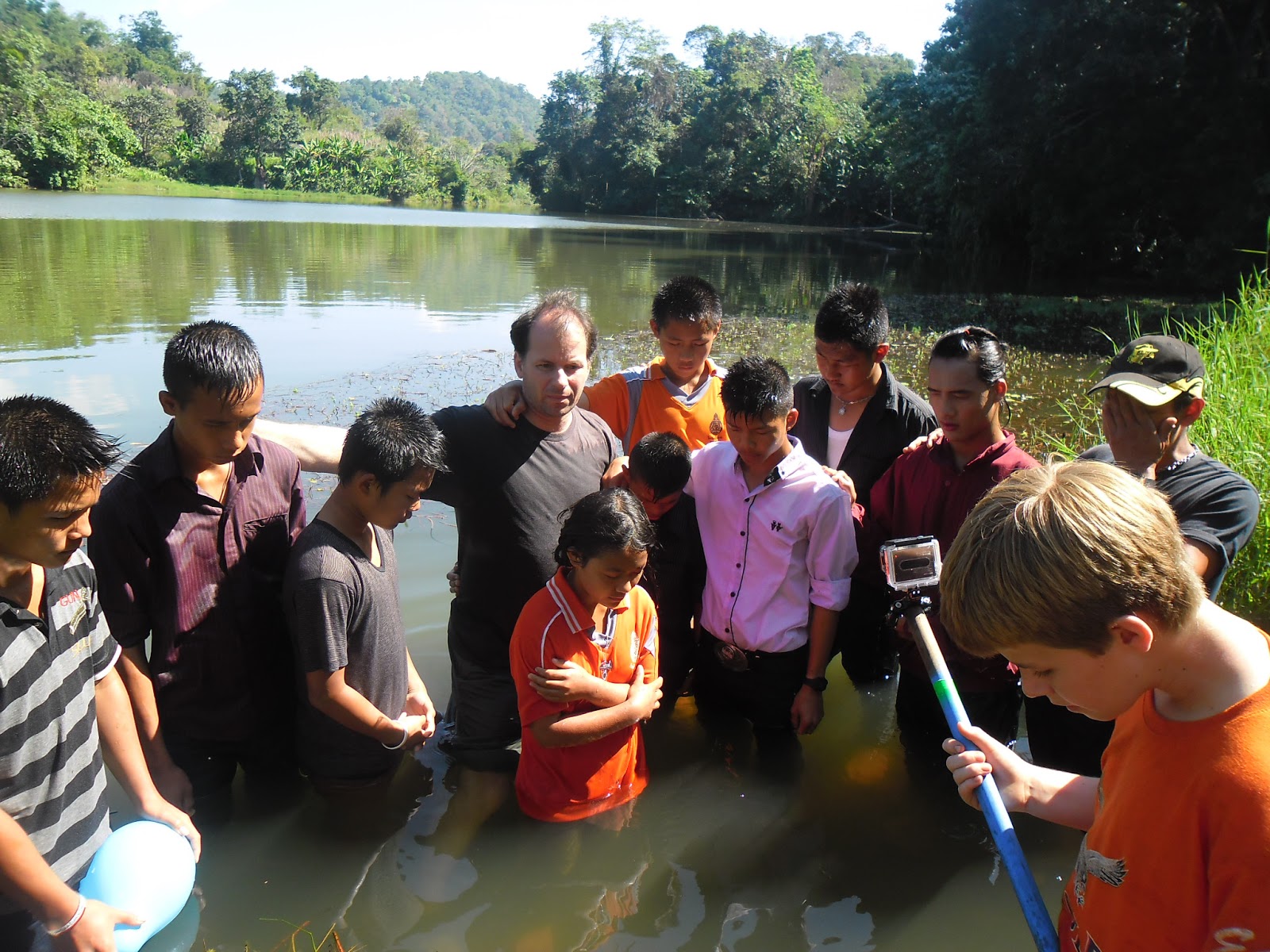
Well here is how I explained it and then did it on my recent visit to Ban Saeng Sawan with The Charis Project.

Now, I don't push baptism. If people ask I respond. I don't push it because I have not yet been in a position where that seemed the right thing to do. I may some time find myself in such a situation and will cross that bridge when I get to it. When I was with my friends up in the hills in Thailand, Judah, the lead guy at the children's home we manage, notified me that there were a number of the kids and one guy from the village who wanted to be baptized and that they wanted me to do it.

So we talked about it for a bit. I started off by saying that there are a lot of different understandings of what baptism is. Many Christians think many different things about it, but this is what I think.

Historically, Christian baptism comes from the Hebrew practice of baptism which was a mixture of ceremonial washing and a reenactment and recapitulation of Israel's passage through the Red Sea in the Exodus, the event in which Israel was transformed from the family of Abraham into the nation of the people of God. In Christian baptism a person is participating in the cleansing redemptive work of Jesus and is going through the "naturalization" process into citizenship in the "people of God." (I take this "people of God" to be a functional designation rather than a designation of status, that is, it is an entry into responsibility rather than into a position of special standing.)

I said that it is a public declaration of solidarity with all the others who have been baptized.

I also said that baptism is not magic. It is not the sort of thing that if you do it wrong, you mispronounce the incantation, you perform the act incorrectly (maybe the water is the wrong sort or or you did it at an age that someone thinks is wrong or whatever), or the wrong person does it, it will not work. It is the one baptism of Jesus that we participate in however we are able.

Then we went out to the lake.


When there, I said that baptism is a public declaration of a person's commitment to be a disciple of Jesus. I commented that different Christian traditions may have a process that leads up to baptism but I will just ask two questions and if you agree to them then I will go ahead and baptize you.


Then with each of the people I asked, "Do you choose today to be a disciple of Jesus for the rest of your life?" Then, "Do you commit to obey his commands and to work for the growth of his kingdom in this world from this day forward?" When they said "yes" to these questions I and Judah then dunked them in the water saying, "I baptize you in the name of the Father, in the name of the Son, and in the name of the Holy Spirit." When they came back up I hugged them and said, "Welcome to the community of disciples."


There has been much ink spilled and blood shed in this topic. I tend to take differences in how one does baptism to come down more to style than substance. As with marriage, it is what you do with it that imbues it with it's lasting meaning and significance.

What has been your experience of baptism?
Related Posts Plugin for WordPress, Blogger...