Jesus preached himself as the content of the gospel--a person, a presence. Why do Christians preach a system or an ethic or a principle? Why is it that we find the dynamic freedom of living that presence so abhorrent?
Maybe it is because the person isn't in your face anymore. Maybe it isn't abhorrence, more like simple common sense...dude isn't standing there. Maybe the real abhorrence comes from people telling you to "follow the phantom." What might be missing is the "system" that teaches one how to believe in a presence--a person who once drank wine with you but now only does it "in spirit."
On the contrary, we have no lack of capacity to believe in presences, the thing is we prefer to reify fictitious phantoms. We find it completely natural to believe that the little green pieces of paper we (may or may not) have in our pockets actually have real value (this, even in the face of inflation and threatened market collapse.) There is not now nor has there ever been anything underdeveloped in the human ability to believe in phantoms, whether it be creationism or evolutionism, causation or the demonic consciousness present in plumbing, the State or grandpa's ghost or progress. However, what I am talking about is an experiential power rather than a spiritualization of demands. I would go as far as to say that either the Holy Spirit is a real, effective power and presence in and through us or Christianity is false and moreover a waste of time and energy.
Why do we so deeply fear the uncertainty of living the presence of Jesus in the deep complexity of the world and instead cower in the false refuge of ethical principles and semi-baptized political or economic programs?
More importantly, how do we become accustomed to, I think that getting comfortable with is a ridiculous hope, living the dynamic freedom of the active embodiment of the presence of Jesus? It goes way beyond what is usually meant when we are urged to step outside our comfort zone. It is actively living without a roadmap, without a system to depend on to tell us what is the right thing to do or to use to judge others. It is living along a completely different tangent than the flow of the world.
Showing posts with label meaning of christianity. Show all posts
Sunday, January 13, 2013
Tuesday, January 8, 2013
Baptism Isn't Magic
The issue of baptism occasionally comes up in several different groups I associate with, from academic theological discussion groups to Christians who have no clue what baptism is about to non-Christians who have no clue what baptism is.
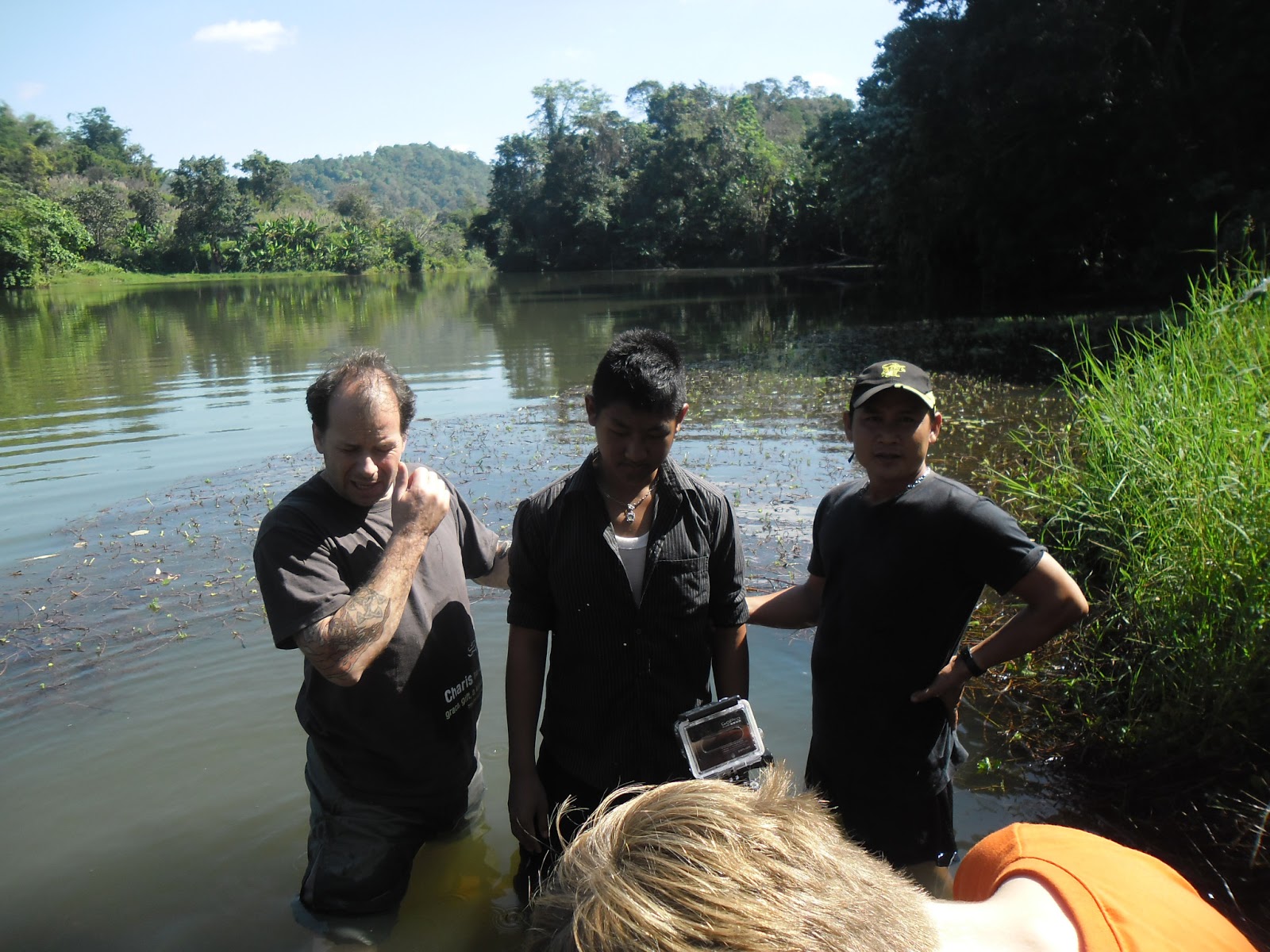
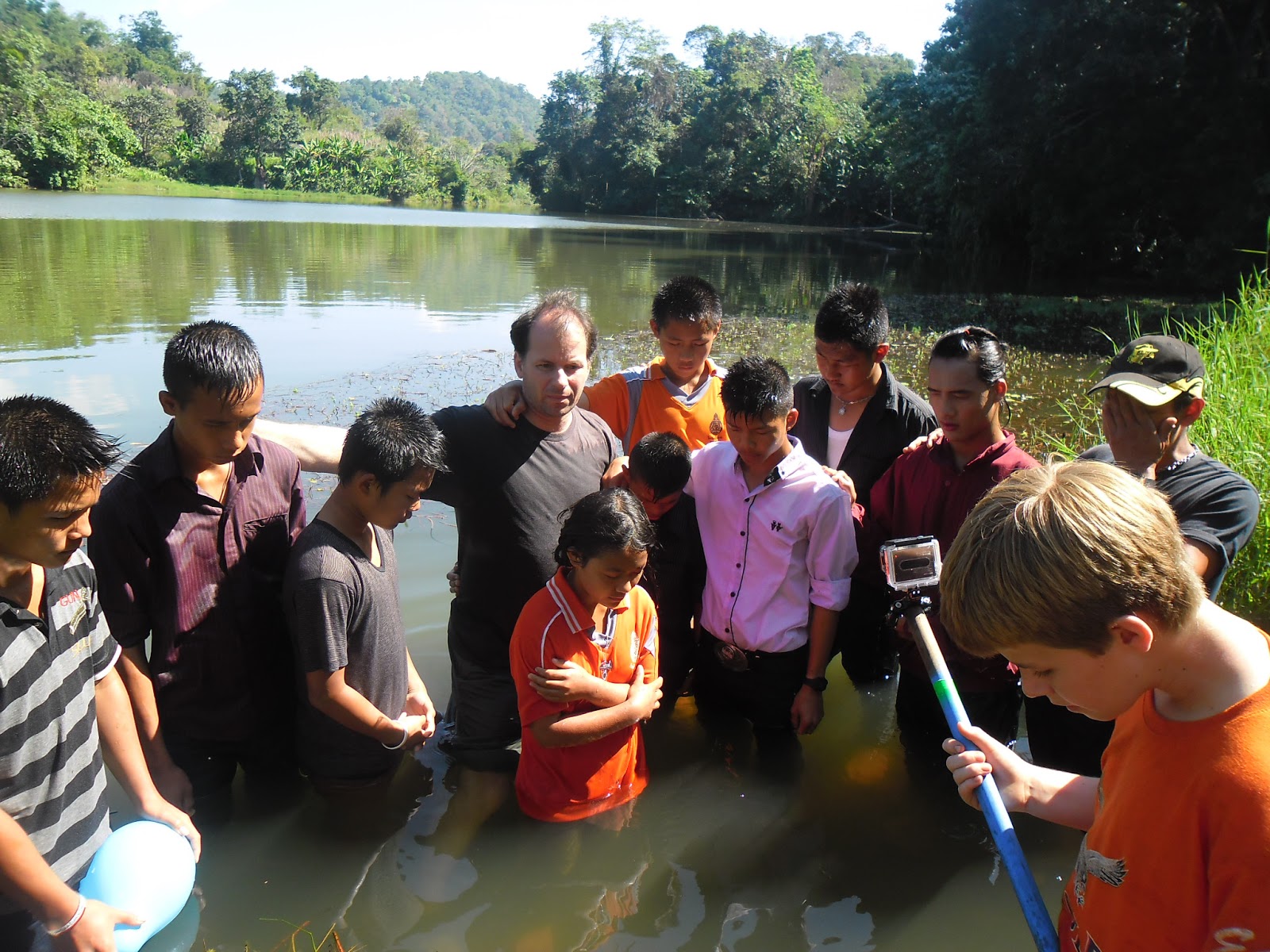
Well here is how I explained it and then did it on my recent visit to Ban Saeng Sawan with The Charis Project.
Now, I don't push baptism. If people ask I respond. I don't push it because I have not yet been in a position where that seemed the right thing to do. I may some time find myself in such a situation and will cross that bridge when I get to it. When I was with my friends up in the hills in Thailand, Judah, the lead guy at the children's home we manage, notified me that there were a number of the kids and one guy from the village who wanted to be baptized and that they wanted me to do it.
So we talked about it for a bit. I started off by saying that there are a lot of different understandings of what baptism is. Many Christians think many different things about it, but this is what I think.
Historically, Christian baptism comes from the Hebrew practice of baptism which was a mixture of ceremonial washing and a reenactment and recapitulation of Israel's passage through the Red Sea in the Exodus, the event in which Israel was transformed from the family of Abraham into the nation of the people of God. In Christian baptism a person is participating in the cleansing redemptive work of Jesus and is going through the "naturalization" process into citizenship in the "people of God." (I take this "people of God" to be a functional designation rather than a designation of status, that is, it is an entry into responsibility rather than into a position of special standing.)
I said that it is a public declaration of solidarity with all the others who have been baptized.
I also said that baptism is not magic. It is not the sort of thing that if you do it wrong, you mispronounce the incantation, you perform the act incorrectly (maybe the water is the wrong sort or or you did it at an age that someone thinks is wrong or whatever), or the wrong person does it, it will not work. It is the one baptism of Jesus that we participate in however we are able.
Then we went out to the lake.
When there, I said that baptism is a public declaration of a person's commitment to be a disciple of Jesus. I commented that different Christian traditions may have a process that leads up to baptism but I will just ask two questions and if you agree to them then I will go ahead and baptize you.
Then with each of the people I asked, "Do you choose today to be a disciple of Jesus for the rest of your life?" Then, "Do you commit to obey his commands and to work for the growth of his kingdom in this world from this day forward?" When they said "yes" to these questions I and Judah then dunked them in the water saying, "I baptize you in the name of the Father, in the name of the Son, and in the name of the Holy Spirit." When they came back up I hugged them and said, "Welcome to the community of disciples."
There has been much ink spilled and blood shed in this topic. I tend to take differences in how one does baptism to come down more to style than substance. As with marriage, it is what you do with it that imbues it with it's lasting meaning and significance.
What has been your experience of baptism?
Well here is how I explained it and then did it on my recent visit to Ban Saeng Sawan with The Charis Project.
Now, I don't push baptism. If people ask I respond. I don't push it because I have not yet been in a position where that seemed the right thing to do. I may some time find myself in such a situation and will cross that bridge when I get to it. When I was with my friends up in the hills in Thailand, Judah, the lead guy at the children's home we manage, notified me that there were a number of the kids and one guy from the village who wanted to be baptized and that they wanted me to do it.
So we talked about it for a bit. I started off by saying that there are a lot of different understandings of what baptism is. Many Christians think many different things about it, but this is what I think.
Historically, Christian baptism comes from the Hebrew practice of baptism which was a mixture of ceremonial washing and a reenactment and recapitulation of Israel's passage through the Red Sea in the Exodus, the event in which Israel was transformed from the family of Abraham into the nation of the people of God. In Christian baptism a person is participating in the cleansing redemptive work of Jesus and is going through the "naturalization" process into citizenship in the "people of God." (I take this "people of God" to be a functional designation rather than a designation of status, that is, it is an entry into responsibility rather than into a position of special standing.)
I said that it is a public declaration of solidarity with all the others who have been baptized.
I also said that baptism is not magic. It is not the sort of thing that if you do it wrong, you mispronounce the incantation, you perform the act incorrectly (maybe the water is the wrong sort or or you did it at an age that someone thinks is wrong or whatever), or the wrong person does it, it will not work. It is the one baptism of Jesus that we participate in however we are able.
Then we went out to the lake.
When there, I said that baptism is a public declaration of a person's commitment to be a disciple of Jesus. I commented that different Christian traditions may have a process that leads up to baptism but I will just ask two questions and if you agree to them then I will go ahead and baptize you.
Then with each of the people I asked, "Do you choose today to be a disciple of Jesus for the rest of your life?" Then, "Do you commit to obey his commands and to work for the growth of his kingdom in this world from this day forward?" When they said "yes" to these questions I and Judah then dunked them in the water saying, "I baptize you in the name of the Father, in the name of the Son, and in the name of the Holy Spirit." When they came back up I hugged them and said, "Welcome to the community of disciples."
There has been much ink spilled and blood shed in this topic. I tend to take differences in how one does baptism to come down more to style than substance. As with marriage, it is what you do with it that imbues it with it's lasting meaning and significance.
What has been your experience of baptism?
Friday, January 4, 2013
This Is What A Lay Up For A Major Slam Dunk Looks Like
I recently returned from Thailand working with The Charis Project. This is a major highlight from that trip that I recently shared on the Charis Blog. It is so Important to me that I need to share it here as well.
On our Face Book page a short while ago I said that it looked as though we were on a layup for a slam-dunk. This is what I was talking about.
We have been working with a group of people in Mae Sot for about a year. We have been moving slowly and working at getting to know each other and to understand how, and if, our visions intersect and how, and if, we will be able to work well together.
That work is ready to take the next step.
On this last trip we spent an extended period of time discussing in-depth where to move forward and they were already on-board with where we see going.
The de facto leader of the group is named Philip. His father-in-law led in founding a college for hill-tribe peoples and Philip worked there as a teacher. In fact he was one of Judah and Saeng Chen's* teachers when they went there.
This group in Mae Sot is already working responsibly to build up, support, and empower children of the Burmese migrant and refugee community in the area. They have very little in terms of resources aside from the income they themselves earn as laborers and they do not ask for handouts. Instead they have been envisioning businesses that they could start to do a better job of supporting the work they are doing with the children.They are educated, they are motivated, they are hard-working, and they have already begun to innovate.
They do not want to live on donations because they see begging, even for a very good cause, as a weakness that they would very much like to avoid.
They are about the perfect partners for the Charis Project. They are thrilled with our vision for integrating entrepreneurism and the care for at-risk children. They see that what we envision pushes beyond what they thought possible and are excited to bring this all together. They and we are becoming us.
They brought to our discussions two or three business ideas that they had already been thinking about and over the course of our conversations we together came up with half-a-dozen more workable business concepts.
Now, the step we are working on next, is to model, assess, and select the best of these concepts to move forward on, to invest in, and to launch as the financial and entrepreneurial-education foundation of the empowering work with the children living out in the teak plantations and bamboo thickets.
Obviously we are very excited and are chomping at the
bit to be on site to work directly with them as we launch this new
Charis Community and take what we learn here to feed back into the Doi
Muser home to build it up even further.
*Directors at the Doi Muser Home
On our Face Book page a short while ago I said that it looked as though we were on a layup for a slam-dunk. This is what I was talking about.
We have been working with a group of people in Mae Sot for about a year. We have been moving slowly and working at getting to know each other and to understand how, and if, our visions intersect and how, and if, we will be able to work well together.
That work is ready to take the next step.
On this last trip we spent an extended period of time discussing in-depth where to move forward and they were already on-board with where we see going.
The de facto leader of the group is named Philip. His father-in-law led in founding a college for hill-tribe peoples and Philip worked there as a teacher. In fact he was one of Judah and Saeng Chen's* teachers when they went there.
This group in Mae Sot is already working responsibly to build up, support, and empower children of the Burmese migrant and refugee community in the area. They have very little in terms of resources aside from the income they themselves earn as laborers and they do not ask for handouts. Instead they have been envisioning businesses that they could start to do a better job of supporting the work they are doing with the children.They are educated, they are motivated, they are hard-working, and they have already begun to innovate.
They do not want to live on donations because they see begging, even for a very good cause, as a weakness that they would very much like to avoid.
| Philip and I excited about our vision for moving forward in Mae Sot |
They are about the perfect partners for the Charis Project. They are thrilled with our vision for integrating entrepreneurism and the care for at-risk children. They see that what we envision pushes beyond what they thought possible and are excited to bring this all together. They and we are becoming us.
They brought to our discussions two or three business ideas that they had already been thinking about and over the course of our conversations we together came up with half-a-dozen more workable business concepts.
Now, the step we are working on next, is to model, assess, and select the best of these concepts to move forward on, to invest in, and to launch as the financial and entrepreneurial-education foundation of the empowering work with the children living out in the teak plantations and bamboo thickets.
| A few of the kids and another of the team members at Mae Sot |
*Directors at the Doi Muser Home
Friday, November 30, 2012
Mystical Union And Sneezing: A Brief Hermenutic Of Mysticism
Recently on a discussion thread I am involved in someone wondered about the difference between mysticism and prophecy. I started to reply but that reply quickly got out of hand. What follows is characteristically dense. Each paragraph could relatively simply be expanded into a chapter with full citations and completely fleshed out reasoning; something I may do sometime if I have nothing better going on. I here speak more about mysticism than prophecy because that was more pertinent in the discussion this came out of and not because I think that prophecy is a settled matter. Rather, there is a huge amount of goofy thinking about prophecy as well but it is of a different sort.
I should note that I define mysticism as a separate entity to contemplation. Contemplation treats an object, text, or activity Iconically. To treat something Iconically (that is in the same manner as the Eastern Christian tradition treats Icons) is to take that thing as pointing to something beyond itself rather than as an object taken in itself and to pursue or contemplate the thing beyond. Great value as well as great foolishness can come from this approach to things. Simultaneously, the same value and foolishness is manifestly true of the non-Iconic treatment of the same things.
Mysticism pursues union, the sense of being fully taken up, a sense of direct connection.
My deep thinking on this began when I was living in India and Nepal. Naturally I was exposed directly to a wide variety of traditions and understandings of reality. Something that caught my attention was the striking similarity in the form of experience described my the mystical branches of the various religious traditions. Hindu, Buddhist, Muslim, Jewish, Christian, all these traditions have mystical branches. Each use language and images from their conceptual universe to describe their mystical experience. But, they all describe an experience that involves a loss of distinct selfness where the practitioner feels as though their existence ceases to be distinctly separate from anything else in space or time, they feel as though they absorb into the infinite. Muslims will use Muslim words to describe the experience. Christians will use Christian words. Hindus will use Hindu words. And so on. But, they are all describing exactly the same experience.
I then found that I was not the first to observe this. I discovered that there have been many voices within the mystical paths of the various religions that have observed this striking similarity of experience across traditions and took that to indicate that all paths lead to the same place. They take the common mystical experience as evidence of the truly unified ultimate foundation all the religious traditions.
I became more curious about what this experience is. I noted the strong similarities of practices among the different traditions. Looking past what the traditions said their techniques meant they all had the same form. All the traditions engage in some collection of repetitive action, extreme treatment of the body, practices of focus/centering/meditation. I started to get familiar with the neuroscience research on mystical experience. There is quite a bit. What it shows is that the similar practices lead to the same effects in the brain. In particular they affect the sections of the brain that produce our sense of self. Either by deprivation or over-stimulation those sections of the brain lose the ability to clearly define our selfness to our consciousness. This results in the sense of release and union with something beyond our self. Mystical union is a brain state. It is a physical response to the techniques used my those earnestly seeking that experience just like a sneeze is a physical response to irritation in the nasal passage.
Some have linked the beliefs of the "all paths" school I just mentioned to this neurological research to say that all religion is a response to this brain-state. I don't think that this is the case, and dealing with this is not my purpose here.
What I find interesting is the way in which the mystical experience takes on meaning. The experience takes on the meaning attributed to it by the person working to achieve it. When a Christian engages in the mystic disciplines they are seeking a union with Christ. When they achieve the brain-state they experience it as union with Christ. When a Zen Buddhist achieves the same state they experience satori as that is the meaning they brought to it with them.
Now, it would appear that the experience itself can better be understood as an Icon. This would place mysticism as a sub-set of contemplation where the thing in itself is the brain-state and what is important or truly meaningful is the thing beyond that it is taken to point to. The difficulty is that the thing in itself is an internal physical state rather than a painting on a board so it is far more difficult to make the separation between it and the thing it points to. This is why the meaning brought to the experience has historically been conflated with the experience itself.
This conflation has given rise to theological problems in Christian mysticsm. There is a consistently Gnostic flavor to it. Thinking about it has been directed toward escaping the mundane physicality of this world to experience a more purely spiritual reality. This has significant theological problems. Primarily, we were created as bodies with Spirit put into us to make us alive and not as spirits trapped in bodies thus it denies the absolute goodness of our bodyness. It is a force that relativizes our presence in this world that we were created to live in and bring to completion. It takes away from the true experience of union with Christ through participation in his redeeming work in the blood and dirt of this world.
However, I do not reject the disciplines that lead to the brain-state. If for no other reason than that they are demonstrably therapeutic, bringing a calmness of mind, having beneficial effects on blood pressure, as well as on several other body systems. Moreover, when taken Iconically the experience can function as a deep heuristic for internalizing the reality of the union already established in the incarnation and of the full loving adoption by our Heavenly Father.
The difference between prophecy and mysticism is pretty clear to me. Prophecy is the concrete calling of the people of God to God by God with specificity. Mysticism is founded on a particular feeling of spatiotemporally disconnected floatyness that is produced by a specifically identifiable neuro-chemical brain-state that is caused by particular intentional practices. Prophecy must in itself have positive truth content, and must be effectively specific even if it is not entirely lucid. Mysticism is, strictly speaking, neither true nor false but is meaning-absorbing while prophecy is meaning-excreting. Mysticism takes on whatever meaning or content is given to it while prophecy looks you in the face with it's own meaning. While prophecy, if it is true, is always valuable, the value of mysticism lies in what we bring to it.
I should note that I define mysticism as a separate entity to contemplation. Contemplation treats an object, text, or activity Iconically. To treat something Iconically (that is in the same manner as the Eastern Christian tradition treats Icons) is to take that thing as pointing to something beyond itself rather than as an object taken in itself and to pursue or contemplate the thing beyond. Great value as well as great foolishness can come from this approach to things. Simultaneously, the same value and foolishness is manifestly true of the non-Iconic treatment of the same things.
Mysticism pursues union, the sense of being fully taken up, a sense of direct connection.
My deep thinking on this began when I was living in India and Nepal. Naturally I was exposed directly to a wide variety of traditions and understandings of reality. Something that caught my attention was the striking similarity in the form of experience described my the mystical branches of the various religious traditions. Hindu, Buddhist, Muslim, Jewish, Christian, all these traditions have mystical branches. Each use language and images from their conceptual universe to describe their mystical experience. But, they all describe an experience that involves a loss of distinct selfness where the practitioner feels as though their existence ceases to be distinctly separate from anything else in space or time, they feel as though they absorb into the infinite. Muslims will use Muslim words to describe the experience. Christians will use Christian words. Hindus will use Hindu words. And so on. But, they are all describing exactly the same experience.
I then found that I was not the first to observe this. I discovered that there have been many voices within the mystical paths of the various religions that have observed this striking similarity of experience across traditions and took that to indicate that all paths lead to the same place. They take the common mystical experience as evidence of the truly unified ultimate foundation all the religious traditions.
I became more curious about what this experience is. I noted the strong similarities of practices among the different traditions. Looking past what the traditions said their techniques meant they all had the same form. All the traditions engage in some collection of repetitive action, extreme treatment of the body, practices of focus/centering/meditation. I started to get familiar with the neuroscience research on mystical experience. There is quite a bit. What it shows is that the similar practices lead to the same effects in the brain. In particular they affect the sections of the brain that produce our sense of self. Either by deprivation or over-stimulation those sections of the brain lose the ability to clearly define our selfness to our consciousness. This results in the sense of release and union with something beyond our self. Mystical union is a brain state. It is a physical response to the techniques used my those earnestly seeking that experience just like a sneeze is a physical response to irritation in the nasal passage.
Some have linked the beliefs of the "all paths" school I just mentioned to this neurological research to say that all religion is a response to this brain-state. I don't think that this is the case, and dealing with this is not my purpose here.
What I find interesting is the way in which the mystical experience takes on meaning. The experience takes on the meaning attributed to it by the person working to achieve it. When a Christian engages in the mystic disciplines they are seeking a union with Christ. When they achieve the brain-state they experience it as union with Christ. When a Zen Buddhist achieves the same state they experience satori as that is the meaning they brought to it with them.
Now, it would appear that the experience itself can better be understood as an Icon. This would place mysticism as a sub-set of contemplation where the thing in itself is the brain-state and what is important or truly meaningful is the thing beyond that it is taken to point to. The difficulty is that the thing in itself is an internal physical state rather than a painting on a board so it is far more difficult to make the separation between it and the thing it points to. This is why the meaning brought to the experience has historically been conflated with the experience itself.
This conflation has given rise to theological problems in Christian mysticsm. There is a consistently Gnostic flavor to it. Thinking about it has been directed toward escaping the mundane physicality of this world to experience a more purely spiritual reality. This has significant theological problems. Primarily, we were created as bodies with Spirit put into us to make us alive and not as spirits trapped in bodies thus it denies the absolute goodness of our bodyness. It is a force that relativizes our presence in this world that we were created to live in and bring to completion. It takes away from the true experience of union with Christ through participation in his redeeming work in the blood and dirt of this world.
However, I do not reject the disciplines that lead to the brain-state. If for no other reason than that they are demonstrably therapeutic, bringing a calmness of mind, having beneficial effects on blood pressure, as well as on several other body systems. Moreover, when taken Iconically the experience can function as a deep heuristic for internalizing the reality of the union already established in the incarnation and of the full loving adoption by our Heavenly Father.
The difference between prophecy and mysticism is pretty clear to me. Prophecy is the concrete calling of the people of God to God by God with specificity. Mysticism is founded on a particular feeling of spatiotemporally disconnected floatyness that is produced by a specifically identifiable neuro-chemical brain-state that is caused by particular intentional practices. Prophecy must in itself have positive truth content, and must be effectively specific even if it is not entirely lucid. Mysticism is, strictly speaking, neither true nor false but is meaning-absorbing while prophecy is meaning-excreting. Mysticism takes on whatever meaning or content is given to it while prophecy looks you in the face with it's own meaning. While prophecy, if it is true, is always valuable, the value of mysticism lies in what we bring to it.
Monday, November 19, 2012
On My Father's Shoulders
I grew up saturated in the belief that the ultimate source of the universe is actively loving and that our highest notions of love reflect that ultimate source*. That is to say that God really loves us perfectly and his love is recognizable to us through our experience of it's reflection. Even more simply: God loves us completely in a way that makes sense to us.
My father did not grow up in this. Rather, he has had to fight for it. This fight has been most clear in his longstanding and often controversial teaching on the grace of God, speaking in defense of it for thousands of hours, all his writings, outworkings of defending the grace of God. The grace of God needs defending because it is and has been for much of history under attack.
To be more accurate, the grace of God does not need defense. It is quite secure in itself. Rather people are in need of being released from bondage to false notions of God that see him as vindictive, judgmental, irritable, distant, etc.
My father has worked at this for most of his life, pulling and pulling because he needed the truth he knew to train his own heart. He has needed release from the same bondage he fought for for others. This understanding of God is something he has defended. This understanding of God is where I start. I grew up in this environment, starting with a radical notion of the grace of God, early saturation deeply setting the way I think and feel about the world and my life and my place in both. This deeply rooted understanding that reality has such a bright truth at its core grounds freedom and joy at the foundation of my life and work, but at the same time, not having to work for it, impedes my ability to articulate that very grace to people who do not yet truly know it.
The grace of God is not an "issue" for me. That God really loves us and this world he has created is where I start. The difficulty that arises from this is if other people do not start from the this same place, especially on such a fundamentally vital point, what I say can be very horribly misunderstood. Especially since I talk a lot about our responsibilities and the work we have to do in the world. One could very easily think that I am teaching that we in some way earn, by these works, our position with God. Nothing could be further from the truth.
Nothing I say has anything to do with securing a better position with God. Everything I say is predicated on the foundation that we are all already completely secure in the love and acceptance of God.
We are all fully loved and accepted by God, right now exactly as we are. That is bombproof. That is true whether we feel like it or not. That is just as true for the person across the street and across the ocean as it is for you and me. Jesus has already taken up all of humanity into the embrace of the Trinity. The Spirit is always already present in every place and person, ready to be honored and embraced. The Father has, from the very beginning, chosen each and all of us to be adopted as his true children.
That is my foundation. There is nothing I need to do to "get right with God." There are no hoops I need to jump through, no manual I need to read, no cross I need to nail myself to. All is grace. It is by the grace of God that I do right and by the grace of God that I sin. My very existence is a gift. I have nothing and yet by the adoption of the Most High everything is mine.
Given the radical depth and power of the grace of God and his complete acceptance of us all the only thing that is left to us is to get down to work. There is nothing for us to earn so we might as well work at life and that more fully. That is where I go. Given the total love and acceptance of our Father lets get to work. We have been given a creation to complete.
I also talk about my father here.
*For a good primer on what I grew up with see: The Gospel Uncensored
My father did not grow up in this. Rather, he has had to fight for it. This fight has been most clear in his longstanding and often controversial teaching on the grace of God, speaking in defense of it for thousands of hours, all his writings, outworkings of defending the grace of God. The grace of God needs defending because it is and has been for much of history under attack.
To be more accurate, the grace of God does not need defense. It is quite secure in itself. Rather people are in need of being released from bondage to false notions of God that see him as vindictive, judgmental, irritable, distant, etc.
My father has worked at this for most of his life, pulling and pulling because he needed the truth he knew to train his own heart. He has needed release from the same bondage he fought for for others. This understanding of God is something he has defended. This understanding of God is where I start. I grew up in this environment, starting with a radical notion of the grace of God, early saturation deeply setting the way I think and feel about the world and my life and my place in both. This deeply rooted understanding that reality has such a bright truth at its core grounds freedom and joy at the foundation of my life and work, but at the same time, not having to work for it, impedes my ability to articulate that very grace to people who do not yet truly know it.
The grace of God is not an "issue" for me. That God really loves us and this world he has created is where I start. The difficulty that arises from this is if other people do not start from the this same place, especially on such a fundamentally vital point, what I say can be very horribly misunderstood. Especially since I talk a lot about our responsibilities and the work we have to do in the world. One could very easily think that I am teaching that we in some way earn, by these works, our position with God. Nothing could be further from the truth.
Nothing I say has anything to do with securing a better position with God. Everything I say is predicated on the foundation that we are all already completely secure in the love and acceptance of God.
We are all fully loved and accepted by God, right now exactly as we are. That is bombproof. That is true whether we feel like it or not. That is just as true for the person across the street and across the ocean as it is for you and me. Jesus has already taken up all of humanity into the embrace of the Trinity. The Spirit is always already present in every place and person, ready to be honored and embraced. The Father has, from the very beginning, chosen each and all of us to be adopted as his true children.
That is my foundation. There is nothing I need to do to "get right with God." There are no hoops I need to jump through, no manual I need to read, no cross I need to nail myself to. All is grace. It is by the grace of God that I do right and by the grace of God that I sin. My very existence is a gift. I have nothing and yet by the adoption of the Most High everything is mine.
Given the radical depth and power of the grace of God and his complete acceptance of us all the only thing that is left to us is to get down to work. There is nothing for us to earn so we might as well work at life and that more fully. That is where I go. Given the total love and acceptance of our Father lets get to work. We have been given a creation to complete.
I also talk about my father here.
*For a good primer on what I grew up with see: The Gospel Uncensored
Thursday, November 8, 2012
My Wife Just Keeps Hitting It Out Of The Park
This is so good I couldn't resist pulling it right out of the comments section on Carrien's blog (with her permission of course.) The expected response to that last post came in, "But voting and involvement is REALLY IMPORTANT!" Carrien has done an outstanding job of responding.
I didn't say that votes don't matter, and I didn't say to not vote with your conscience and to do your best in this arena. I didn't say you should give up. I didn't even say to not feel frustrated and sad when evil is called good. I didn't say to not speak your mind and stand for what you believe. I didn't say that you should apologize for it. I didn't even say that I disagree with your politics, because largely, I don't.
I just think you maybe frustrated because you are focusing all that fight and passion in the wrong arena.
I am trying to say that when the voting is over and that part is done, remember that our battle is not against flesh and blood.
I'm after total redemption. That's my job, and yours. Laws have a role to play in that. But they are hardly the primary means by which we seek redemption. If evil is to be overcome, it's not by legislation. It's by you and I and everyone else being the presence of God here, to the best of our ability. And I just can't see Jesus, our best picture of God, drawing partisan lines and standing on one side pointing fingers at the other. Can you?
What Jesus got angry at wasn't the people who were sinning, it was the people so terribly missing the point of what being the people of God was all about. It was the ones who thought that their keeping of the law and their lineage made God like them better than the others, it was the ones who kept people away from God and set up barriers for them that He condemned. For all of Jesus' bold talk he didn't use it to condemn sinners, he spent his time with them.
So the question is, are we setting up barriers for people to come into the kingdom? Why is it that hate, not love, is what most people in the country under 30 think of when they think of the religious right? I'm asking us to evaluate how what has been done so far is actually working. Is it bringing people into the kingdom, or driving them away. Does the activity of the religious right accurately reflect the character of God, the testimony of Jesus, and bring light, life and freedom to a broken nation?
I'm not sure it does, or ever did, because the kingdom of God was never intended to be institutionalized through a government, and bad things have almost always happened as a result of people trying to make it happen that way. And perhaps we should apologize for so poorly representing Christ in this country in our political activities. Just maybe.
I didn't say that votes don't matter, and I didn't say to not vote with your conscience and to do your best in this arena. I didn't say you should give up. I didn't even say to not feel frustrated and sad when evil is called good. I didn't say to not speak your mind and stand for what you believe. I didn't say that you should apologize for it. I didn't even say that I disagree with your politics, because largely, I don't.
I just think you maybe frustrated because you are focusing all that fight and passion in the wrong arena.
I am trying to say that when the voting is over and that part is done, remember that our battle is not against flesh and blood.
I'm after total redemption. That's my job, and yours. Laws have a role to play in that. But they are hardly the primary means by which we seek redemption. If evil is to be overcome, it's not by legislation. It's by you and I and everyone else being the presence of God here, to the best of our ability. And I just can't see Jesus, our best picture of God, drawing partisan lines and standing on one side pointing fingers at the other. Can you?
What Jesus got angry at wasn't the people who were sinning, it was the people so terribly missing the point of what being the people of God was all about. It was the ones who thought that their keeping of the law and their lineage made God like them better than the others, it was the ones who kept people away from God and set up barriers for them that He condemned. For all of Jesus' bold talk he didn't use it to condemn sinners, he spent his time with them.
So the question is, are we setting up barriers for people to come into the kingdom? Why is it that hate, not love, is what most people in the country under 30 think of when they think of the religious right? I'm asking us to evaluate how what has been done so far is actually working. Is it bringing people into the kingdom, or driving them away. Does the activity of the religious right accurately reflect the character of God, the testimony of Jesus, and bring light, life and freedom to a broken nation?
I'm not sure it does, or ever did, because the kingdom of God was never intended to be institutionalized through a government, and bad things have almost always happened as a result of people trying to make it happen that way. And perhaps we should apologize for so poorly representing Christ in this country in our political activities. Just maybe.
Game Change: Your argument is invalid
A super special treat for all of you! This is a guest post from my wife Carrien. She put it up on her blog and I begged her to let me re-post it because it is so good and so in line with what I am doing here. LOVE
********
Dear friends on the religious right. Some of whom are beloved readers here. (Yes, I have friends there. They are dear sincere people who care deeply about others, their families, this country, and the world. Just as many of my friends who would define themselves as more moderate or liberal care deeply about others, their families, this country, and the world.)
All day today I have seen you in various shades of despair as Obama prepares to serve as president for another 4 years. Your predictions are dire. America as you know and love it is no longer. Obama's administration is going to destroy all that you love and hold dear. Obama is a baby killer. Obama is destroying the traditional family. God help us because the end is near. You wish this was all just a dream, and I've seen more than one reference to arranging deck chairs on the Titanic.
First, please just stop watching Fox news and all of it's affiliates for a couple of days, ok? Don't tell me that they are the only station reporting the truth anymore. They are a multimillion dollar conglomerate whose business it is to make money. If they can get more of you to tune in and watch everyday by making you paranoid and expressing such polarizing views that you can't help but be sucked in through fear, they will. Because then they make more money. It's all about money. Just like all of the other news networks.
At least do me a favor and give equal time to different stations and perspectives, so that you can begin to see through the hype and understand that the fear is the same, from all of them. It's just different things they tell you to be afraid of. You do know that they are selling fear on the other side too, right? "Be terrified of what will happen if the religious right get their way. We will go back to the dark ages. Women will have no right to say what happens to their bodies anymore. You won't have healthcare when you're sick. They will cut all programs that care for the poor and destitute. There is a war on women. The GOP has no compassion."
Please step away from the fear mongering, all of you, on both sides. Please recognize that the truth lies somewhere on a completely spectrum.
There, ok. Deep breaths. Let go of the fear.
Now, what is left?
You don't like the president. Ok.
You disagree with his fiscal policies. All right then.
Is the world going to end in the next 4 years? Probably not.
Is there a chance that you won't like what this country looks like at the end of it? Maybe. Just remember the legislative process is remarkably slow. Which is kind of on purpose, to keep things from getting out of hand.
Is your security supposed to come from the fact that the party you prefer wields the political power in the country you live in? Not even remotely!
You want abortion to be illegal again. Let's think about this. When has an antiabortion president in the Whitehouse actually accomplished anything in terms of reducing the number of abortions? Since Roe vs. Wade I mean. What do you actually expect to happen if your candidate was elected? I mean, there is still an entire legislative process to go through. What are the odds you are actually going to get the legislation you want? Remember that this country just elected, by what appears to be clear majority, a pro abortion, pro gay marriage president. How do you expect an ever shrinking minority to get such a bill to pass?
Perhaps I shouldn't have picked such a hot button issue as an example, but here's my point. If you are playing at politics, and believing that victory in the political arena = victory for the kingdom of God you are sorely mistaken.
Do you remember Jesus? He refused to play any of the games that everyone else was playing. He played an entirely different game, and by an entirely different set of rules. You are called to do the same.
You see, making abortion illegal again isn't going to stop women from having abortions. It didn't before it was legal. You aren't going to change people by changing laws.
Do I believe that every abortion is a tragedy? Absolutely!
But I've learned a few things over the years. One of those is that trying to control people is a mistake. God gave people freedom, therefore they are free, and the choices they make are theirs, and they are responsible for them. Trying to legislate this country back toward the way it used to, or ought to, be is a futile effort. That is trying to use laws to control behavior, to control people.
The religious right has become so obsessed with controlling behavior through legislation in the claim to fight for freedom that they have forgotten what their real mission is. (Both sides do that exact same thing, claim to fight for freedom by limiting people's choices through legislation.)
You see, the kingdom of God is not red states vs. blue states. It's not fiscal conservatives vs. big government spending. It's not even prolife vs. prochoice.
The kingdom of God is the followers of Jesus vs. no one. It's loving everyone. It's never dismissing a woman who's situation is so complicated that abortion seems like a viable option as a baby killer. It's loving her enough to walk through the pain she is feeling with her. To love her no matter her choice, even if it's not the one you wanted her to make. And to give her all the support you are able, to help her actually feel free to choose without fear.
It's loving the friend who voted for Obama, and honoring the ways that they are moved by the democratic rhetoric of caring for all of those who struggle. Even if you think it's total BS and that the actual policies will do the opposite. It's realizing that you have more in common with people on the other side of the polls than not, and choosing to care about them as people.
It's loving that gay couple with the giant happy smiles on their faces as they come down the courthouse steps, and remembering that God loves them just as much as He loves you.
It's letting go of hate and fear and winning the hearts and minds of people through loving them.
It's rolling up your sleeves and personally attending to the needs you see, rather than waiting for the government to do it for you. It's caring for those in need. It's loving those who are alone. It's the opposite of the polarizing fundamentalist positions that drive a wedge through this nation on both sides of the aisle.
The culture wars are over. You lost. Now how about we get back to what is really important, loving our neighbor as ourselves. How about we stop villainizing people and start treating them as individuals who are worthy of love and respect? Even if we disagree with them.
How about we start listening to opinions other than our own and actually having a dialogue rather than a shouting match? Every time someone does that they eventually discover common ground.
How about, and here is the kicker, we stop believing that politics is a war between good and evil and all that disagree with us are on the side of evil?
How about we step back and stop playing the game, and do the real work of the kingdom instead?
Who's with me?
----NOW WE HAVE A FOLLOWUP POST! RIPPED STRAIGHT FROM CARRIEN"S COMMENT SECTION-----
********
Dear friends on the religious right. Some of whom are beloved readers here. (Yes, I have friends there. They are dear sincere people who care deeply about others, their families, this country, and the world. Just as many of my friends who would define themselves as more moderate or liberal care deeply about others, their families, this country, and the world.)
![]() |
| Totally borrowed this from Fox news. They won't mind. |
First, please just stop watching Fox news and all of it's affiliates for a couple of days, ok? Don't tell me that they are the only station reporting the truth anymore. They are a multimillion dollar conglomerate whose business it is to make money. If they can get more of you to tune in and watch everyday by making you paranoid and expressing such polarizing views that you can't help but be sucked in through fear, they will. Because then they make more money. It's all about money. Just like all of the other news networks.
At least do me a favor and give equal time to different stations and perspectives, so that you can begin to see through the hype and understand that the fear is the same, from all of them. It's just different things they tell you to be afraid of. You do know that they are selling fear on the other side too, right? "Be terrified of what will happen if the religious right get their way. We will go back to the dark ages. Women will have no right to say what happens to their bodies anymore. You won't have healthcare when you're sick. They will cut all programs that care for the poor and destitute. There is a war on women. The GOP has no compassion."
Please step away from the fear mongering, all of you, on both sides. Please recognize that the truth lies somewhere on a completely spectrum.
There, ok. Deep breaths. Let go of the fear.
Now, what is left?
You don't like the president. Ok.
You disagree with his fiscal policies. All right then.
Is the world going to end in the next 4 years? Probably not.
Is there a chance that you won't like what this country looks like at the end of it? Maybe. Just remember the legislative process is remarkably slow. Which is kind of on purpose, to keep things from getting out of hand.
Is your security supposed to come from the fact that the party you prefer wields the political power in the country you live in? Not even remotely!
You want abortion to be illegal again. Let's think about this. When has an antiabortion president in the Whitehouse actually accomplished anything in terms of reducing the number of abortions? Since Roe vs. Wade I mean. What do you actually expect to happen if your candidate was elected? I mean, there is still an entire legislative process to go through. What are the odds you are actually going to get the legislation you want? Remember that this country just elected, by what appears to be clear majority, a pro abortion, pro gay marriage president. How do you expect an ever shrinking minority to get such a bill to pass?
Perhaps I shouldn't have picked such a hot button issue as an example, but here's my point. If you are playing at politics, and believing that victory in the political arena = victory for the kingdom of God you are sorely mistaken.
Do you remember Jesus? He refused to play any of the games that everyone else was playing. He played an entirely different game, and by an entirely different set of rules. You are called to do the same.
You see, making abortion illegal again isn't going to stop women from having abortions. It didn't before it was legal. You aren't going to change people by changing laws.
Do I believe that every abortion is a tragedy? Absolutely!
But I've learned a few things over the years. One of those is that trying to control people is a mistake. God gave people freedom, therefore they are free, and the choices they make are theirs, and they are responsible for them. Trying to legislate this country back toward the way it used to, or ought to, be is a futile effort. That is trying to use laws to control behavior, to control people.
The religious right has become so obsessed with controlling behavior through legislation in the claim to fight for freedom that they have forgotten what their real mission is. (Both sides do that exact same thing, claim to fight for freedom by limiting people's choices through legislation.)
You see, the kingdom of God is not red states vs. blue states. It's not fiscal conservatives vs. big government spending. It's not even prolife vs. prochoice.
The kingdom of God is the followers of Jesus vs. no one. It's loving everyone. It's never dismissing a woman who's situation is so complicated that abortion seems like a viable option as a baby killer. It's loving her enough to walk through the pain she is feeling with her. To love her no matter her choice, even if it's not the one you wanted her to make. And to give her all the support you are able, to help her actually feel free to choose without fear.
It's loving the friend who voted for Obama, and honoring the ways that they are moved by the democratic rhetoric of caring for all of those who struggle. Even if you think it's total BS and that the actual policies will do the opposite. It's realizing that you have more in common with people on the other side of the polls than not, and choosing to care about them as people.
It's loving that gay couple with the giant happy smiles on their faces as they come down the courthouse steps, and remembering that God loves them just as much as He loves you.
It's letting go of hate and fear and winning the hearts and minds of people through loving them.
It's rolling up your sleeves and personally attending to the needs you see, rather than waiting for the government to do it for you. It's caring for those in need. It's loving those who are alone. It's the opposite of the polarizing fundamentalist positions that drive a wedge through this nation on both sides of the aisle.
The culture wars are over. You lost. Now how about we get back to what is really important, loving our neighbor as ourselves. How about we stop villainizing people and start treating them as individuals who are worthy of love and respect? Even if we disagree with them.
How about we start listening to opinions other than our own and actually having a dialogue rather than a shouting match? Every time someone does that they eventually discover common ground.
How about, and here is the kicker, we stop believing that politics is a war between good and evil and all that disagree with us are on the side of evil?
How about we step back and stop playing the game, and do the real work of the kingdom instead?
Who's with me?
----NOW WE HAVE A FOLLOWUP POST! RIPPED STRAIGHT FROM CARRIEN"S COMMENT SECTION-----
Tuesday, April 10, 2012
I Don't Have Any Original Thoughts
My friend keeps giving me rewrite assignments, and as I am a good little boy and he is a lit prof, I keep producing.
Here are the preceding posts:
----
In the beginning God created the heavens and the earth.
Now the earth was chaotic and useless
For the creation eagerly waits for the revelation of the children of God. For the creation was subjected to futility—not willingly but because of God who subjected it—in hope that the creation itself will also be set free from the bondage of decay into the glorious freedom of God’s children. For we know that the whole creation groans and suffers together until now.
God created humankind in his own image
[God] breathed into his nostrils the breath of life, and the man became a living being.
God blessed them and said to them, “Be fruitful and multiply! Fill the earth and subdue it!"
[God said] "You must not eat from the tree of the knowledge of good and evil, for when you eat from it you will surely die.”
The man said, “The woman whom you gave me, she gave me some fruit from the tree and I ate it.” So the LORD God said to the woman, “What is this you have done?” And the woman replied, “The serpent tricked me, and I ate.”
[God said "They] must not be allowed to stretch out [their] hand and take also from the tree of life and eat."
Moses said to him... "I wish that all the LORD’s people were prophets, that the LORD would put his Spirit on them!”
I will give you a new heart, and I will put a new spirit within you. I will remove the heart of stone from your body and give you a heart of flesh. I will put my Spirit within you; I will take the initiative and you will obey my statutes and carefully observe my regulations.
I will pour out my Spirit on all flesh.
In the beginning was the Word, and the Word was with God, and the Word was fully God The Word was with God in the beginning. All things were created by him, and apart from him not one thing was created that has been created. In him was life, and the life was the light of mankind. And the light shines on in the darkness, but the darkness has not mastered it.
Now the Word became flesh and took up residence among us.
He said, “The time is fulfilled and the kingdom of God is near. Repent and believe the good news!”
But if I cast out demons by the Spirit of God, then the kingdom of God has already overtaken you. How else can someone enter a strong man’s house and steal his property, unless he first ties up the strong man? Then he can thoroughly plunder the house.
He is the image of the invisible God, the firstborn over all creation,
for all things in heaven and on earth were created by him—all things, whether visible or invisible, whether thrones or dominions, whether principalities or powers—all things were created through him and for him.
He himself is before all things and all things are held together in him.
He is the head of the body, the church, as well as the beginning, the firstborn from among the dead, so that he himself may become first in all things.
For God was pleased to have all his fullness dwell in the Son
and through him to reconcile all things to himself by making peace through the blood of his cross—through him, whether things on earth or things in heaven.
He has destroyed what was against us, a certificate of indebtedness expressed in decrees opposed to us. He has taken it away by nailing it to the cross. Disarming the rulers and authorities, he has made a public disgrace of them, triumphing over them by the cross.
In spite of what you think, these men are not drunk, for it is only nine o’clock in the morning. But this is what was spoken about through the prophet Joel
For those who live according to the flesh have their outlook shaped by the things of the flesh, but those who live according to the Spirit have their outlook shaped by the things of the Spirit. For the outlook of the flesh is death, but the outlook of the Spirit is life and peace.
For just as in Adam all die, so also in Christ all will be made alive.
Do not be conformed to this present world, but be transformed by the renewing of your mind, so that you may test and approve what is the will of God—what is good and well-pleasing and perfect
The only thing that matters is a new creation!
Here are the preceding posts:
[original] "Theology Is A Deliverance Ministry"
[rewrite 1] "Going Hammer-Time On That Last Post" a bullet point breakdown
[rewrite 2] "That Just Happened" a haiku
[rewrite 3] "Leviathan" a free-verse internal monologue in a sci-fi/fantasy allegorical genre
And now this is [rewrite 4]. A textual collage consisting of scraps of several different Biblical genres.
----
In the beginning God created the heavens and the earth.
Now the earth was chaotic and useless
For the creation eagerly waits for the revelation of the children of God. For the creation was subjected to futility—not willingly but because of God who subjected it—in hope that the creation itself will also be set free from the bondage of decay into the glorious freedom of God’s children. For we know that the whole creation groans and suffers together until now.
God created humankind in his own image
[God] breathed into his nostrils the breath of life, and the man became a living being.
God blessed them and said to them, “Be fruitful and multiply! Fill the earth and subdue it!"
[God said] "You must not eat from the tree of the knowledge of good and evil, for when you eat from it you will surely die.”
The man said, “The woman whom you gave me, she gave me some fruit from the tree and I ate it.” So the LORD God said to the woman, “What is this you have done?” And the woman replied, “The serpent tricked me, and I ate.”
[God said "They] must not be allowed to stretch out [their] hand and take also from the tree of life and eat."
Moses said to him... "I wish that all the LORD’s people were prophets, that the LORD would put his Spirit on them!”
I will give you a new heart, and I will put a new spirit within you. I will remove the heart of stone from your body and give you a heart of flesh. I will put my Spirit within you; I will take the initiative and you will obey my statutes and carefully observe my regulations.
I will pour out my Spirit on all flesh.
In the beginning was the Word, and the Word was with God, and the Word was fully God The Word was with God in the beginning. All things were created by him, and apart from him not one thing was created that has been created. In him was life, and the life was the light of mankind. And the light shines on in the darkness, but the darkness has not mastered it.
Now the Word became flesh and took up residence among us.
He said, “The time is fulfilled and the kingdom of God is near. Repent and believe the good news!”
But if I cast out demons by the Spirit of God, then the kingdom of God has already overtaken you. How else can someone enter a strong man’s house and steal his property, unless he first ties up the strong man? Then he can thoroughly plunder the house.
He is the image of the invisible God, the firstborn over all creation,
for all things in heaven and on earth were created by him—all things, whether visible or invisible, whether thrones or dominions, whether principalities or powers—all things were created through him and for him.
He himself is before all things and all things are held together in him.
He is the head of the body, the church, as well as the beginning, the firstborn from among the dead, so that he himself may become first in all things.
For God was pleased to have all his fullness dwell in the Son
and through him to reconcile all things to himself by making peace through the blood of his cross—through him, whether things on earth or things in heaven.
He has destroyed what was against us, a certificate of indebtedness expressed in decrees opposed to us. He has taken it away by nailing it to the cross. Disarming the rulers and authorities, he has made a public disgrace of them, triumphing over them by the cross.
In spite of what you think, these men are not drunk, for it is only nine o’clock in the morning. But this is what was spoken about through the prophet Joel
For those who live according to the flesh have their outlook shaped by the things of the flesh, but those who live according to the Spirit have their outlook shaped by the things of the Spirit. For the outlook of the flesh is death, but the outlook of the Spirit is life and peace.
For just as in Adam all die, so also in Christ all will be made alive.
Do not be conformed to this present world, but be transformed by the renewing of your mind, so that you may test and approve what is the will of God—what is good and well-pleasing and perfect
The only thing that matters is a new creation!
Monday, April 2, 2012
Going Hammer-Time On That Last Post
One of my friends requested that I rewrite "Theology Is A Deliverance Ministry" twice so that he can be sure of what I am saying. He is a lit professor so I will obey. I will rewrite in different formats and possibly even genres if only to work my skills.
In this first rewrite I will break it down:
God intends that creation be completed.
The world exists as concrete time and space.
The forgiveness of God must come concretely into time and space to take effect in this world.
Jesus is the concrete expression of God's forgiveness in time and space.
As God takes on humanity in Jesus humanity is taken into God.
In the life, death, resurrection, and ascension of Jesus God effects his forgiveness on humanity.
The proof of this forgiveness is the return of the life of God into the humans.
Redemption is the action of this forgiveness taking full root in humanity.
Though the forgiveness has been made concrete the redemption is yet to be fulfilled in space and time.
Humans are complex entities.
The overtaking of this complexity by redemption involves the totality of this complexity.
As the redemption overtakes us we progressively become more aware and active in our participation in the reason for which we were created.
Our thoughts and beliefs are part of this complexity.
When our thoughts and beliefs are inconsistent with reality they require energy to maintain.
The greater our thoughts and beliefs diverge from reality the more energy they take to maintain.
Theology and evangelism are means by which our thoughts and beliefs come more into line with reality.
Theology and evangelism deliver us from ideas and beliefs that take up energy to maintain.
As these tools of redemption have their effect our energies are released to be focused on the completion of creation once again in obedience to God by the life of God in us.
We proclaim the good news because Jesus tells us to proclaim the good news.
We proclaim the good news because doing so moves redemption forward in the concrete time and space of this world.
We proclaim the good news so that the whole of humanity that has been taken up into God by the incarnation may become fully self aware as the body of Christ.
We proclaim the good news because the workers are few and the harvest is great, as great as the whole of creation.
Stop, hammer-time.
Sunday, April 1, 2012
Theology Is A Deliverance Ministry
Being Christian does not get you into heaven. That is not the point
of Christianity. At least it wasn't until Christianity lost it's way and
needed a punishment/reward system to compensate for it's waning focus
on the centrality of Jesus' work of effecting the forgiveness of God in
the concrete history of the world that reinstated humanity as the very
presence of God by the indwelling of the Spirit of God and the
participating instruments of God's plan to bring the creation to
completion (see here) (also, the length of this sentence is a tribute to my partial German heritage).
The work of Jesus is universal in scope for all things are in him.
Yet this complete salvation is incomplete. This universality of salvation is in principle. Just as the forgiveness of God has been an in principle reality from the first instance of disobedience. Though God's forgiveness has always been there it still needed to have its concrete establishment in the actual history of the world for it to take effect in the world. In the same way, the universality of this forgiveness and redemption must work out into the actual dirt and blood of history. Though in the incarnation all of humanity has been drawn into the life, death, resurrection, and ascension of Jesus and been opened to the life of the Spirit this reality has yet to actually overcome the futility and chaos that pervade the concrete reality of history.
This points to the purpose of theology and evangelism.
Evangelism is the wider end of theology. Where theology deals with the fine grains, evangelism interacts on the level of large chunks but they are on the same continuum. They are both addressing the actual structure of reality.
If redemption is universal then why theologize or evangelize? If what we think and believe has nothing to do with our ultimate destiny then why concern ourselves with it? If "God Gets Everyone" then what is the point of working hard?
First, because Jesus tells us to proclaim the good news.
Second, because our ultimate destiny was never the issue. The issue has always been the fulfillment of creation, so the objection is really baseless in that it assumes a falsity.
Third, we proclaim the Gospel, we work hard to accurately grasp reality because our purpose is active participation in this plan of God for creation.
If our beliefs are inconsistent or are at odds with reality then we suffer cognitive dissonance. We must exert a tremendous amount of creative mental energy to hold together ideas and beliefs that do not fit.
Now, imagine how much God given creative energy would be freed up if we were delivered from false ideas. Energy that could then be directed toward our actual purpose in this world: our active participation in bringing the universal redemption enacted in principle in Jesus into the concrete blood and dirt of history.
Theology is a deliverance ministry. It releases the the children of God from the demonically onerous futility of screwy ideas.
Evangelism is the process by which the universal body of Christ becomes self-aware.
The work of Jesus is universal in scope for all things are in him.
Yet this complete salvation is incomplete. This universality of salvation is in principle. Just as the forgiveness of God has been an in principle reality from the first instance of disobedience. Though God's forgiveness has always been there it still needed to have its concrete establishment in the actual history of the world for it to take effect in the world. In the same way, the universality of this forgiveness and redemption must work out into the actual dirt and blood of history. Though in the incarnation all of humanity has been drawn into the life, death, resurrection, and ascension of Jesus and been opened to the life of the Spirit this reality has yet to actually overcome the futility and chaos that pervade the concrete reality of history.
This points to the purpose of theology and evangelism.
Evangelism is the wider end of theology. Where theology deals with the fine grains, evangelism interacts on the level of large chunks but they are on the same continuum. They are both addressing the actual structure of reality.
If redemption is universal then why theologize or evangelize? If what we think and believe has nothing to do with our ultimate destiny then why concern ourselves with it? If "God Gets Everyone" then what is the point of working hard?
First, because Jesus tells us to proclaim the good news.
Second, because our ultimate destiny was never the issue. The issue has always been the fulfillment of creation, so the objection is really baseless in that it assumes a falsity.
Third, we proclaim the Gospel, we work hard to accurately grasp reality because our purpose is active participation in this plan of God for creation.
If our beliefs are inconsistent or are at odds with reality then we suffer cognitive dissonance. We must exert a tremendous amount of creative mental energy to hold together ideas and beliefs that do not fit.
Now, imagine how much God given creative energy would be freed up if we were delivered from false ideas. Energy that could then be directed toward our actual purpose in this world: our active participation in bringing the universal redemption enacted in principle in Jesus into the concrete blood and dirt of history.
Theology is a deliverance ministry. It releases the the children of God from the demonically onerous futility of screwy ideas.
Evangelism is the process by which the universal body of Christ becomes self-aware.
Saturday, March 10, 2012
Shameless Foundations: Part 4-God's Position
Part 1
Part 2
Part 3
So God must be pretty pissed off at us for screwing up right? If we listen to much of the tradition that is what we would gather. This tradition does not act out of mean intent. Rather out of a desire to build the glory of God. However, the tradition has taken as its model of glory an understanding that has arisen out of the chaos that we have become subjected to.
Inadvertently, and with the best of intentions, the tradition has portrayed the glory of God as a petulant seven-year-old: "I made this and it is mine, now you messed it up, so I am going to play mean now." As if God is so insecure that he would have a tantrum. As if the Creator of all worries about his rights.
God doesn't need our defense of his glory to feel good about himself.
Remember in Part 1 I mentioned the dangers of turning God into a set of principles and deriving an ideology from those principles? This is a case in point.
The traditional notion of God's glory and what it means to us comes out of a set of supposedly ultimate principles that are supposed to describe the concept of God. First, I see no good reason why God should either have to or even want to conform himself to a set of principles that we have set up as conditions for us to conceptualize him as God. Second, God can do what God wants to do. The Creator of all has no obligation to behave in ways that we set out for him.
So our only really legitimate course of action is to look at what God does to figure out the the way God behaves.
When we look at this we do not see a petulant child. We do not see a God who says, "You messed this up, screw you all."
When we disobeyed and ate from the tree that God had commanded us not to he didn't slam down in a bolt of lightening and beat the crap out of us. He talked to us. He took us seriously enough to ask us what was up (as if he didn't know) almost as though he actually did intend to work through and with us to get his plan accomplished.
He comes into the garden and asks, "Hey, where are you guys?" We were hiding and said so and said that we were hiding because we were ashamed that we were naked. We had not been ashamed before. God knows this and asks "Who told you that you were naked?" And goes on to observe, "Oh, you must have eaten from that tree, why would you do that?" Our response its to start passing the buck of blame. Our primordial understanding of the character of God lacked the revelation of God's care for and committed interest in our well being. I have always wondered, in light of the span of the later story what would have happened if we would have, instead of passing the blame, said, "I screwed up. I disobeyed you. I did what you told me not to do. I should not have done that."* However this is not what happened. We persisted in our resistance.
Now the unfortunate results of our disobedience are not at all out of proportion to that disobedience. God doesn't destroy us. God doesn't beat the ever-loving crap out of us. God didn't impale us and stick red hot pokers in our eyes. God had designed and commissioned us to carry out his plan of bringing this world to completion. To go out and subdue the chaotic and futile earth. We rejected the connection that would have enabled us to carry out that plan. God merely released us into the world to experience for ourselves the chaotic futility that he had designed us to overcome.
He releases us but he does not reject us. Rather than berating us for our stupid insistence on the evils of nakedness he gives us clothes. And he lets us die rather than live forever in our subjection to futility.
We find a similar sort of story with Cain and Abel. And then we go out and multiply and fail to subdue the the chaotic futility. Rather, we wholeheartedly contribute to it. God had made us to complete this world because he wanted it completed and he wanted to do it through us and we were tearing it apart. In frustration and regret God decides to start over. Take it back to before the garden and then decide whether to try again.
But no. He finds a way to keep this plan on track. There is at least one person who is willing to obey him. God says, "I can work with that. We can try to reset to the garden with someone who is willing to obey."
So, Noah and the Flood.
After the reset, God reminds us that we created us for and recommissions us, but it is different this time, "Be fruitful and multiply; increase abundantly on the earth and multiply on it." There is no subduing. The breath is gone from us. We have not the power to carry out our full purpose. God is just hoping for obedience at this point, but with his finished earth final goal still fully in view he decides that if it gets this bad again he will figure out another way to get his plan done than flooding out the world.
What can we say about God? He is committed to overcome adversity in order to get his plan accomplished. This plan is for the completion of the world. He created us as central to getting that plan done. He is committed to us and getting us back on track with the ultimate plan. Our place in that plan involves a radically tight bond between us and God. Our disobedience to God endangers that bond.
This is the conclusion of this series. In the next one we will look at how God interacts with us to finally accomplish his grand strategy and get the completed world filled with humans, fully alive and in radical union with him: his very presence in this world.
*This interaction points right back to Part 2. Nudity is not the point. God himself makes the conclusion: "Who told you were naked....you must have eaten from the tree, you have clearly come to your own conclusions as to what is good and what is evil and are obeying that in opposition to obeying me." (Obviously this is an extension of the text, but it is fully warranted and right as well.) We had set up our own system of morality and were obeying that rather than God. We can obey a system of morality or we can obey God. Not both. This is important. Notice that we were naked before we gained the knowledge of good and evil. It was only when we gained that knowledge that we decided that nakedness was bad. Before we gained that knowledge all we had was "Yes, Father." The very notion of good and evil was meaningless. When the totality of our assessment of action is limited to "Yes, Father" the categories of good and evil have no content. In obeying a system of morality, a law, we are withholding obedience to God and giving it to another.
Part 2
Part 3
So God must be pretty pissed off at us for screwing up right? If we listen to much of the tradition that is what we would gather. This tradition does not act out of mean intent. Rather out of a desire to build the glory of God. However, the tradition has taken as its model of glory an understanding that has arisen out of the chaos that we have become subjected to.
Inadvertently, and with the best of intentions, the tradition has portrayed the glory of God as a petulant seven-year-old: "I made this and it is mine, now you messed it up, so I am going to play mean now." As if God is so insecure that he would have a tantrum. As if the Creator of all worries about his rights.
God doesn't need our defense of his glory to feel good about himself.
Remember in Part 1 I mentioned the dangers of turning God into a set of principles and deriving an ideology from those principles? This is a case in point.
The traditional notion of God's glory and what it means to us comes out of a set of supposedly ultimate principles that are supposed to describe the concept of God. First, I see no good reason why God should either have to or even want to conform himself to a set of principles that we have set up as conditions for us to conceptualize him as God. Second, God can do what God wants to do. The Creator of all has no obligation to behave in ways that we set out for him.
So our only really legitimate course of action is to look at what God does to figure out the the way God behaves.
When we look at this we do not see a petulant child. We do not see a God who says, "You messed this up, screw you all."
When we disobeyed and ate from the tree that God had commanded us not to he didn't slam down in a bolt of lightening and beat the crap out of us. He talked to us. He took us seriously enough to ask us what was up (as if he didn't know) almost as though he actually did intend to work through and with us to get his plan accomplished.
He comes into the garden and asks, "Hey, where are you guys?" We were hiding and said so and said that we were hiding because we were ashamed that we were naked. We had not been ashamed before. God knows this and asks "Who told you that you were naked?" And goes on to observe, "Oh, you must have eaten from that tree, why would you do that?" Our response its to start passing the buck of blame. Our primordial understanding of the character of God lacked the revelation of God's care for and committed interest in our well being. I have always wondered, in light of the span of the later story what would have happened if we would have, instead of passing the blame, said, "I screwed up. I disobeyed you. I did what you told me not to do. I should not have done that."* However this is not what happened. We persisted in our resistance.
Now the unfortunate results of our disobedience are not at all out of proportion to that disobedience. God doesn't destroy us. God doesn't beat the ever-loving crap out of us. God didn't impale us and stick red hot pokers in our eyes. God had designed and commissioned us to carry out his plan of bringing this world to completion. To go out and subdue the chaotic and futile earth. We rejected the connection that would have enabled us to carry out that plan. God merely released us into the world to experience for ourselves the chaotic futility that he had designed us to overcome.
He releases us but he does not reject us. Rather than berating us for our stupid insistence on the evils of nakedness he gives us clothes. And he lets us die rather than live forever in our subjection to futility.
We find a similar sort of story with Cain and Abel. And then we go out and multiply and fail to subdue the the chaotic futility. Rather, we wholeheartedly contribute to it. God had made us to complete this world because he wanted it completed and he wanted to do it through us and we were tearing it apart. In frustration and regret God decides to start over. Take it back to before the garden and then decide whether to try again.
But no. He finds a way to keep this plan on track. There is at least one person who is willing to obey him. God says, "I can work with that. We can try to reset to the garden with someone who is willing to obey."
So, Noah and the Flood.
After the reset, God reminds us that we created us for and recommissions us, but it is different this time, "Be fruitful and multiply; increase abundantly on the earth and multiply on it." There is no subduing. The breath is gone from us. We have not the power to carry out our full purpose. God is just hoping for obedience at this point, but with his finished earth final goal still fully in view he decides that if it gets this bad again he will figure out another way to get his plan done than flooding out the world.
What can we say about God? He is committed to overcome adversity in order to get his plan accomplished. This plan is for the completion of the world. He created us as central to getting that plan done. He is committed to us and getting us back on track with the ultimate plan. Our place in that plan involves a radically tight bond between us and God. Our disobedience to God endangers that bond.
This is the conclusion of this series. In the next one we will look at how God interacts with us to finally accomplish his grand strategy and get the completed world filled with humans, fully alive and in radical union with him: his very presence in this world.
*This interaction points right back to Part 2. Nudity is not the point. God himself makes the conclusion: "Who told you were naked....you must have eaten from the tree, you have clearly come to your own conclusions as to what is good and what is evil and are obeying that in opposition to obeying me." (Obviously this is an extension of the text, but it is fully warranted and right as well.) We had set up our own system of morality and were obeying that rather than God. We can obey a system of morality or we can obey God. Not both. This is important. Notice that we were naked before we gained the knowledge of good and evil. It was only when we gained that knowledge that we decided that nakedness was bad. Before we gained that knowledge all we had was "Yes, Father." The very notion of good and evil was meaningless. When the totality of our assessment of action is limited to "Yes, Father" the categories of good and evil have no content. In obeying a system of morality, a law, we are withholding obedience to God and giving it to another.
Friday, March 9, 2012
Go Forth And Conquer
The majority of humanity operates at the level of reptilian stimulus-response, this includes Christians. "There might be danger so we should hide." There is pain in the box so we take our hand out. But this is death.
We stand blinded behind our walls of protection. Walls that we have constructed to give us a sense of security in the open world that we find ourselves in. We build walls so that we can see that we are "in," so that we can touch and handle our "assurance of salvation." Like a medieval city that acts like it were under siege, we get sick and diseased as if the siege were real and we invite any passing army to fill the void around our walls.
Our only assurance of salvation is God's promise of victory. If Jesus is for real and the incarnation true then to participate in Christ is is to participate in the way God wins the victory. The actual redemption of this world involves radical pouring out, aggressive identification, and ultimate commitment. Our survival depends on this
The chaotic evil that pervades this world is not a conceptual problem to be understood but a practical problem to be annihilated. We are engaged in a war of conquest for our inheritance. Our success depends on us constantly engaging. Attack, attack, attack! Shine the light, Shine the light until there is no darkness. Go out and fuck shit up because when we hide in apparent safety we lose.
This is the movement of the Spirit: to bring the Kingdom of God on earth, and those who are of the Spirit live by the movement of the Spirit.
The Father has given the inheritance, the Son has empowered the inheritors to take possession, and by the Spirit we go forth and multiply and subdue the earth, bringing the creation and redemption to completion. And we look like Jesus as we do it.
Thank you DLM for writing this post. You have helped to re-catalyze my understanding of why we do what we do.
We stand blinded behind our walls of protection. Walls that we have constructed to give us a sense of security in the open world that we find ourselves in. We build walls so that we can see that we are "in," so that we can touch and handle our "assurance of salvation." Like a medieval city that acts like it were under siege, we get sick and diseased as if the siege were real and we invite any passing army to fill the void around our walls.
Our only assurance of salvation is God's promise of victory. If Jesus is for real and the incarnation true then to participate in Christ is is to participate in the way God wins the victory. The actual redemption of this world involves radical pouring out, aggressive identification, and ultimate commitment. Our survival depends on this
The chaotic evil that pervades this world is not a conceptual problem to be understood but a practical problem to be annihilated. We are engaged in a war of conquest for our inheritance. Our success depends on us constantly engaging. Attack, attack, attack! Shine the light, Shine the light until there is no darkness. Go out and fuck shit up because when we hide in apparent safety we lose.
This is the movement of the Spirit: to bring the Kingdom of God on earth, and those who are of the Spirit live by the movement of the Spirit.
The Father has given the inheritance, the Son has empowered the inheritors to take possession, and by the Spirit we go forth and multiply and subdue the earth, bringing the creation and redemption to completion. And we look like Jesus as we do it.
Thank you DLM for writing this post. You have helped to re-catalyze my understanding of why we do what we do.
Thursday, March 8, 2012
Shameless Foundations: Part 3-Things Go Wrong
Part 1
Part 2
So God chose to make this world and put us in this world. God has largely ordered the cosmos out of his primordial lump of chaotic stuff but a significant degree of disorder remains. Into this he decides to carve out a a bit that looks remarkably finished. Into this corner of the world God then sticks creatures that are made out of the stuff of this world and makes them alive by putting his own life into them, making these creatures become his own very presence in this world, not above this world but in this world. He then makes clear why he made these creatures with a great commission: "Go out from this corner, become numerous, and bring this world to completion."
And then we ate a bit of fruit, started blaming each other, and lost the ability to do what we were designed to do. Instead of us going out and bringing the chaotic futility in the world into useful structure, we went out and became subjected to that very futility.
Now, even though we had the breath of God in us that gave us the sort of life force that would enable us to carry out our commission we did not have all that was needed. However much of himself God put in us was enough for us to do our job but we still needed instruction on how to get that job done. We can see our lack of knowledge in that God gave us a command: "do not eat from the tree of the knowledge of good and evil, if you do you will die." This is something important that he seems confident that we would not know otherwise. I don't think that this sort of lack of pragmatic knowledge about what may be dangerous in the environment is all that is going on. It would seem that God's direction to us to "finish the earth" would indicate that there is a completed state that God is expecting. Furthermore, it appears that he has some manner of strategy whereby to achieve it that he hasn't built into us, neither into the earth stuff he made us out of nor into the bit of himself that he put into us. So to be successful at the purpose for which we were designed and put on this earth we would need to obey God.
Okay, wait. Where did this obey stuff come from? Remember that this story does not necessarily intend to be a historical account of some dude named Adam and his hot broad Eve and whether or not they had bellybuttons. The primary point of this story is to get at what is going on in the world in terms of God, humans, the rest of the world, how problematic the world is, and that the world is at odds with how we expect it should be. So the tree might not actually be a magic apple tree that takes away our superpowers. It may just represent something else. Now remember that the tree is not the tree of evil, we do not consume evil by eating of that tree. It is the tree of "the knowledge of good and evil." Knowing both good and evil. Consuming this "fruit" is taking into ourselves the distinction of good from evil. We gain our own understanding of right from wrong. We have a term for this: systematized morality or ethics. Why is it that this would lead to death?
Well, remember the thing that I haven't mentioned yet? There was another tree in the garden. The tree of life. Remember what made us living beings? God breathing into us his Spirit. In the two trees the story places these two things in opposition: knowledge of good and evil (ethical regulations as such) and life (being the very presence of God in the world.) Now, God is not us, God made all of this, and God has a plan and strategy for how to finish what he has started. For us to know what this plan and strategy is he has to tell us, for us to execute God's plan and strategy we need to obey him. If we are obeying a set of ethical regulations are we obeying God? No, we are obeying a set of ethical regulations. If we are not obeying God and his strategy and plan for this world are we truly his presence in the world? No, in disobeying God we set ourselves over against his plans for the world and in doing so we lost that which made us alive (the tree of life, the breath of God), that which made us the very presence of God in this world. Having lost that life force by which we would have been able to subdue the useless chaos of the not yet complete creation, we became subjected to its futility.
Out in the chaos of the world, unable to break free of the stupid futility, useless chaos and weeping and wailing and the gnashing of teeth.
Part 4
Part 2
So God chose to make this world and put us in this world. God has largely ordered the cosmos out of his primordial lump of chaotic stuff but a significant degree of disorder remains. Into this he decides to carve out a a bit that looks remarkably finished. Into this corner of the world God then sticks creatures that are made out of the stuff of this world and makes them alive by putting his own life into them, making these creatures become his own very presence in this world, not above this world but in this world. He then makes clear why he made these creatures with a great commission: "Go out from this corner, become numerous, and bring this world to completion."
And then we ate a bit of fruit, started blaming each other, and lost the ability to do what we were designed to do. Instead of us going out and bringing the chaotic futility in the world into useful structure, we went out and became subjected to that very futility.
Now, even though we had the breath of God in us that gave us the sort of life force that would enable us to carry out our commission we did not have all that was needed. However much of himself God put in us was enough for us to do our job but we still needed instruction on how to get that job done. We can see our lack of knowledge in that God gave us a command: "do not eat from the tree of the knowledge of good and evil, if you do you will die." This is something important that he seems confident that we would not know otherwise. I don't think that this sort of lack of pragmatic knowledge about what may be dangerous in the environment is all that is going on. It would seem that God's direction to us to "finish the earth" would indicate that there is a completed state that God is expecting. Furthermore, it appears that he has some manner of strategy whereby to achieve it that he hasn't built into us, neither into the earth stuff he made us out of nor into the bit of himself that he put into us. So to be successful at the purpose for which we were designed and put on this earth we would need to obey God.
Okay, wait. Where did this obey stuff come from? Remember that this story does not necessarily intend to be a historical account of some dude named Adam and his hot broad Eve and whether or not they had bellybuttons. The primary point of this story is to get at what is going on in the world in terms of God, humans, the rest of the world, how problematic the world is, and that the world is at odds with how we expect it should be. So the tree might not actually be a magic apple tree that takes away our superpowers. It may just represent something else. Now remember that the tree is not the tree of evil, we do not consume evil by eating of that tree. It is the tree of "the knowledge of good and evil." Knowing both good and evil. Consuming this "fruit" is taking into ourselves the distinction of good from evil. We gain our own understanding of right from wrong. We have a term for this: systematized morality or ethics. Why is it that this would lead to death?
Well, remember the thing that I haven't mentioned yet? There was another tree in the garden. The tree of life. Remember what made us living beings? God breathing into us his Spirit. In the two trees the story places these two things in opposition: knowledge of good and evil (ethical regulations as such) and life (being the very presence of God in the world.) Now, God is not us, God made all of this, and God has a plan and strategy for how to finish what he has started. For us to know what this plan and strategy is he has to tell us, for us to execute God's plan and strategy we need to obey him. If we are obeying a set of ethical regulations are we obeying God? No, we are obeying a set of ethical regulations. If we are not obeying God and his strategy and plan for this world are we truly his presence in the world? No, in disobeying God we set ourselves over against his plans for the world and in doing so we lost that which made us alive (the tree of life, the breath of God), that which made us the very presence of God in this world. Having lost that life force by which we would have been able to subdue the useless chaos of the not yet complete creation, we became subjected to its futility.
Out in the chaos of the world, unable to break free of the stupid futility, useless chaos and weeping and wailing and the gnashing of teeth.
Part 4
Labels:
chaos,
creation,
evil,
futility,
God's Grand Strategy,
Image of God,
Life And Death,
meaning of christianity,
power of God,
The Garden,
The Spirit,
The Struggle,
The Two Trees,
theology
Wednesday, March 7, 2012
Shameless Foundations: Part 2-Humanity
Part 1
So God is shaping the world out of the chaotic lump of cosmic stuff. Making progress, things are taking shape, then he gets to us.
God formed humanity out of the stuff of this earth. We are intrinsically part of this place. We do not belong somewhere else. This is literally our native ground.
Now, how the text talks about the establishment of humanity is important, and a little history is in order. In the cultures around which this story was written there were certain rituals for worship that are pertinent to the meaning of the Biblical story. When it was determined that a new temple was in order the first thing to be done was to plant a sacred grove, a garden if you will, that would demarcate the holy precinct. Then the priests would form the image of the god out of clay, or wood, or metal and would put it in the garden. Then the priests would perform a ceremony in which the breath or spirit of whatever god the image was of would come into the idol and the image would thereby become the very presence of that god in the earth. If you don't know the Biblical story take a look at it in the first two chapters of Genesis. Notice the similarities. The Genesis story was written to people familiar with these forms of worship. Notice how Genesis subverts the story and applies it to humanity. After establishing the the sacred grove, God himself forms the human as an image of himself, he places the human in the garden and puts his breath or spirit into the human and this breath is the thing that makes the human a living being. Let it hit hard: the human is the idol that God himself formed of himself and then put his own Spirit into to make the human the very presence of himself in the world.
By God's decision we are made of the stuff of this world, this is our place, and God has designed us to be his very presence in this world and in the beginning that is what we were. That is what we were intended to be. God also had a purpose for us. He made us for a job, a function, a task and not merely to simply be in some blissed out garden of Eden. First we were to tend the garden, then God gave us our orders. God formed us here and made us his very presence in this world to "go forth and multiply and subdue the earth."
Okay, remember that the garden was a special niche that God had carved out of the larger world which he was making, that is, wresting from chaos and futility. God could very well have fully ordered the whole thing completely but the way he did it is how he in fact decided to do it. In this context God forms us as his image, puts us that carved out garden, makes us into his very presence in the world and then commands us to complete the last bits of making this world. In us, God put himself into this world to finish making it but in such a way that we, this world's native inhabitants, get the huge dignity and honor and responsibility of fully participating in this act of creation.
What I have said here differs somewhat from most standard understandings on many points of this story. One big one is the "image of God." In most models the "image of God" is taken in terms of a reflection in a mirror or a painting. Such understandings work to find links between humans and God in terms of attributes (in the same way a picture is similar to the model that posed for it.) They derive principles of the divine nature from looking at the seemingly higher aspects of humanity: we are creative, God is creative therefore creativity is part of what it is to be the image of God the same with choice making, rationality, etc. What we end up with is a collection of observed human attributes that we project on or link to the divine nature (at least to the degree that we claim to know and understand it as such.) All this "image of God" does is ratify the human as defined by the human as next to the divine in the human's own eyes. What I am proposing is not some formal similarity but an actual presence. This actual presence constitutes the power by which we may accomplish the task for which we were designed--which brings me to the other difference I want to point out. In most models, humans are passive creatures put here kinda to just hang out and be mellow with God and stuff. What I am saying is that humanity is instrumental. God created us to a specific function within this creation. A function that if we don't do doesn't get done.
You are designed by God to be his very presence in this world, filled with his breath, to bring the perfection of this world to completion.
Part 3
Part 4
So God is shaping the world out of the chaotic lump of cosmic stuff. Making progress, things are taking shape, then he gets to us.
God formed humanity out of the stuff of this earth. We are intrinsically part of this place. We do not belong somewhere else. This is literally our native ground.
Now, how the text talks about the establishment of humanity is important, and a little history is in order. In the cultures around which this story was written there were certain rituals for worship that are pertinent to the meaning of the Biblical story. When it was determined that a new temple was in order the first thing to be done was to plant a sacred grove, a garden if you will, that would demarcate the holy precinct. Then the priests would form the image of the god out of clay, or wood, or metal and would put it in the garden. Then the priests would perform a ceremony in which the breath or spirit of whatever god the image was of would come into the idol and the image would thereby become the very presence of that god in the earth. If you don't know the Biblical story take a look at it in the first two chapters of Genesis. Notice the similarities. The Genesis story was written to people familiar with these forms of worship. Notice how Genesis subverts the story and applies it to humanity. After establishing the the sacred grove, God himself forms the human as an image of himself, he places the human in the garden and puts his breath or spirit into the human and this breath is the thing that makes the human a living being. Let it hit hard: the human is the idol that God himself formed of himself and then put his own Spirit into to make the human the very presence of himself in the world.
By God's decision we are made of the stuff of this world, this is our place, and God has designed us to be his very presence in this world and in the beginning that is what we were. That is what we were intended to be. God also had a purpose for us. He made us for a job, a function, a task and not merely to simply be in some blissed out garden of Eden. First we were to tend the garden, then God gave us our orders. God formed us here and made us his very presence in this world to "go forth and multiply and subdue the earth."
Okay, remember that the garden was a special niche that God had carved out of the larger world which he was making, that is, wresting from chaos and futility. God could very well have fully ordered the whole thing completely but the way he did it is how he in fact decided to do it. In this context God forms us as his image, puts us that carved out garden, makes us into his very presence in the world and then commands us to complete the last bits of making this world. In us, God put himself into this world to finish making it but in such a way that we, this world's native inhabitants, get the huge dignity and honor and responsibility of fully participating in this act of creation.
What I have said here differs somewhat from most standard understandings on many points of this story. One big one is the "image of God." In most models the "image of God" is taken in terms of a reflection in a mirror or a painting. Such understandings work to find links between humans and God in terms of attributes (in the same way a picture is similar to the model that posed for it.) They derive principles of the divine nature from looking at the seemingly higher aspects of humanity: we are creative, God is creative therefore creativity is part of what it is to be the image of God the same with choice making, rationality, etc. What we end up with is a collection of observed human attributes that we project on or link to the divine nature (at least to the degree that we claim to know and understand it as such.) All this "image of God" does is ratify the human as defined by the human as next to the divine in the human's own eyes. What I am proposing is not some formal similarity but an actual presence. This actual presence constitutes the power by which we may accomplish the task for which we were designed--which brings me to the other difference I want to point out. In most models, humans are passive creatures put here kinda to just hang out and be mellow with God and stuff. What I am saying is that humanity is instrumental. God created us to a specific function within this creation. A function that if we don't do doesn't get done.
You are designed by God to be his very presence in this world, filled with his breath, to bring the perfection of this world to completion.
Part 3
Part 4
Tuesday, March 6, 2012
Shameless Foundations: Part 1-The Beginning
I was planning on holding off starting this series until I had finished the "Running From A Shameful Gospel" series: Part 1, Part 2, Part 3. I had my strategy planned out to get the list of criticisms all out before I started the constructive work that I am starting here. The problem is that it is really difficult for me to critically analyze something that I have left behind. At some point I will go back and finish that series. But, after I published my last post I realized that I had better get some constructive "This is what I believe and these are the foundations, see I am not quite the sort of dangerous raving heretic you are starting to think I am" sort of material up here in an attempt to not completely alienate conscientious Christians.
This is what is going on in the world.
God chose to make this world in the way that he decided to make this world. He made this world rather than some other world, which he could very well have done. In fact, he my very well have done so but that is not particularly relevant to us because this, in fact, is the world that he put us in. He may very well have put creatures very like us in other worlds but neither is that relevant because, again, we are, in fact, here. This is important to remember this lest we decide to turn God into a set of principles and derive an ideology from our interpretation of those principles. This world derives from the contingency of God's decision making and not from some set of supposedly absolute principles. God can do whatever God wants to do for whatever reasons God wants to do it. Who are we to tell him otherwise?
So, God decided to make this world. He then got down to it however he got down to it. Whether he did it fast or slow or a little here a little there it doesn't really matter. I have no intention of embroiling myself in the ideologically prejudiced (on both sides) street fights (picturing "Anchor Man") as to how the universe came into being. At a deep epistemological level we can't really prove anything and even if someone happened to "get the right answer" there is no way we could be sure that it was in fact right. Human knowledge is limited not only in the amount of stuff we can know but in the surety we can actually have of the accuracy of that knowledge. So stand back and let me work what I got.
The point of the creation story(s) in scripture is not to give a modern textbook blow-by-blow of what actually happened. The people who wrote them and read them didn't care about that. The writers cared about God's relationship to this world and mankind's place in it. Now, telling a story talking about that in terms of the original formation of everything seems to me like a pretty crunchy thing to do. They wrote it, we didn't, who are we to complain. So what do they say?
God's creative movement in this world constitutes pushing back, even subverting the "formless and void." Actually a better modern translation of this would be "useless and chaotic." Now these adjectives describe the initial state of the cosmic "all of this." The picture is like God started by just kinda throwing a lump of stuff out there and it is a big mess which he then begins to form. Right off there is the clear impression the the Spirit or Breath has a very important function in policing the useless chaos (the "deep" was a particularly potent image of the power of that useless chaos the power of meaningless futility.) So God progressively orders the world bit by bit and then humans happen....
Part 2
Part 3
Part 4
This is what is going on in the world.
God chose to make this world in the way that he decided to make this world. He made this world rather than some other world, which he could very well have done. In fact, he my very well have done so but that is not particularly relevant to us because this, in fact, is the world that he put us in. He may very well have put creatures very like us in other worlds but neither is that relevant because, again, we are, in fact, here. This is important to remember this lest we decide to turn God into a set of principles and derive an ideology from our interpretation of those principles. This world derives from the contingency of God's decision making and not from some set of supposedly absolute principles. God can do whatever God wants to do for whatever reasons God wants to do it. Who are we to tell him otherwise?
So, God decided to make this world. He then got down to it however he got down to it. Whether he did it fast or slow or a little here a little there it doesn't really matter. I have no intention of embroiling myself in the ideologically prejudiced (on both sides) street fights (picturing "Anchor Man") as to how the universe came into being. At a deep epistemological level we can't really prove anything and even if someone happened to "get the right answer" there is no way we could be sure that it was in fact right. Human knowledge is limited not only in the amount of stuff we can know but in the surety we can actually have of the accuracy of that knowledge. So stand back and let me work what I got.
The point of the creation story(s) in scripture is not to give a modern textbook blow-by-blow of what actually happened. The people who wrote them and read them didn't care about that. The writers cared about God's relationship to this world and mankind's place in it. Now, telling a story talking about that in terms of the original formation of everything seems to me like a pretty crunchy thing to do. They wrote it, we didn't, who are we to complain. So what do they say?
God's creative movement in this world constitutes pushing back, even subverting the "formless and void." Actually a better modern translation of this would be "useless and chaotic." Now these adjectives describe the initial state of the cosmic "all of this." The picture is like God started by just kinda throwing a lump of stuff out there and it is a big mess which he then begins to form. Right off there is the clear impression the the Spirit or Breath has a very important function in policing the useless chaos (the "deep" was a particularly potent image of the power of that useless chaos the power of meaningless futility.) So God progressively orders the world bit by bit and then humans happen....
Part 2
Part 3
Part 4
Monday, March 5, 2012
A Rabbi, An Imam And A Pastor Walk Onto A Stage....: Part 2
Here is Part 1
In a strict sense Christians don't worship the same God. From an epistemological viewpoint what we worship is our idea or understanding of God and there are as many of those as there are people. All that a human has access to as far as worshiping God is a participation in worship empowered by the Holy Spirit. Now since this is a general human condition there is no self-evident reason to limit or segregate this by sociological boundaries. If there are boundaries they would be set by the selective empowering of the Holy Spirit to worship. And the only legitimate way to assess any possible boundaries is to assess the empowering of the Holy Spirit. It seems to me that we do not have access to this data, at least with respect to worship.
We could, however, look for Holy Spirit empowerment in other more possibly verifiable contexts and postulate that Holy Spirit empowerment in these areas implies empowerment in the area of worship (though I believe a case for this could be made I will suffice to observe here that such a case is assumed to apply within the sociological bounds of Christianity.) This leads us to establishing criteria for assessing the empowerment of the Holy Spirit; in itself a tricky task. As with establishing any criteria we want to include everything that is pertinent without including anything that would give a false result.*
For the sake of argument I will propose that the fundamental work of the Holy Spirit is most simply to enact the "Thy kingdom come, thy will be done" of the Lord's prayer and that the multiple descriptions of the action of the Holy Spirit in scripture are examples of this fundamental work. From this I posit that an act that makes the earth more like heaven is empowered by the Holy Spirit. What follows is that if a Muslim acts in such a way that the earth becomes more like heaven then they are doing so by the empowerment of the Holy Spirit and that it is then reasonable to assume that they may very well, by the same empowerment, participate in true worship of God.
All we need then is a single example of this empowerment in more than one of the religions represented to falsify the distinctions upon which the interfaith discussion was based. We lose our beloved us/them beliefs. We are stuck with all just being people.
The obvious criticism of this line of reasoning is, "What about doctrine (a.k.a. believing the right stuff)?" To which I would respond, "What about doctrine?"
Doctrine is a network of logical propositions to which we may or may not give mental assent. If we set this mental assent to logical propositions as prior in importance to the work of the Holy Spirit then my reasoning falls down. However, buyer beware. With this we run into some at least equally severe problems. What doctrine is right doctrine? How right does it need to be? How much is enough? Who gets to make these determinations as to what is actually right and enough? What constitutes mental assent? Moreover, how could we possibly know with surety that we had the right answers to these questions; and, what difference would it really make other than enabling us to observe for ourselves who is in and who is out?
I do not see a really good reason for setting the priority this way. First, I don't see a good reason from the scriptural data since it appears that doctrine is derived from the Spirit rather than the other way around. And second, in the application, I just don't see anything of value gained and quite a bit of otherwise unfounded problems introduced.
This whole analysis leads to some very difficult implications. First, in a very important sense it places Christianity on a par with all other religions because it cuts the "in/out" pie on lines that show no intrinsic regard for religious commitments. From this a whole host of other Christianity-specific problems arise such as: why be Christian, why evangelize, what about the uniqueness of Christianity, isn't believing the truth important? These are all good questions to ask. So, let us ask them. If my reasoning holds,` then why be Christian, why evangelize, what about uniqueness and the importance of truth?
*This establishment of Holy Spirit empowerment criteria is something that I would be very interested in hearing from readers on.
In a strict sense Christians don't worship the same God. From an epistemological viewpoint what we worship is our idea or understanding of God and there are as many of those as there are people. All that a human has access to as far as worshiping God is a participation in worship empowered by the Holy Spirit. Now since this is a general human condition there is no self-evident reason to limit or segregate this by sociological boundaries. If there are boundaries they would be set by the selective empowering of the Holy Spirit to worship. And the only legitimate way to assess any possible boundaries is to assess the empowering of the Holy Spirit. It seems to me that we do not have access to this data, at least with respect to worship.
We could, however, look for Holy Spirit empowerment in other more possibly verifiable contexts and postulate that Holy Spirit empowerment in these areas implies empowerment in the area of worship (though I believe a case for this could be made I will suffice to observe here that such a case is assumed to apply within the sociological bounds of Christianity.) This leads us to establishing criteria for assessing the empowerment of the Holy Spirit; in itself a tricky task. As with establishing any criteria we want to include everything that is pertinent without including anything that would give a false result.*
For the sake of argument I will propose that the fundamental work of the Holy Spirit is most simply to enact the "Thy kingdom come, thy will be done" of the Lord's prayer and that the multiple descriptions of the action of the Holy Spirit in scripture are examples of this fundamental work. From this I posit that an act that makes the earth more like heaven is empowered by the Holy Spirit. What follows is that if a Muslim acts in such a way that the earth becomes more like heaven then they are doing so by the empowerment of the Holy Spirit and that it is then reasonable to assume that they may very well, by the same empowerment, participate in true worship of God.
All we need then is a single example of this empowerment in more than one of the religions represented to falsify the distinctions upon which the interfaith discussion was based. We lose our beloved us/them beliefs. We are stuck with all just being people.
The obvious criticism of this line of reasoning is, "What about doctrine (a.k.a. believing the right stuff)?" To which I would respond, "What about doctrine?"
Doctrine is a network of logical propositions to which we may or may not give mental assent. If we set this mental assent to logical propositions as prior in importance to the work of the Holy Spirit then my reasoning falls down. However, buyer beware. With this we run into some at least equally severe problems. What doctrine is right doctrine? How right does it need to be? How much is enough? Who gets to make these determinations as to what is actually right and enough? What constitutes mental assent? Moreover, how could we possibly know with surety that we had the right answers to these questions; and, what difference would it really make other than enabling us to observe for ourselves who is in and who is out?
I do not see a really good reason for setting the priority this way. First, I don't see a good reason from the scriptural data since it appears that doctrine is derived from the Spirit rather than the other way around. And second, in the application, I just don't see anything of value gained and quite a bit of otherwise unfounded problems introduced.
This whole analysis leads to some very difficult implications. First, in a very important sense it places Christianity on a par with all other religions because it cuts the "in/out" pie on lines that show no intrinsic regard for religious commitments. From this a whole host of other Christianity-specific problems arise such as: why be Christian, why evangelize, what about the uniqueness of Christianity, isn't believing the truth important? These are all good questions to ask. So, let us ask them. If my reasoning holds,` then why be Christian, why evangelize, what about uniqueness and the importance of truth?
*This establishment of Holy Spirit empowerment criteria is something that I would be very interested in hearing from readers on.
Sunday, March 4, 2012
A Rabbi, An Imam And A Pastor Walk Onto A Stage....: Part 1
Christian/Muslim discussion seems to be a pretty hot topic in some circles right now. Two circles in particular seem evident, 1) what passes for Christianity in US politics interacting with Islamic states, and 2) progressive Evangelicals attempting to figure out how to stay faithful to the Gospel within their progressive commitments. There are other circles but these seem to me the dominant voices. First, I have no clue if there are circles within Islam where this sort of dialog is such a big thing. Also, I have an interest in the dialog but I am neither political (as in I hold out little to no hope for actually effective political solutions to anything that really matters) nor am I particularly Evangelical (though that is a bit tenuous, since, like Canadians over against Americans, Evangelicals are really not sure what it actually means to be Evangelical except that they are not Catholic......maybe.)
That attempt at incisive cleverness aside; a rabbi, an imam, and a pastor walk into an auditorium......
A Christian Church that I frequent recently held a panel discussion at the Sunday morning service. Now this panel included a rabbi, an imam, and a pastor. The question to be addressed was, "Do we all worship the same God/god?"
Now, I have some rather particular and somewhat strong positions on the execution of a Sunday morning service (I will expose these at some point in the future as I foray into the field of pro-bono unsolicited blog-based church consulting.) Interestingly enough, this panel discussion sets a few of these positions at odds with each other and the result is interesting. While not directly proclaiming the Gospel, the panel had the opportunity to demonstrate the Gospel in action while at the same time being excellently timed marketing.
As it happens, I was, in the wickedness of my heart, earning a living and thus unable to be present at the meeting. However, I spoke to several people who were there to get an idea of how it went and what happened. I have gathered that it was mainly a PR press conference where an actual direct answer to the question posed was politely avoided. One of the people that I talked to said that the pastor commented on intimacy with God through Jesus and the rabbi and imam essentially said, "Great, but we don't need Jesus for that intimacy."
I think that the whole question and discussion was misframed. I believe that, judged on deeper criteria than strictly sociological assessment the distinctions between the participants are false to the discussion at hand (maybe "false" is too strong a word, possibly "misleading" would be better.)
More to come.
Do you hate cliffhangers with subsequent posts more than ridiculously long individual posts?
And well, here is Part 2
That attempt at incisive cleverness aside; a rabbi, an imam, and a pastor walk into an auditorium......
A Christian Church that I frequent recently held a panel discussion at the Sunday morning service. Now this panel included a rabbi, an imam, and a pastor. The question to be addressed was, "Do we all worship the same God/god?"
Now, I have some rather particular and somewhat strong positions on the execution of a Sunday morning service (I will expose these at some point in the future as I foray into the field of pro-bono unsolicited blog-based church consulting.) Interestingly enough, this panel discussion sets a few of these positions at odds with each other and the result is interesting. While not directly proclaiming the Gospel, the panel had the opportunity to demonstrate the Gospel in action while at the same time being excellently timed marketing.
As it happens, I was, in the wickedness of my heart, earning a living and thus unable to be present at the meeting. However, I spoke to several people who were there to get an idea of how it went and what happened. I have gathered that it was mainly a PR press conference where an actual direct answer to the question posed was politely avoided. One of the people that I talked to said that the pastor commented on intimacy with God through Jesus and the rabbi and imam essentially said, "Great, but we don't need Jesus for that intimacy."
I think that the whole question and discussion was misframed. I believe that, judged on deeper criteria than strictly sociological assessment the distinctions between the participants are false to the discussion at hand (maybe "false" is too strong a word, possibly "misleading" would be better.)
More to come.
Do you hate cliffhangers with subsequent posts more than ridiculously long individual posts?
And well, here is Part 2
Thursday, March 1, 2012
You Don't Get To Choose Your Cross: Part 2
Here is Part 1
And here is where it gets good:
We must neither cower in illusions of perfection nor capitulate to unrighteousness. Rather, continually recognize the contradiction into which we have been thrust, the true intolerable confluence we embody. We must throw ourselves into the struggle for it is in the very midst of this struggle that we are a witness. It is here that the judgement of eternity falls with creative power on the sin of the world. This is living redemption, subversive and creative.
To give an image from parenting: an example of perfection is of no value to our children since they themselves are not angels, as well, capitulation to destruction is a disservice to them since they are alive. Rather, they deserve to see the struggle and learn to fight the fight of a forgiven sinner, of a wounded soldier who will not leave the battle because they are the breath of God in a broken mind, the fiery core in a wayward heart, the very presence of God in a suicidal world.
We live the struggle in full (though through a mirror dimly) view of eternity. That fundamentally alters our current reality. The pain of the struggle becomes not something to be reflexively avoided but rather a powerful elixir to be wisely engaged, like climbing a mountain or giving birth. We embody the brokenness of the world and the light of eternity, birth-pain is inevitable and in it we are born along with the new heavens and the new earth.
God, in his love and wisdom, has placed us in the world, in this intolerable situation. He has however called us to not be of this world. What can this possibly mean? We are sent neck deep into the quagmire in order to be an actual presence here that is not of this place.
What can this subversive redemption be while we remain active if unwilling participants in the brokenness of that which we are sent to redeem?
We embody the contradiction, the intolerable confluence of life and death and it is in and out of this struggle that redemption becomes concrete, that the love of eternity comes into the very dirt of this world.
And here is where it gets good:
We must neither cower in illusions of perfection nor capitulate to unrighteousness. Rather, continually recognize the contradiction into which we have been thrust, the true intolerable confluence we embody. We must throw ourselves into the struggle for it is in the very midst of this struggle that we are a witness. It is here that the judgement of eternity falls with creative power on the sin of the world. This is living redemption, subversive and creative.
To give an image from parenting: an example of perfection is of no value to our children since they themselves are not angels, as well, capitulation to destruction is a disservice to them since they are alive. Rather, they deserve to see the struggle and learn to fight the fight of a forgiven sinner, of a wounded soldier who will not leave the battle because they are the breath of God in a broken mind, the fiery core in a wayward heart, the very presence of God in a suicidal world.
We live the struggle in full (though through a mirror dimly) view of eternity. That fundamentally alters our current reality. The pain of the struggle becomes not something to be reflexively avoided but rather a powerful elixir to be wisely engaged, like climbing a mountain or giving birth. We embody the brokenness of the world and the light of eternity, birth-pain is inevitable and in it we are born along with the new heavens and the new earth.
God, in his love and wisdom, has placed us in the world, in this intolerable situation. He has however called us to not be of this world. What can this possibly mean? We are sent neck deep into the quagmire in order to be an actual presence here that is not of this place.
What can this subversive redemption be while we remain active if unwilling participants in the brokenness of that which we are sent to redeem?
We embody the contradiction, the intolerable confluence of life and death and it is in and out of this struggle that redemption becomes concrete, that the love of eternity comes into the very dirt of this world.
Tuesday, February 28, 2012
You Don't Get To Choose Your Cross: Part 1
We have recently been exposed to the shortcomings of Apple and their subcontractor’s treatment of labor. And I am a little surprised that I have seen no commentary from my “social justice” friends (who mostly use Apple products.) So I will let loose on this aspect of “justice” and our situation in the world. Now these revelations are nothing new nor is the situation by any means limited to Apple. It is pervasive. At nearly all levels of production. In this real world no one gets their “stuff” without someone being abused.
We are all inextricably enmeshed in the banal evil of the world, even if we do not kill, steal or commit adultery we remain fundamentally complicit in maintaining oppression, slavery, wholesale murder. By living in the world we unavoidably participate in the systemic sin of the world. If we as Christians do not find this intolerable it is because we have consumed the opiate of religion.
Some will object: If this is true, how then did Jesus ever avoid sinning in his lifetime? This is not an attempt to avoid addressing the sin of this world and what we might do about it, but really question about what is and is not sin. It cannot be "a sin" to unavoidably participate in the systemic sin of the world. Our specific actions have to be sinful, or not, but we cannot be systemically guilty of sin in this way without also indicting our Saviour.
To this I would ask: to what extent did Jesus bear our humanity, to what extent was he one of us, to what extent then are we now in him? To the extent that Jesus was a Jew, he was under sin (Rom. 3:9), to the extent that Jesus was part of everyone he was under sin (Gal. 3:22, yet, nevertheless he is God's redemption from that sin) and more pointedly, 2Cor. 5:21 "God made the one who did not know sin to be sin for us, so that in him we would become the righteousness of God." This is not in my mind a conclusive refutation of this concern, rather an observation of a greater complexity at work. The issue remains problematic on many levels. However I do not have this concern. I do not necessarily have a problem with Jesus implicitly participating in a form of sin common to all humanity yet fully obedient to the Father and furthermore declared righteous by the Father and in so doing opening redemption to all of humanity that too is found under sin. I do not depend on getting all of Jesus' "A's" imputed to my report card, rather I hold to the righteousness declared over me by the Father on the basis of Jesus' obedient faithfulness.
Others may question whether we really are inextricably enmeshed in the banal evil of the world.
This is the banality of evil that I mean. I am no Marxist but the capitalist reduction of humans to units of production and consumption is hardly righteous. The purchase of corn or soy products empowers economic and environmental oppression. The purchase of gasoline supports evil regimes and bio-fuels have more than doubled the price of food globally leading to starvation. The vast majority of cotton, chocolate, coffee comes on the back of slavery. The purchase of any commodity that has exploitation in one of it’s production regions supports that exploitation. Our taxes support not only the good of our governments but also the evil.
The situation is much more complex and interesting when you remember that making money, trading food, using gas, etc... all also help people prosper and are significant means with which to treat each other with kindness. We work to be good while unavoidably participating in evil.
Here is Part 2
We are all inextricably enmeshed in the banal evil of the world, even if we do not kill, steal or commit adultery we remain fundamentally complicit in maintaining oppression, slavery, wholesale murder. By living in the world we unavoidably participate in the systemic sin of the world. If we as Christians do not find this intolerable it is because we have consumed the opiate of religion.
Some will object: If this is true, how then did Jesus ever avoid sinning in his lifetime? This is not an attempt to avoid addressing the sin of this world and what we might do about it, but really question about what is and is not sin. It cannot be "a sin" to unavoidably participate in the systemic sin of the world. Our specific actions have to be sinful, or not, but we cannot be systemically guilty of sin in this way without also indicting our Saviour.
To this I would ask: to what extent did Jesus bear our humanity, to what extent was he one of us, to what extent then are we now in him? To the extent that Jesus was a Jew, he was under sin (Rom. 3:9), to the extent that Jesus was part of everyone he was under sin (Gal. 3:22, yet, nevertheless he is God's redemption from that sin) and more pointedly, 2Cor. 5:21 "God made the one who did not know sin to be sin for us, so that in him we would become the righteousness of God." This is not in my mind a conclusive refutation of this concern, rather an observation of a greater complexity at work. The issue remains problematic on many levels. However I do not have this concern. I do not necessarily have a problem with Jesus implicitly participating in a form of sin common to all humanity yet fully obedient to the Father and furthermore declared righteous by the Father and in so doing opening redemption to all of humanity that too is found under sin. I do not depend on getting all of Jesus' "A's" imputed to my report card, rather I hold to the righteousness declared over me by the Father on the basis of Jesus' obedient faithfulness.
Others may question whether we really are inextricably enmeshed in the banal evil of the world.
This is the banality of evil that I mean. I am no Marxist but the capitalist reduction of humans to units of production and consumption is hardly righteous. The purchase of corn or soy products empowers economic and environmental oppression. The purchase of gasoline supports evil regimes and bio-fuels have more than doubled the price of food globally leading to starvation. The vast majority of cotton, chocolate, coffee comes on the back of slavery. The purchase of any commodity that has exploitation in one of it’s production regions supports that exploitation. Our taxes support not only the good of our governments but also the evil.
The situation is much more complex and interesting when you remember that making money, trading food, using gas, etc... all also help people prosper and are significant means with which to treat each other with kindness. We work to be good while unavoidably participating in evil.
Here is Part 2
Tuesday, January 31, 2012
On A Mission From God
I was recently in Thailand doing the part of my job as the CEO of The Charis Project that I find most difficult and invigorating and that puts me in the greatest danger of growth and transformation.
I had the privilege and pleasure of spending the trip with my brother and co-founder Wayland Blue. He and I are alike in many ways that we are both divergent from the main population. In the way we think and in our attitudes. We have a great deal of mutual respect and push and support each other in ways that no one else does or can.
This trip was particularly taxing for the Blues Brothers. We, however, take the struggle as a birthright. A great honor we have been entrusted with. Because of the incarnation, because God became human and thereby took into himself humanity, and because of the Spirit that has made us brothers and heirs of the salvation that Jesus has already won, our struggle is direct participation in the very action of God in effecting that salvation in the very dirt of history. Because we are sons of the living God, born of the Spirit and caught up in the very life of Christ we are rulers of the universe. We look at the world and in all truth say, "we own all of this." Because of the incarnation this is our world. We have been given back the dominion that Adam and Eve lost. It is ours to subdue, not as a foreign beachhead but as our rightful inheritance.
We are not settlers or besieged villagers holding out for reinforcements. We are giants of salvation and forgiveness walking the face of the earth. We are not victims of spiritual warfare or disease or the military industrial complex. We are the agents of subversive redemption wherever we step. It is by the active power of our Father that we succeed and fail and in failing we still succeed; such is the radical depth of God's subversive grace. We are not victims, we are free and willingly take on the weight of our freedom in the shining face of the Lord.
This is yours also, the kingdom of God is at your very hand. There is no act so small or menial that it cannot be world shifting.
Go forth and rule.
I had the privilege and pleasure of spending the trip with my brother and co-founder Wayland Blue. He and I are alike in many ways that we are both divergent from the main population. In the way we think and in our attitudes. We have a great deal of mutual respect and push and support each other in ways that no one else does or can.
This trip was particularly taxing for the Blues Brothers. We, however, take the struggle as a birthright. A great honor we have been entrusted with. Because of the incarnation, because God became human and thereby took into himself humanity, and because of the Spirit that has made us brothers and heirs of the salvation that Jesus has already won, our struggle is direct participation in the very action of God in effecting that salvation in the very dirt of history. Because we are sons of the living God, born of the Spirit and caught up in the very life of Christ we are rulers of the universe. We look at the world and in all truth say, "we own all of this." Because of the incarnation this is our world. We have been given back the dominion that Adam and Eve lost. It is ours to subdue, not as a foreign beachhead but as our rightful inheritance.
We are not settlers or besieged villagers holding out for reinforcements. We are giants of salvation and forgiveness walking the face of the earth. We are not victims of spiritual warfare or disease or the military industrial complex. We are the agents of subversive redemption wherever we step. It is by the active power of our Father that we succeed and fail and in failing we still succeed; such is the radical depth of God's subversive grace. We are not victims, we are free and willingly take on the weight of our freedom in the shining face of the Lord.
This is yours also, the kingdom of God is at your very hand. There is no act so small or menial that it cannot be world shifting.
Go forth and rule.
Subscribe to:
Posts (Atom)