Showing posts with label The Charis Project. Show all posts

Tuesday, April 8, 2014

What Are We Going To Do Tonight, Brain?

In 1999 I met Jeff Hammond. My brother, Emmet, and I had traveled to Indonesia to “research ministry opportunities and help out however we could.” Some friends in Australia had introduced us to Jeff and encouraged us to connect when we got to Jakarta. So, some flights and busses and taxis and emails and phone calls later we sat in a restaurant in a “suburb” of Jakarta with Jeff and his wife Annette. After a few pleasantries “the question” came up as it always does when expats and missionaries and such meet overseas.

“So, Jeff, what are you up to?”

“Taking over the world.”

No hyperbole, no humor, no arrogance, just completely serious. On the day-to-day Jeff was working throughout Indonesia building unity among the different denominations at the local level with a concentration on grace, prayer, and signs and wonders. But this was a stepping-stone toward the real goal of “taking over the world.”

Hearing this man say this set me free. Anything less than total global domination became too small of a strategic goal. This attitude integrated nicely with my developing kingdom theology and open, progressive, quasi-universalist eschatology along with my burgeoning rejection of the neo-platonic underpinnings of some of dominant Christianity’s beloved doctrines.


Let me tell you a story.

At the beginning God brought this world into being. He did this because he thought it would be worth doing. He formed and sculpted the world doing, by his standards, a good job of it all along the process. Till at one point he said, “Yah, that’s pretty good I reckon. I am about done with working on it from the outside. I will now get in there and finish the work.” So God made humans to be his own idol of himself, to be his very presence in the world and put his life and power into them so that he could finish what he started through them. To have them go out and subdue the earth, to finish forming the formless and filling the void.

A significant problem developed when the humans set up an abstract system of rules about fairness over against mere direct obedience to God. They obeyed the rules as if the rules were God. So, to protect the as yet unfinished world from accelerated damage, God removed his life and power from them and the “complete the world” project went on hold. The whole earth has been groaning for that life and power to return so that it could finally be completed and actually get started with its real story.

For thousands of years God worked to disabuse the humans of their infatuation with law and judgment and to retune them to grace and obedience. Finally he put his own image back in the world again to decisively and concretely enact his own obedience and grace in the history of the world. The result being that the presence and power came again into those humans who accepted that grace and obedience and finally the stalled completion of the world got back on track.

We now work in grace and obedience for the fullness of creation. Not bound by law and judgment but filled with the life and power of God to complete what God has begun.

Now, a consistent problem with all theology is that it is problematic. Every way of telling has it’s problem verses. What I like about this story is that it provides a robust explanatory matrix that significantly shifts perspective on a number of historically intractable problems ranging from the problem of evil to foundations for evangelism given the universal grace of God to the paradox of continuity/discontinuity in the movement from “Old” to “New” covenants. But what really gets me about this story is that it is truly and deeply beautiful. The other thing is that it provides an organic impetus (nearly as a categorical imperative) for “mission.” We all know that mission is important but we seem to be at pains to say why in a way that doesn’t continue to feel like it is tacked on rather than absolutely fundamental to our very existence. In this story salvation and mission and calling and existence are absolutely inextricable. We as humans exist to be the very presence of God in the world to complete the creation that is still “under construction” and in Jesus we have been reinstated as that presence to fulfill that calling and re-empowered to live the mission to all the world.

In this telling, evangelism and discipleship cannot separate. Rather, our fundamental human purpose dictates that all our life, including our human interactions drive toward the completion of creation. When It comes to other humans we work to empower more competent world builders. From this perspective evangelism and discipleship are exactly the same thing. So we go out and preach the gospel in all things because that is what Jesus commanded us to do and also because the gospel is the power of God, living and active, the salvation and freedom and empowerment to competently and consciously participate as wholly engaged and alive humans, integrated images of God, ushering in the New Heavens and New Earth, the completion of this world.

We have been given the honor and the responsibility of materially participating in and contributing to the completion of creation. I want to see what happens when the creation is complete and the real story gets rolling. I look forward to the resurrection so that I can get in on that story. I work now to invite and equip as many as I possibly can as well as I possibly can to be world creators, like our Father, together with me. I work now to hone my skill as a craftsman in the likeness of Jesus working by obedience and grace and cunning strategies as one called to participate in completing this world.

I work with a development organization. We work at the intersection of care for at-risk children and community development. We are not street corner witnessers, however we do not hide the one who we serve. We are working through trial and error and (hopefully) the inspiration of the Spirit to develop structures of human interaction that are self reinforcing and that produce ever increasing positive externalities. We are working on food security because there are no hungry people in the Kingdom of God. We are working on solving problems of abuse because there is no abuse and are no victims in the Kingdom of God. We are working primarily with children because it is more effective to shift a social structure by shifting those who are coming into it than to attempt to shift those who have a vested interest in the status quo, this is not a “burden” or “calling,” it is goal-oriented pragmatism.

Now, 15 years after I met Jeff, I am working with an organization whose marketing talks about “sustainability through entrepreneurism,” “deinstitutionalization of orphan care,” and “deployable models of effective development.” Bullshit NGO/UN terms that I hate but that are helpful to both indicate and obfuscate that what we are really about is executing a legit plan to achieve total global domination. Like Jeff, we are not kidding. Like Jeff, we are not overstating our goals. Like Jeff, we are not boasting. This is a weight and a responsibility that is only achievable at the intersection of the full grace of God and the intense and sustained effort of people. Our true success is measured by our participation in manifesting the fullness of the Kingdom of God, by how well we participate in God’s work to complete the creation.


You can do much worse with your life than to try to tell a beautiful story.

Tuesday, January 8, 2013

Baptism Isn't Magic

The issue of baptism occasionally comes up in several different groups I associate with, from academic theological discussion groups to Christians who have no clue what baptism is about to non-Christians who have no clue what baptism is.

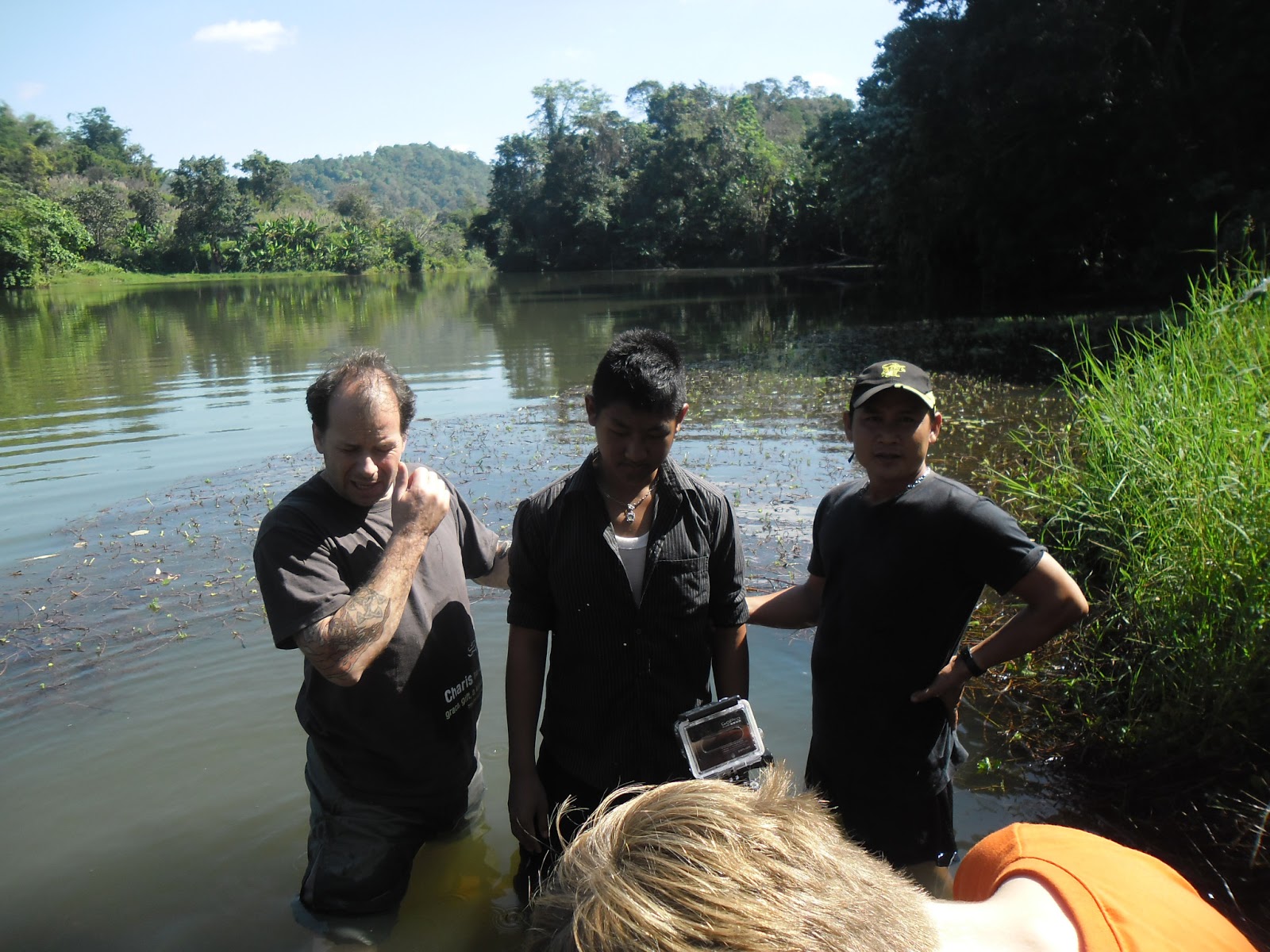
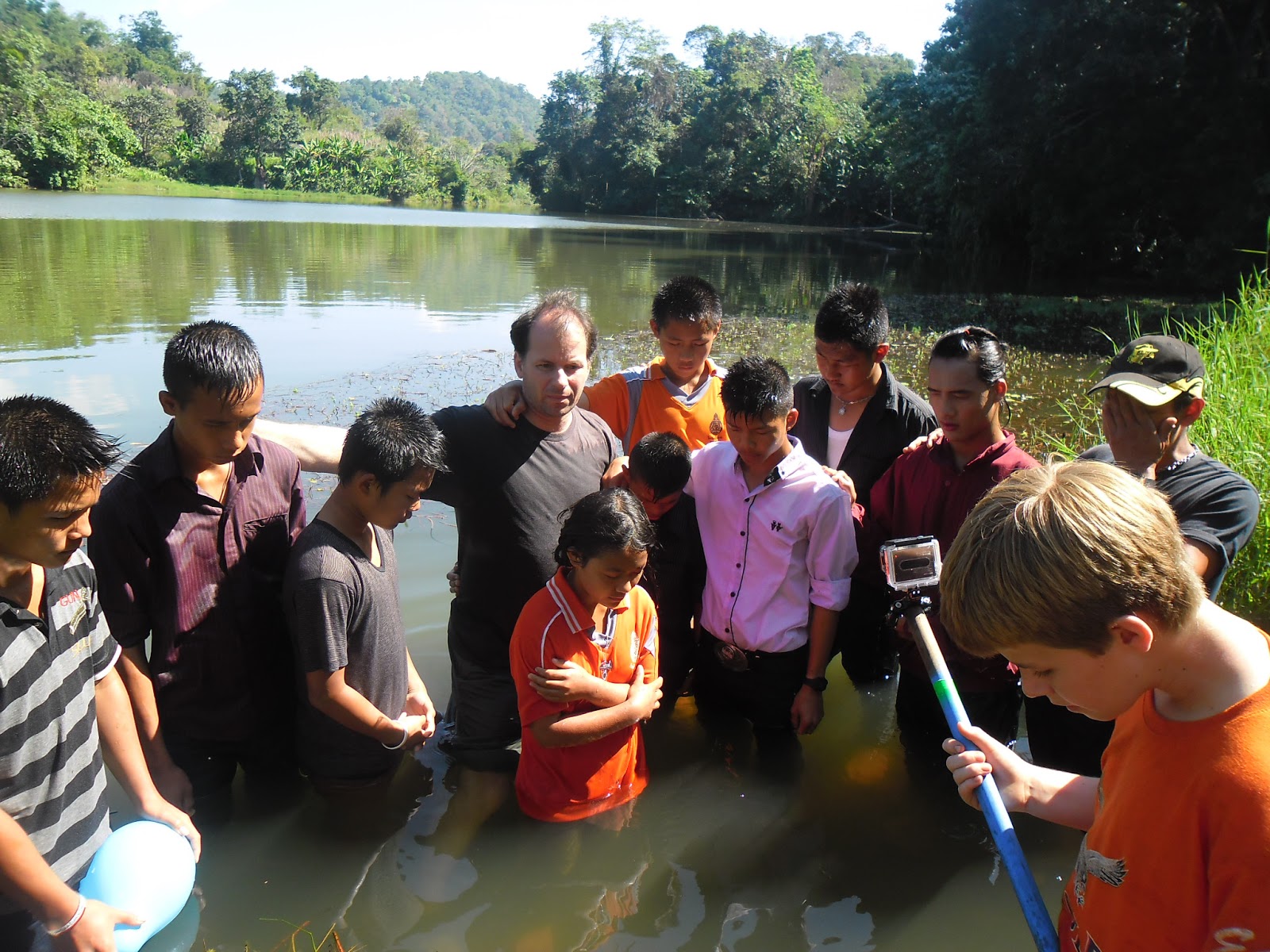
Well here is how I explained it and then did it on my recent visit to Ban Saeng Sawan with The Charis Project.

Now, I don't push baptism. If people ask I respond. I don't push it because I have not yet been in a position where that seemed the right thing to do. I may some time find myself in such a situation and will cross that bridge when I get to it. When I was with my friends up in the hills in Thailand, Judah, the lead guy at the children's home we manage, notified me that there were a number of the kids and one guy from the village who wanted to be baptized and that they wanted me to do it.

So we talked about it for a bit. I started off by saying that there are a lot of different understandings of what baptism is. Many Christians think many different things about it, but this is what I think.

Historically, Christian baptism comes from the Hebrew practice of baptism which was a mixture of ceremonial washing and a reenactment and recapitulation of Israel's passage through the Red Sea in the Exodus, the event in which Israel was transformed from the family of Abraham into the nation of the people of God. In Christian baptism a person is participating in the cleansing redemptive work of Jesus and is going through the "naturalization" process into citizenship in the "people of God." (I take this "people of God" to be a functional designation rather than a designation of status, that is, it is an entry into responsibility rather than into a position of special standing.)

I said that it is a public declaration of solidarity with all the others who have been baptized.

I also said that baptism is not magic. It is not the sort of thing that if you do it wrong, you mispronounce the incantation, you perform the act incorrectly (maybe the water is the wrong sort or or you did it at an age that someone thinks is wrong or whatever), or the wrong person does it, it will not work. It is the one baptism of Jesus that we participate in however we are able.

Then we went out to the lake.


When there, I said that baptism is a public declaration of a person's commitment to be a disciple of Jesus. I commented that different Christian traditions may have a process that leads up to baptism but I will just ask two questions and if you agree to them then I will go ahead and baptize you.


Then with each of the people I asked, "Do you choose today to be a disciple of Jesus for the rest of your life?" Then, "Do you commit to obey his commands and to work for the growth of his kingdom in this world from this day forward?" When they said "yes" to these questions I and Judah then dunked them in the water saying, "I baptize you in the name of the Father, in the name of the Son, and in the name of the Holy Spirit." When they came back up I hugged them and said, "Welcome to the community of disciples."


There has been much ink spilled and blood shed in this topic. I tend to take differences in how one does baptism to come down more to style than substance. As with marriage, it is what you do with it that imbues it with it's lasting meaning and significance.

What has been your experience of baptism?

Sunday, January 6, 2013

The Jungle House Of God


There is a picture I tell when I am speaking in the rural areas of Thailand, working with The Charis Project, that I have brought back to tell on the US side. I tell it to my children enough that they roll their eyes at me when I start to tell them again. But I will tell them again because I want the picture built deep into how they see the world, I want it to form part of the architecture that makes up the stories in which they live.

In the rural areas of Thailand, as in many areas of the world that are prone to heavy rainfall and possibly flooding, the people build their houses on poles set in the ground. They will lay out the shape of the house and dig holes and set hardwood poles in those holes and fill them back in. Then, at a  height off the ground that will keep the floor out of flooding water, they will attach some manner of timbers, maybe wood or maybe bamboo to those poles as the floor supports. Then, higher up at the top, they attach the timbers that make up the roof structure. On the roof structure goes leaves, or plastic, or metal, depending on how much money they have. And on the floor timbers goes the floor of woven bamboo or wood planks. The walls too, between the floor and roof will be made out of woven bamboo or wood planks.

Now, if you cut at one of the poles with a knife or axe or whatever it will become weaker, the cuts will give purchase for mold and termites and eventually the pole will fail. It will fall down and it will not be alone. That pole was holding up part of the house, part of the same house that the other poles are holding up. All of the poles are attached to each other by the house that they are each built together into. When one pole fails it pulls on all the others. If others have also been weakened then they could collapse as well. So cutting at one of the poles puts the whole house in danger.


On the other hand, if you build up that same pole, if your shore it and add strapping and bind additional poles to it it will become stronger. If you coat it with oil treatments rot and termites will not be able to get at it. That pole will become stronger and stronger. When that pole is strengthened it is more able support the weight of other poles if they get damaged and be more resilient to damage itself as well, also as that pole gets stronger it is able to hold more weight, it can hold up a larger structure so the house can be built larger.

building up the pillars
A family, or a community, or a church is like one of these houses. Each person is like one of the poles.

When we criticize or scold or judge one another or gossip or do any such things it is like taking a knife and cutting at one of the other poles holding the house up. The more we cut at the other person the weaker and more susceptible to further damage they become. When we do this we are actively contributing to the destruction of the house, the house that we are built into. Doing such things damages the other's ability to support us when we get damaged.

However, if we build up each of the people around us they get stronger. Encouragement, blessing, holding the sideways tongue and replacing it with speaking good words of truth and actions of support, these things strengthen and shore up and defend the other pillars. Such actions make the house all together stronger. When you get damaged the other pillars will be able to hold you up and they will be far more resistant to damage themselves.

Extend this out. As we all keep building up and strengthening all the other pillars the whole house gets stronger and can grow bigger and bigger until this house of God is big enough to shelter and protect the whole world.

One more thing, this is grace. Grace is not letting people slide, grace is building people up in the power of the redemption.

Now, how can I make a pillar stronger today?

Friday, January 4, 2013

This Is What A Lay Up For A Major Slam Dunk Looks Like

I recently returned from Thailand working with The Charis Project. This is a major highlight from that trip that I recently shared on the Charis Blog. It is so Important to me that I need to share it here as well.

On our Face Book page a short while ago I said that it looked as though we were on a layup for a slam-dunk. This is what I was talking about.

We have been working with a group of people in Mae Sot for about a year. We have been moving slowly and working at getting to know each other and to understand how, and if, our visions intersect and how, and if, we will be able to work well together.

That work is ready to take the next step.

On this last trip we spent an extended period of time discussing in-depth where to move forward and they were already on-board with where we see going.

The de facto leader of the group is named Philip. His father-in-law led in founding a college for hill-tribe peoples and Philip worked there as a teacher. In fact he was one of Judah and Saeng Chen's* teachers when they went there.

This group in Mae Sot is already working responsibly to build up, support, and empower children of the Burmese migrant and refugee community in the area. They have very little in terms of resources aside from the income they themselves earn as laborers and they do not ask for handouts. Instead they have been envisioning businesses that they could start to do a better job of supporting the work they are doing with the children.They are educated, they are motivated, they are hard-working, and they have already begun to innovate.

They do not want to live on donations because they see begging, even for a very good cause, as a weakness that they would very much like to avoid.

Philip and I excited about our vision for moving forward in Mae Sot

They are about the perfect partners for the Charis Project. They are thrilled with our vision for integrating entrepreneurism and the care for at-risk children. They see that what we envision pushes beyond what they thought possible and are excited to bring this all together. They and we are becoming us.

They brought to our discussions two or three business ideas that they had already been thinking about and over the course of our conversations we together came up with half-a-dozen more workable business concepts.

Now, the step we are working on next, is to model, assess, and select the best of these concepts to move forward on, to invest in, and to launch as the financial and entrepreneurial-education foundation of the empowering work with the children living out in the teak plantations and bamboo thickets.

A few of the kids and another of the team members at Mae Sot
Obviously we are very excited and are chomping at the bit to be on site to work directly with them as we launch this new Charis Community and take what we learn here to feed back into the Doi Muser home to build it up even further.


*Directors at the Doi Muser Home
Related Posts Plugin for WordPress, Blogger...